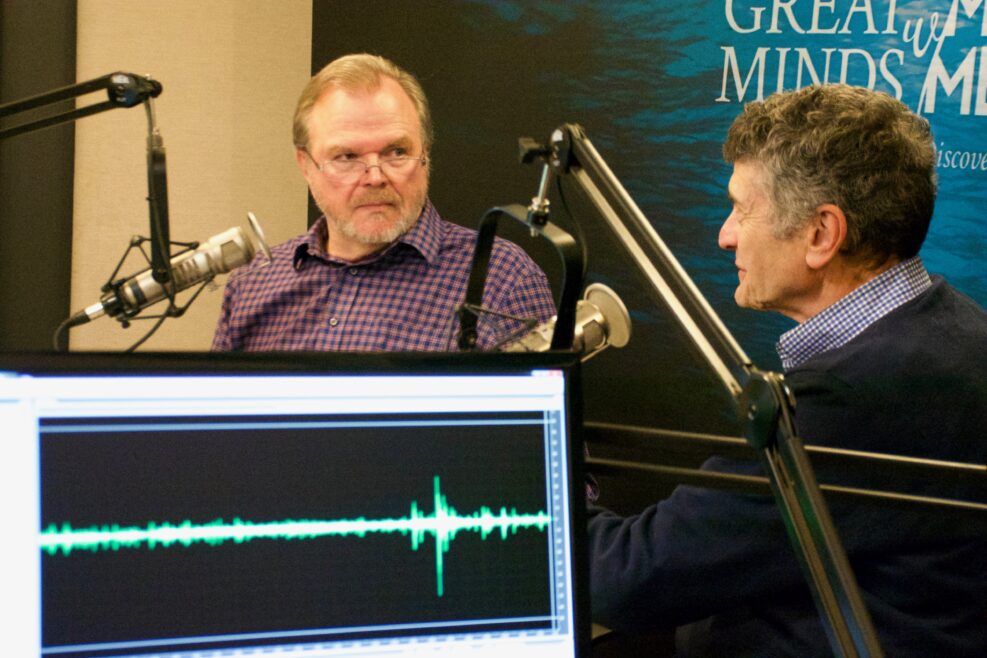
Like many, you may be storing important files and photos in the cloud. But just where is this magical cloud? How is it powered? Is it safe? To answer these questions and more, host Robert J. Marks is joined by Walter Myers III, a principal engineering manager for Microsoft’s Azure Cloud and a Senior Fellow at Discovery Institute. Their conversation provides an overview of cloud computing infrastructure, including an explanation of where the cloud is physically located, the different service models (infrastructure, platform, and software as a service), and the technical details of how data is stored and protected in the cloud. Then, the conversation turns to the philosophical with a discussion about the concept of the Ship of Theseus and how it relates to questions of personal identity, the mind-body problem, and the relationship between the soul and the physical body.
Robert J. Marks, host of the Mind Matters podcast, recently put out an article at Newsmax discussing “scientific consensus,” and how that term has been used to bully dissenting scientific viewpoints and even establish political and social policy. Marks writes, Consensus was used as a reason to stifle debate during the COVID crisis. Facebook and YouTube saw opposition to the government narrative as disinformation. Posts against consensus were censored and users were banned. Pre-Musk Twitter had a policy concerning tweets about climate change: “Misleading advertisements on #Twitter that contradict the scientific consensus on #climatechange are prohibited, in line with its inappropriate content policy.” The word pairing “scientific consensus” is a destructive science-stifling oxymoron. -Robert J. Marks, Consensus Doesn’t Equal Science | Newsmax.com Read More ›
If you’re a regular reader of Mind Matters, you’ve probably heard us applaud and discuss the book by computer scientist and professor Robert J. Marks, Non-Computable You: What You Do That Artificial Intelligence Never Will. The book is well worth reading and sheds much needed insights on our current technological moment where AI is either seen as the “greatest thing ever” or the tool that will enslave and destroy humanity, Terminator style. However, if you’re more of an audiobook kind of person, maybe you’ll just want to listen to a new podcast episode in which Dr. Marks discusses the key themes of his book with various hosts. You can listen to the podcast or download it for free here: Why Read More ›
Clinical psychologist, world-renowned speaker, and author Jordan B. Peterson, who rose to international fame in 2017 after speaking out against an impending Canadian speech law involving mandatory gender pronoun use, may be compelled to take in “social media training.” (RELATED: Three More Key Takeaways From the Twitter Files and Their Fallout | Mind Matters) Several complaints regarding Peterson’s online rhetoric were sent to the College of Psychologists of Ontario in 2022, and the organization decided to have him undergo a professionalism training in order to address his online tone. Peterson appealed the decision, but lost, according to CBC: Three Ontario Divisional Court judges unanimously dismissed Peterson’s application, ruling that the college’s decision falls within its mandate to regulate the profession in Read More ›
Episode 8 is one of the stronger episodes in the series. It starts with Bernard waking up after killing Theresa. Also horrified to realize he is a robot.
Dr. Jay Richards, a Senior Fellow at Discovery Institute and a friend of the Walter Bradley Center, which publishes Mind Matters, spoke recently at the Acton University conference, discussing both transhumanism and AI. Transhumanists, Richards notes, look at the scope of “cosmic evolution,” see a kind of increasing complexity among the human race, and speculate the next dramatic step: achieving immortality through a mixture of genetic engineering, nanotechnology, and artificial intelligence. Richards described the transhumanist ideology as “anti-human,” but cautioned against having a reactionary response to all new technologies that seem to be involved in transhumanism’s vision, noting that some of them, when analyzed specifically, could have benefits (such as AI). The underlying philosophy of transhumanism, however, should be rejected. Read More ›
The Federal Trade Commission (F.T.C.) sent a letter to OpenAI, the San Fransisco company responsible for creating ChatGPT, the Large Language Model that captured the world’s imagination in November of 2022. Per the New York Times, the F.T.C. is investigating the AI company’s methods of data acquisition and also plans on measuring the potential harms of AI on society, citing concerns over false information and job replacement. Cecilia Kang and Cade Metz report: In a 20-page letter sent to the San Francisco company this week, the agency said it was also looking into OpenAI’s security practices. The F.T.C. asked the company dozens of questions in its letter, including how the start-up trains its A.I. models and treats personal data. The Read More ›
Originally posted in 2018. Mind Matters is a podcast and a news and commentary site where “artificial and natural intelligence meet head-on.” That’s a great slogan, but what does it mean? As your host for the podcast part of the site, I thought I’d take advantage of my role to talk you about some of our exciting plans for both the podcast and the online journal (the latter to be edited by science journalist Denyse O’Leary). Here’s a quick run-down: Topics Mind Matters will track the latest developments in applied AI and technology. How will AI continue to augment human performance and abilities? What are the latest innovations of AI? And how does AI affect you? How is AI applied in pricing Read More ›
Just last week, Mind Matters editor Peter Biles wrote about That Hideous Strength by C.S. Lewis, a dystopian novel about a fearsome technocracy trying to conquer humanity. New York Times also wanted in on the fun, too, apparently. Ross Douthat, the conservative voice of the Times’ opinion column, published his latest essay on Lewis’s harrowing tale, and examined its modern pertinence. Douthat acknowledges the possibility of a mega-powerful technocracy, but notes how Lewis believed that on the outside, such an organization may look like the face of progress and humanitarianism. Douthat writes, Crucially, almost nobody in Lewis’s invented organization has any idea that in the inner ring they’re contacting the dark powers. Most people think they’re working for humanitarianism and Read More ›
C.S. Lewis’s 1946 science fiction novel That Hideous Strength is almost eighty years old now. Written during the throes of World War II, the novel is the culmination of Lewis’s cosmic trilogy, preluded by Out of the Silent Planet and Perelandra. There are hosts of other articles attending to the prescience of Lewis’s terrifying novel, and for good reason; That Hideous Strength is a warning against using technology to dehumanize people and ultimately cripple the world into submission. It’s a great book as a novel, but it seems especially appropriate to revisit in lieu of the growing interest in transhumanism and the rapid acceleration of AI development. It feels like much of the talk on AI in recent months involves Read More ›
In a recent Mind Matters podcast episode, host Robert J. Marks spoke with Kent Marks, former Boy Scout guide who now works with Trail Life USA. In the wake of Boy Scouts’ precipitous decline over the last decade, Trail Life offers boys the chance to get outside and go on wilderness adventures. This is a huge opportunity to help young men get off the screens and into the beauty of creation. Speaking about the gravity of the problem, Robert said, The impact of social media has just been terrible. Teenage suicides are up, depression rates are up. I think a third of all girls involved in social media have body image problems. And that’s terrible. These are the symptoms of Read More ›
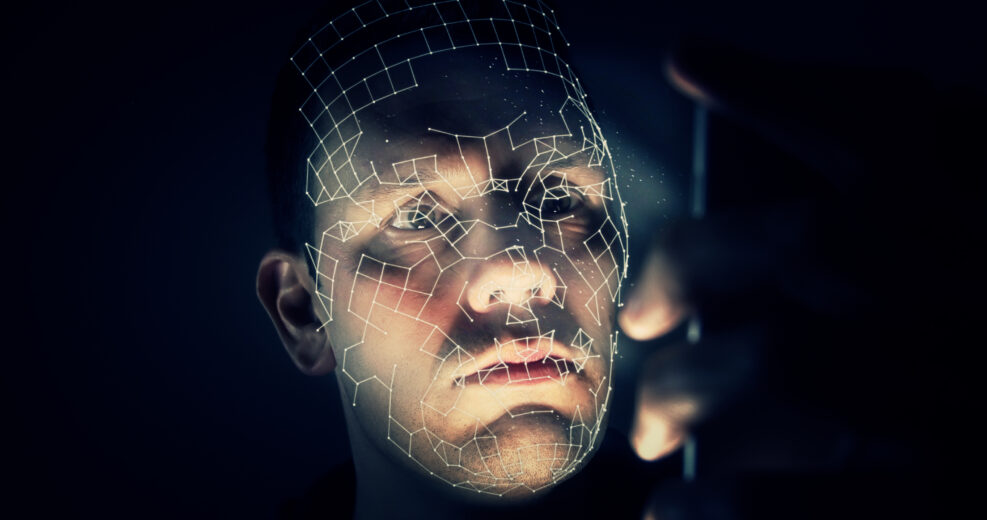
Unlocking latest smartphone with biometric facial identification scan
Sometimes AI seems a bit of a niche idea, relegated to dystopian prophecies or sentient robots. But AI is much more pervasive and influential in our present world in more ways than we might assume. Oxford mathematician John Lennox reminds us in this recent podcast episode that our society teems with AI. Lennox commented, Now, the final example I would give you is the fact that we’re all involved in AI. That is any of us who own a smartphone, it’s tracking us all the time. What many of us don’t realize is that, for example, we make a purchase at Amazon. A few days later, we’ll get a pop-up saying, people that bought this book were interested in that Read More ›
Walter Bradley Center Senior Fellow Gary Smith’s book Distrust: Big Data, Data-Torturing, and the Assault on Science was reviewed in The Washington Post today. Smith is a frequent contributor to Mind Matters and teaches economics at Pomona College. In his new book, Smith argues that science itself is being “undermined” by the tools scientists use. Reviewer Abby Ohlheister writes, Smith, an economist whose work often examines the misuse of data and statistics in a variety of disciplines, argues that the current crisis of trust in science falls at the intersection of three forces: disinformation, data torturing and data mining. Disinformation, as Smith writes, is “as old as the human race,” but accelerated in speed and reach alongside social media. Data Read More ›
OpenAI’s ChatGPT passed the Master of Business Administration (MBA) exam according to a news report from NBC. Professor Christian Terwiesch of Wharton, who conducted the research and authored a paper on the matter, said that the bot scored somewhere in the B range on the exam, and that this has major implications for education. The report is just another in a flux of news and concerns about AI invading the spheres of education and academia. Terwiesch wrote, [The bot’s score shows] remarkable ability to automate some of the skills of highly compensated knowledge workers in general and specifically the knowledge workers in the jobs held by MBA graduates including analysts, managers, and consultants.” Despise its apparent advancement, the bot did Read More ›