
What Do People Who Are Conscious But Lack a Cortex Demonstrate?
Consciousness does not necessarily reside in the cortex, as is commonly assumed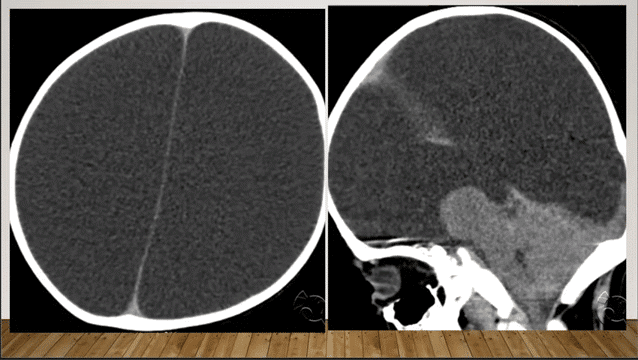
It is not to be confused with hydrocephalus, which just means
water on the brain.
Recently, neurosurgeon Michael Egnor and I have been looking at the claims made in an article in Popular Mechanics in connection with our book, The Immortal Mind: (2025). The many misconceptions the PM article introduced have provided us with an opportunity to discuss some topics at greater length than we could do in the book.
One of these topics is people who are born without a cortex. From the PM article:
He also talks about near-death experiences, current theories of consciousness, and the concept of hydranencephaly, a rare condition where a patient is missing large parts of their cerebral cortex. That this condition exists disproves all current theories of consciousness, says Egnor in our interview, because they all maintain it originates in the cortex. There have only been a few documented cases of hydranencephaly in the literature.
Steven Novella, a Yale School of Medicine neuroscientist, and Newsome both stressed that plasticity of the brain plays a big role here. Children who lacked certain regions of cortex would adapt to compensate for the tissue’s absence, whereas if an adult lost half their brain capacity (as is the case with a major stroke) it would be devastating. No one without a cortex is conscious, says Novella, and studies of hydranencephaly point out that most die before birth or within a year of life. But The Immortal Mind implies there are thousands of people walking around, completely fine, without cortical tissue.
“This Neurosurgeon Studies the Brain Close to Death,” April 30, 2026
O’Leary: Okay, can we talk about Steven Novella’s comments on hydranencephaly [lacking a cortex]?
Egnor: Novella does what they all do: just tap dance around this. First of all, I should point out that virtually all materialist theories of consciousness — with one exception I’m aware of, and that’s Mark Solms’ theory about the reticular activating system in the brainstem — attribute consciousness to cortical and subcortical processing, to some kind of interaction between neurons and the cortex, and neurons down in the deeper layers of the brain. Just one simple observation: If there’s only one person in the history of humanity who lacks a cortex, but is conscious, then all of those theories are disproven.
O’Leary: What about the claim in the article that The Immortal Mind “Implies that there are thousands of people walking around, completely fine, without cortical tissue.”
Egnor: That’s not at all what we said or mean. First of all, nobody walks without cortical tissue. You have to have a cortex to walk. You can have a very thin cortex and have massive hydrocephalus — which is not hydranencephaly. I think the person who wrote the article got hydrocephalus and hydranencephaly mixed up.
From current research: How long do they live? What about consciousness?
Longevity is variable. Most die within the year, as Dr. Novella says. But one study of 50 children found that roughly seven years was common. Other papers feature a patient who was examined at the age of twenty-two and another at the age of thirty-two. A recent news story reported on a Nebraska woman who survived to the age of twenty despite the condition. The oldest one Dr. Egnor treated lived to be seven.
About that patient, Egnor says, “He was a sweet little boy, quite conscious, with a broad range of emotions including joy, sadness, fear and affection. By nearly any of the neuroscientific theories widely today, Charlie should have utterly lacked consciousness — he had much less brain tissue than most people in deep comas. It’s ironic that the most sophisticated theories held by brilliant neuroscientists are disproven by Charlie and by each handicapped child with hydranencephaly. There is more to the mind than just neuronal processing in the brain hemispheres if thousands of people without brain hemispheres are conscious.”
Egnor: Hydrocephalus is just water on the brain, and you still have a cortex. It might be squished, but it’s still there. Hydroencephaly is when you don’t have a cortex. And Novella would know the difference between the two of them.
O’Leary: Well, I have a question that stems from all this. One of the things we discussed in The Immortal Mind was the fact that some people manage with only half a brain. And some people are missing a temporal lobe. Some people don’t have a cerebellum. Novella attributes all that to neuroplasticity generally.
So, what proportion of the human race do you suppose has ever had a brain scan, you know, a look through their whole brain?
Egnor: I really don’t know. In developed countries, my guess would be maybe 10% or 20%.
O’Leary: The only reason I’m asking is, it may be that lacking a large portion of the brain is more common than we can know because we only know if we can actually see or not see something.
Egnor: That’s quite true. But lacking a cortex is a different matter because almost all theories of consciousness presuppose cortical processing as the basis for it.
When I mention this to Allen Institute neuroscientist Christof Koch, he didn’t even know what I was talking about. It wasn’t like this has been thought about deeply in the neuroscience community and they’ve tried to come to grips with it. They don’t even know. This clearly is just not a part of their reasoning process.
O’Leary: Say I have a lab, and I have 50 rats. I check all their brains; they all have working brains. But if you have 8 billion people, the overwhelming majority of whom you’ve never actually checked, it might be taking on a lot to say that human beings can’t survive or be conscious without a specific thing. How do you know?
Egnor: 1% of 8 billion, if my calculation is right, is about 80 million people. So if 1% of people have missing parts of their brain, there are 80 million people walking around with missing parts of their brain who don’t know it.
It’s one of the things that led me to this conclusion about the existence of the soul. Missing parts of the brain is soft evidence for the soul. I have a lot of patients missing parts of their brains, and the correlation between neurological function and missing parts of the brain is not clean. You know, a lot of these people are just fine. And some weren’t. Some of them have deficits. It’s good evidence but it’s soft.
A more pressing issue is that materialists cannot escape what I call the problem of phrenology. Modern materialism is just kind of an updated version of phrenology. That is, this notion that the brain is like a computer, and this little area here controls this, that area controls that. Or they’ll tap dance and say, well, it’s not that one area controls abstract thought, it’s the integration of all these areas. They say it is entirely a function of the material world.
And we propose that a much better understanding in light of the neuroscience is that the process that underlies abstract thought, reason and free will is not a process that originates in the physical world. That explains many things.
O’Leary: But Novella essentially said you can attribute it all to neuroplasticity.
Egnor: That’s like O.J. Simpson saying after he was acquitted that now he’s going to go out and look for the real killers. In these situations, neuroplasticity is just a catch-all term that people use when they can’t explain why mental states don’t correlate all that well with brain states. They say, “Oh, it’s neuroplasticity.”
O’Leary: On the one hand, people invoke neuroplasticity, On the other hand, they want to be very specific about what different parts of the brain do.
Egnor: Neuroplasticity is a real thing in some circumstances. It’s a very interesting and important area of research. But the careless and casual attribution of unexpected mental states to neuroplasticity is junk science.
