
Do People With Split Brains Have Back Door Communications?
Some neuroscientists think that split brain communications can thus be explained that way. Michael Egnor disagreesLast month at Popular Mechanics, Hanna Webster who has a bachelor’s degree in neuroscience, took a look at neurosurgeon Michael Egnor’s and my recent book, The Immortal Mind (2025). We thought we had better respond to some of the claims made there. Earlier this week, we looked at the remarkable way split brain patients have split perceptions but do not have split concepts. (Their brains were split in order to prevent brainwide epileptic seizures.)
Bill Newsome, a neuroscientist of 40 years’s standing who is a professor at Stanford University School of Medicine, told PM that there is a simple explanation: the two hemispheres are not really separated:
“The corpus callosum is also not the only tract that connects the hemispheres; the anterior commissure sends messages across as well.
“That’s a deep misinterpretation of split-brain science,” he says. “People seem to have a lot of inter-hemisphere communication.”
How much is cut?
O’Leary: So now, what about the claim that there really is a means by which the two hemispheres are still communicating?
Egnor: The patients who are studied, generally, are the ones who’ve had a complete cut, which usually is a couple of operations. You usually don’t do that in one operation.
And the complete cut goes from the rostrum of the corpus callosum, which is way up in front here, to the splenium, which is the very back part of it. And there’s a lot of work you have to do between the hemispheres, and again, to safely access the corpus callosum, you generally want to do that in two separate procedures coming from two different directions.
So far as I know, neuroscientists, at least in the modern era, have relied upon CAT scans and MRIs to confirm a complete corpus callosum cut anatomically, before they do research on these patients, just to make sure that they’re really dealing with a real corpus callosum cut.
O’Leary: That would make sense. So it is a more extreme type of operation?
Egnor: The usual corpus callosotomy is partial. That is, for most patients who have a corpus callosotomy, we don’t generally cut the whole corpus callosum. We’ll cut maybe a third or half of it. Usually cutting the posterior portion of the corpus callosum is most effective in stopping seizures. But some of that depends upon where you think the seizures are coming from, and so on.
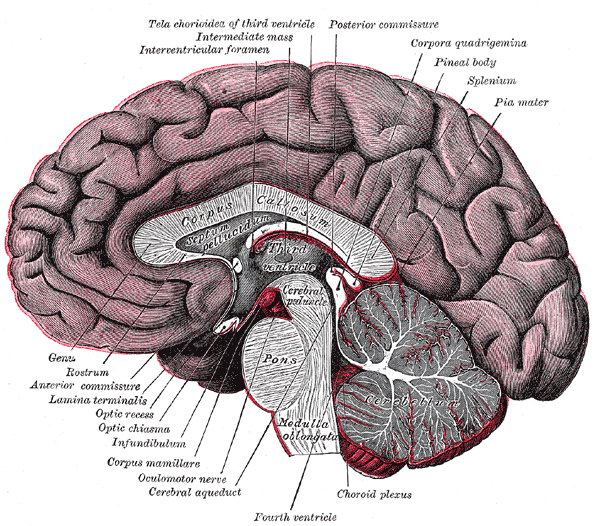
Um, there is another operation called a commissurotomy. A commissure, is any connection between the hemispheres. The corpus callosum has, like, 200 million axons. Commiserotomy cuts the corpus callosum, which is the biggest commissure but also cut several other commissures.
There’s one commissure in particular that no one cuts, and that’s the posterior commissure.
It lies dorsal to the cerebral aqueduct in the midbrain. And the problem with the posterior commissure. well, first of all, it’s quite small. But it is located very near the reticular activating system, which is the system that keeps you conscious. So operating within the midbrain is something you simply don’t do, because people don’t wake up from it. So I’m not aware of anybody who would cut the posterior commissure.
O’Leary: What about other possible channels?
Egnor: There are, of course, other hypothetical, multi-synaptic ways that information might get across, jumping into the spinal cord, going back up through the sensory pathways. But and I should say, researchers in this field, have looked at these questions of what are the other pathways? Can you account for things?
The most important fact is that, after these operations, whether it’s a corpus callosotomy or a near-total commissurotomy, perception is split and conception is not split — That you can’t get information from the right hemisphere to the left hemisphere that enables you to name an object. That is cut completely. You can make concepts between the two hemispheres without any difficulty whatsoever.
Do concepts travel?
O’Leary: That would suggest that concepts are traveling by a different system…
Egnor: That would suggest that concepts don’t travel. That’s the point. You could say
sure, the concepts are jumping down to the spinal cord and coming up. Or maybe the concepts are all crowding their way through the posterior commissure. But then you get into some pretty weird neuroscience that no one really accepts.
The simpler explanation is that percepts, perceptions travel through axons. Conceptions don’t travel through axons because they’re not material.
O’Leary: Newsome’s claim, I believe, is that those concepts could be traveling through these roundabout circuits that you mentioned.
Egnor: Sure. So why aren’t the percepts traveling through those circuits?
O’Leary: Well, that’s a good question. And now I have another question. Maybe I spend too much time thinking in terms of computers but what about the byte load, the amount of information that must be carried in relation to the power of the system?
Egnor: Well, that’s been looked at. Neuroscientist Yair Pinto has written on that. I’ve read his comments. He’s looked at the extra-callossal pathways that are known to exist in patients who’ve had a corpus callosotomy. He notes that the pathways — he doesn’t specify them, but I think he’s talking about the posterior commissure — have, if my memory serves me right, it’s like 7,000 axons. Which isn’t that much. The size of the posterior commissure is probably 2 millimeters in diameter.
The corpus callosum has 200 million axons. So, if you do the math, you’ve cut 99.9999, that’s four nines, of all the connections between the brain hemispheres because the ratio between the 2 million and the 7,000 is so is so high. The messaging rate through axons is an extraordinarily low rate of transmission.
And then you can then get into all kinds of other questions that are almost metaphysical. How would a concept be passed along anyway?
Everyone notices the really remarkable thing
I’m arguing is that the remarkable thing about split brain surgery is, you cut the brain in half, kind of, and in everyday life, nothing happens. That alone is really something rather remarkable. Everybody who deals with these patients for the first time is surprised by that.
I mean, you talk to the nurses in the recovery room. And they say, “Wow, he’s he looks perfectly normal but he just cut his brain in half.” I mean, everybody says, this is kind of interesting.
The second point, which I think is really the salient point, and the point that neuroscientists scandalously disregard is the dichotomy between the two things: The fact is, when you cut corpus callosum, commissures, whatever you want to cut, you cut perceptions in a very hard, definite way. And you do not cut conceptions. And neuroscience has no good explanation for that.
Next: Why Egnor finds the lack of curiosity in neuroscience unbelievable.
