
Privacy Rights: Innermost Thoughts Can Smash Your Life
As I have discovered, justice can depend upon how adverse people view your private thoughtsHow are police-involved shootings and privacy of data on the Internet related? Both involve the deepest element of human privacy: internal thoughts.
As a lawyer, I have assisted many law officers who had to shoot and sometimes kill suspects in the gravest of extreme situations. After an officer-involved shooting (OIS), the agency always investigates the circumstances to decide whether the shooting was a lawful defense use of deadly force. The investigators want to know whether the officer basically had “no choice but to shoot” to protect the officer’s or other innocents’ lives.
The pivotal issue: Did the officer reasonably fear being killed or gravely injured by the suspect?
Internal Investigation Seeks Private Thoughts
At a post-shooting interview, an investigator will ask the officer to describe the entire situation. The investigator will eventually ask: “What were you thinking just before you pulled the trigger?” As counsel, my job has been to help the officer tell the full truth in a clear way that doesn’t cause more problems.
To answer this question, what should the officer say? What is the truth? One answer can mean the shooting was “righteous,” to use the informal police term. A different answer subjects the officer to homicide charges. Here’s the problem: Both answers might be “truthful.”
In a pre-interview consultation, I ask the officer to relate the whole shooting incident to me, including all of his thoughts. Just before he pulled the trigger, what was he thinking? Frankly, it was often something like this: “I was seeing my grandfather going fishing with me, my daughter at her Catholic Confirmation, my son’s hitting a home run in Little League, and I imagined my kids’ weddings, and what my wife would do if I were not there.”
Those were the officer’s internal thoughts. Does he have a right to privacy for those thoughts? If the investigation could compel the officer to reveal them, imagine the impact.
Here’s what happens. The officer describes his thoughts, as above, as he faced the armed suspect. But then a transcript of the hostile cross examination looks like this:
Q: So, just before you shot the suspect, you were thinking of your grandfather, right?
A: Yes.
Q: And about your daughter’s Confirmation, right?
A: Yes.
Q: And about your son’s Little League game, right?
A: Yes.
Q: You were thinking about those things, not about any fear of harm from the suspect, right?
A: Well, wait a minute. I was thinking about the suspect, too.
Q: Really? You just said you were thinking about everything else but the suspect, you just testified, right?
A: No, you don’t understand…
Q: You weren’t thinking much about the suspect endangering you, right?
A: No, I was, I was worried, but my mind was so clouded…
Q: So, you weren’t really afraid for your life, right, you were thinking about other things, right?
A: No, I was afraid for my life.
Q: Except you were thinking about grandpa and kids and wife. You weren’t focused on the suspect, right?
A: No, see, it was a flurry of thoughts, I was scared.
Q: Not really focused, right. No further questions.
See what happened? The officer’s internal thoughts, framed by a prosecutor, portrayed him as not paying attention to the issue of killing a fellow human being. Is that fair and just?
In fact, people facing the prospect of their own death very often report a life review. As reported in Psychology Today (2025):
Some life reviews feature a complete sequential vision of all the events of a person’s life, which is often compared to a high-speed film. Some occur as panorama rather than a sequence … Other reviews feature a selection of a person’s life events …. This usually consists of events that hold special significance or had a powerful emotional impact. In one example … a participant recalled a violent attack when she was beaten unconscious: “I watched screenshots or snapshots of some of the moments of my life.”
So, the overriding fact is: The officer’s life flashed before his eyes because he feared he was going to die in the next instant. That’s the predominant truth; that’s all the officer should say. He believed his life was over, and his mind played his last look at it.
Privacy Rights Protect the Real Truth
 Published by Oxford University Press
The officer’s truthful answer about what he was thinking just before he pulled the trigger, stated clearly, would be: “I was sure I was going to die, I feared my life was over, that the suspect would kill me.” Then he was justified to shoot the suspect.
Officer-involved shootings show how internal thoughts, the most private thoughts, could devastate a person’s life if revealed. The right to privacy of internal thoughts must be sacrosanct.
Sometimes people push back, asking: “What are you afraid of? What have you got to hide?” At minimum, the answer should be, “I have the right to hide my stream of consciousness that some adverse party wants to take apart and punish me with.”
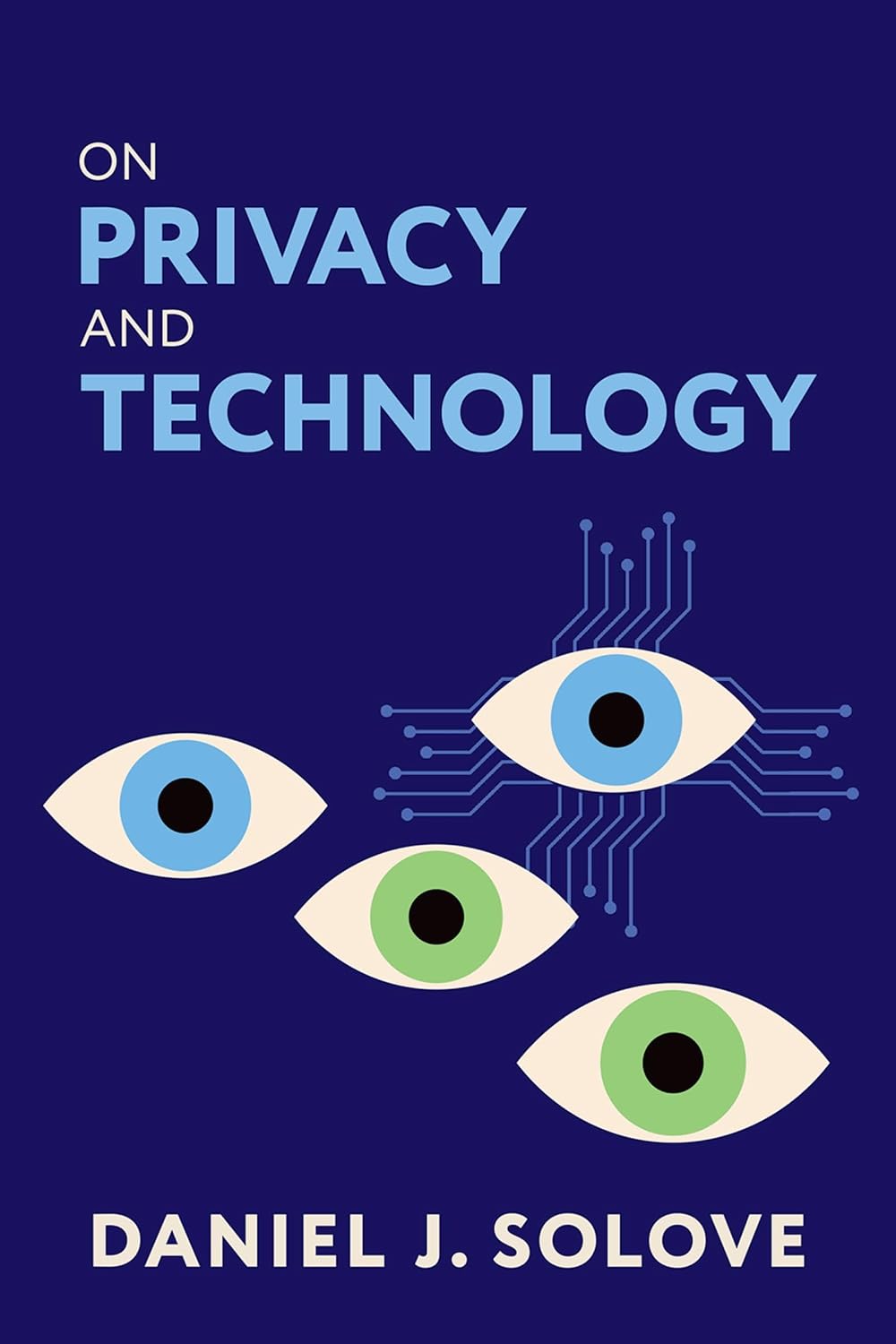
Law professor Daniel Solove’s book, On Privacy and Technology (2025), frames the key point:
Privacy matters because people should not always have to justify their thoughts and actions. Many statements and actions that were not intended to be widely disseminated can be misjudged from afar and can lead to embarrassment or worse. Constantly having to worry about how others will perceive such actions is a heavy burden that privacy can help alleviate. The freedom from having to constantly justify oneself is a social value that represents a key difference between a free society and a totalitarian one.
When AI Judges Your Private Words and Actions
The 2026 movie Mercy tells a near-future sci-fi crime story where an AI judge examines computer-assembled evidence to calculate the percentage chance that an accused person committed a violent crime. The defendant charged with murder, strapped in a death chair, gets 90 minutes to use phone calls to friends and some AI resources on a screen, striving to create “reasonable doubt” and avoid instant execution.
Front and center, Mercy shows how bits and pieces of evidence, taken by themselves, lead to a finding of guilt. We see the AI judge also treating the defendant’s words of anger and frustration — his inner thoughts spoken aloud — as more evidence of guilt.
Back in 2007, Solove saw that privacy is not just about hiding things. It is about managing boundaries and protecting individuals from misuse or abuse of their data. Surveillance, data aggregation, use of data for unintended purposes, and breaches of confidentiality may expose secrets and violate privacy. Collections of seemingly harmless data can reveal “patterns” about a person. In his 2025 book, Solove explains:
Technology makes it easy to aggregate data. Privacy is often threatened not by a massive violation but instead by the aggregation of many tiny infringements. … merging small pieces of personal data can reveal much more than the sum of the parts.
When users share their personal thoughts and feelings on the Internet, AI systems can readily obtain them and also compile the users’ online searches, subject interests, and behavior. An AI system can connect the dots and draw conclusions about the users.
Consider: Would AI compare a given user’s thoughts and behavior with thousands of other users’ and decide what an “average” person would do? Or instead, would AI be able to see the situation from the individual human’s perspective? Would AI be curious to find different ways to think about the same evidence?
For the shooting situation, will the officer’s fleeting thoughts prove he was distracted and unfocused? Or will AI know how to put all the facts into the context of a human facing death?
Explore these conflicts in the Mercy movie. Then consider whether what surveillance advocates say, “If you’ve got nothing to hide, you’ve got nothing to fear,” is really true. The right to privacy in internal thoughts becomes paramount when AI is judging human mindsets and decisions.
