Star Wars: The Force Awakens Review Part 12
It’s a philosophical position to assume that a story’s goal should be to portray events as realisticThe fact is genres carry a philosophical worldview; they can’t help it
Read More ›The fact is genres carry a philosophical worldview; they can’t help it
Read More ›
In this episode of the Mind Matters News podcast, Dr. Robert J. Marks and Pat Flynn welcome returning guest Dr. Angus Menuge, professor of philosophy at Concordia University Wisconsin, to discuss his paper “Powers of the Soul Beyond AI.”
Dr. Menuge breaks down the philosophical and logical limits of artificial intelligence, targeting the concept of anthropic mechanism to explain why material machines cannot replicate the immaterial aspects of human agency. Through the lens of five distinct powers—including insight, meta-insight, and free will—Menuge explores why large language models and advanced computing systems fall short of genuine understanding and human consciousness.
Read More ›
We now await an army of predominantly middle-aged, bearded male philosophy graduates, out of work for the past 20 years, raising their wrists, thus pointing their fingers to the sky as they make the journey for an interview in Silicon Valley.
Read More ›
Even if reality were an illusion only perceived by spirits, then there is still a source of order for that illusion, a core source of reality.
Read More ›
On this archive “bingecast” episode of Mind Matters News, hosts Robert J. Marks and Angus Menuge welcome Dr. Mihretu Guta to discuss his contribution to the book Minding the Brain. The discussion covers a number of relevant topics, highlighting the profound and puzzling nature of consciousness and the importance of philosophical inquiry in grappling with this fundamental aspect of human experience.
Read More ›
On this episode of Mind Matters News, hosts Robert J. Marks and Brian Krouse continue their conversation with Dr. Joseph Green on the limitations of cutting-edge neuroscience. In this segment, the focus turns to the philosophical questions involved. As Dr. Green explains, neuroscience is limited in its ability to answer philosophical questions about the nature of the mind and its Read More ›

The book may not present neat answers to our problems, but it presents a vital picture of what it looks like to cherish life and hold onto to the inherent value of human life.
Read More ›
On this episode out of the vault, neuroscientist Dr. Michael Egnor welcomes Dr. Joshua Farris for a discussion about his recent published paper “Descartes’ New Clothes: Cartesian Thought in Philosophy, Neuroscience and Theism.” Descartes is famous for his dictum “I think, therefore I am.” Farris and Egnor discuss this statement and its implications for the mind-body debate. They also talk Read More ›
Get caught up with the Mind Matters podcast by listening to this special episode featuring hosts Angus Menuge and Robert J. Marks and their guest, Dr. Robert Larmer. Dr. Larmer wrote a fascinating chapter in last year’s groundbreaking book Minding the Brain, and sat down with Mind Matters to discuss the limits of “methodological naturalism.” For Larmer, this approach to getting knowledge is limited because it rules out non-physical causes, even if they exist. In addition, holding to naturalism at all costs can undermine our self-understanding as rational agents. How can we trust our brains? Does the physical activity in our brains correlate with non-physical mental states? Find out more by listening to Part One of the conversation here. Be Read More ›

Idealism as the most compelling final destination for former dualists (of which I count myself).
Read More ›
Kemp’s vivid picture of Internet addiction is sadly accurate for many modern folks, especially those enmeshed in the superficial, image-driven economy of social media.
Read More ›
Dr. Jay Richards, a Senior Fellow at Discovery Institute and a friend of the Walter Bradley Center, which publishes Mind Matters, spoke recently at the Acton University conference, discussing both transhumanism and AI. Transhumanists, Richards notes, look at the scope of “cosmic evolution,” see a kind of increasing complexity among the human race, and speculate the next dramatic step: achieving immortality through a mixture of genetic engineering, nanotechnology, and artificial intelligence. Richards described the transhumanist ideology as “anti-human,” but cautioned against having a reactionary response to all new technologies that seem to be involved in transhumanism’s vision, noting that some of them, when analyzed specifically, could have benefits (such as AI). The underlying philosophy of transhumanism, however, should be rejected. Read More ›
If we can uncover the smallest quantum particles in nature, will we have uncovered the fundamental secrets of reality? A longstanding philosophical tradition in the sciences claims “yes.” Uncovering the mystery of the world lies in the ability to interrogate the smallest of the small. But is that the right way to approach it? What special status does the tiny have over the large? A paper at IAI News by London philosopher Peter West argues that reality can’t in fact be elucidated simply by observing quantum mechanics. He talks in some length about the 17th century text Micrographia by Robert Hooke, which features various images of insects and other organisms under the microscope. West notes that Hooke set the stage, Read More ›

Contemporary Western culture is disillusioned. Under the mainstream narrative of materialism, moderns struggle to connect their lives with a transcendent meaning beyond the self. In the United States, we enjoy a level of privilege and wealth foreign to the majority of prior generations, and yet we see “deaths of despair,” frightening rates of anxiety and depression, and heightened political tensions. None of this is news to you, I’m guessing. I’ve personally written a variation of that paragraph in other articles a number of times. The question behind our collective disillusionment is, frankly, why? Why do we struggle to make something of our lives? Why do we enjoy technological and scientific progress but lack the moral and cultural means to enjoy Read More ›
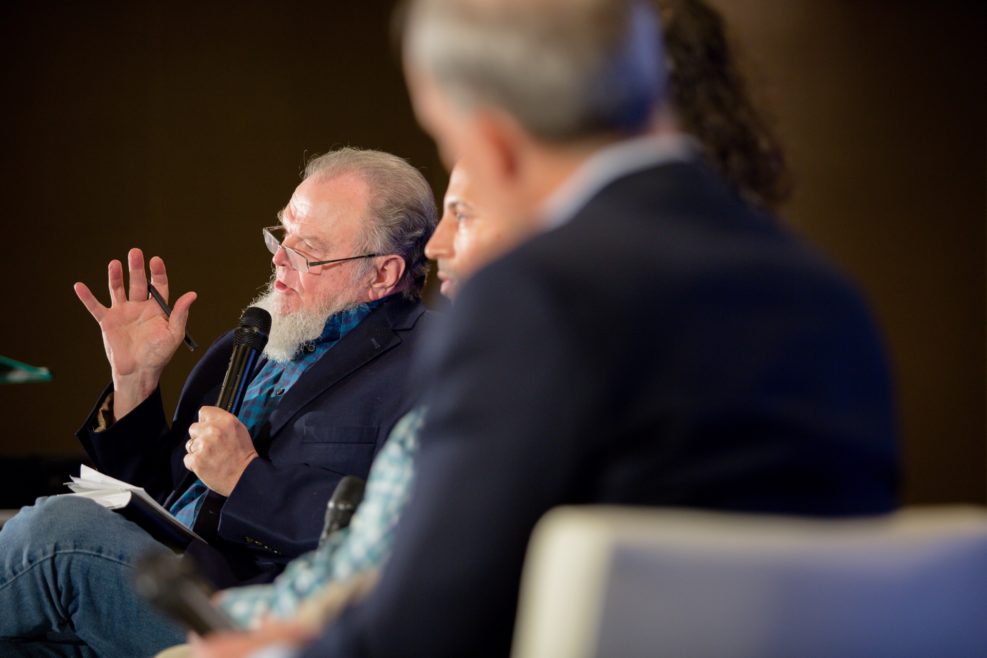
Note: Mind Matters News is made possible by support from the Walter Bradley Center for Natural and Artificial Intelligence, a project of the non-profit Discovery Institute. Here is a report of our activities for 2022. If you benefit from the work of Mind Matters News, could you donate to support our work in 2023? Humans are unique and will never be replaced by the machines they invent. That was the powerful takeaway from this year’s new book by Walter Bradley Center Director Robert J. Marks, Non-Computable You: What You Do that Artificial Intelligence Never Will. The release of Marks’ book was one of many ways that the Bradley Center advanced its mission in 2022 to defend human dignity and creativity Read More ›
Will computers ever be conscious? What happens to our consciousness after we die? Has science made philosophy irrelevant? Dr. Michael Egnor and Dr. Bernardo Kastrup discuss consciousness, artificial intelligence, and philosophy. Show Notes Additional Resources
In a recent podcast, “Does the Moon Exist if No One is Looking at It?”, neurosurgeon Michael Egnor interviewed philosopher and computer programmer Bernardo Kastrup. Dr. Kastrup has been, in Dr. Egnor’s words, “leading a modern renaissance of metaphysical idealism”—that is, reality is essentially mental rather than physical.
Read More ›
If we approach the arguments logically, as the ancient philosophers did, we will see that it is more certain that God exists than that anything else does. Atheist evolutionary biologist Jerry Coyne should consider the arguments more carefully before assuming that prayer is foolish.
Read More ›
David Hilbert wanted all mathematics to be proved by logical steps. Kurt Gödel showed that no axiomatic system could be complete and consistent at the same time.
Read More ›
The limits of science can be as instructive as the discoveries. If science someday proved that computer systems could never reproduce some aspect of mind, we’d have learned something important about the nature of mind.
Read More ›