How to Think Clearly in the Age of AI
AI isn’t really artificial intelligence, but simulated intelligenceHuman beings possess a unique and powerful innovative energy that can bring forth new things that did not exist before.
Read More ›
Human beings possess a unique and powerful innovative energy that can bring forth new things that did not exist before.
Read More ›
Many graduating students may just want a simpler life where they can work, afford to live, and enter life-giving relationships.
Read More ›


High school students struggle in places afflicted with poverty, family breakdown, and other social woes. However, it doesn’t necessarily follow that students from wealthier regions are demonstrating academic excellence.
Read More ›
Because he says the “genie” (or maybe the GenAI) “is out of the bottle,” Dr. Dembski wants me to submit to the myth of progress by sharing even one use of AI in education that I support.
Read More ›
Have we become so accustomed to surveillance capitalism that we are completely blinded to the implications? Or has Big Tech become so trustworthy that we can trust them to handle the data of student brain states with benevolent intent?
Read More ›
She’s been fired, despite the huge success of her classic books program, which is now “going in a different direction.”
Read More ›
The tragedy about AI is that those who depend on it to “think” for them won’t have the work ethic, skill, or wisdom to offer value to the world.
Read More ›
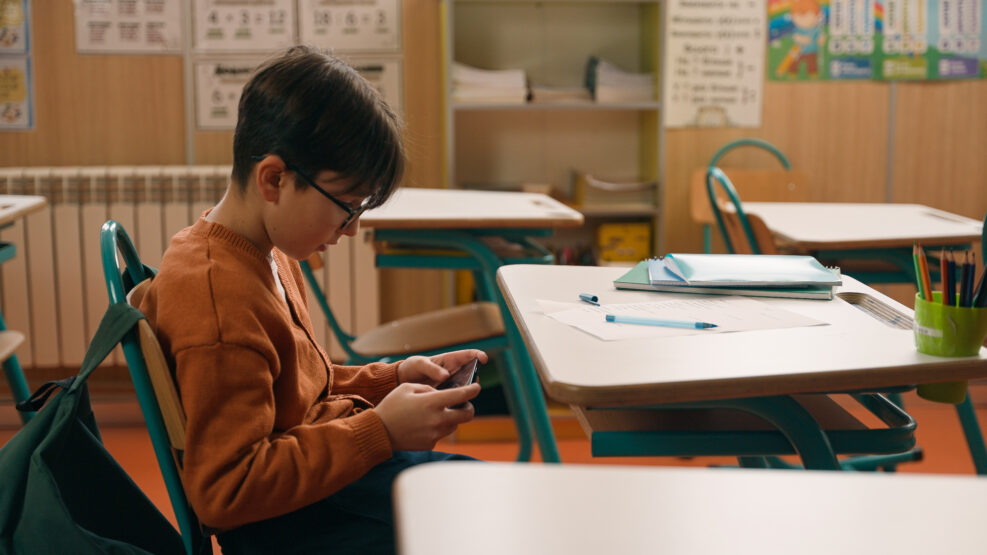
How can students be expected to read and study or engage in discussions when educators are competing with TikTok videos and Instagram in the classroom?
Read More ›
I grew up in a “phone-free” school in the 2010s and would highly recommend it. Phones represented clear threats to learning, collaboration, and creativity.
Read More ›
This summer, several states have proposed banning smartphones in public schools or introducing programs that will limit kids’ phone use during school hours. So far New York, Indiana, Ohio, California, and Oklahoma have proposed bans or restrictions, showing rare bipartisan concern over the issue. The impetus for this movement came in May when Arkansas Gov. Sarah Huckabee Sanders sent a letter to every fellow governor in the United States with a complimentary copy of The Anxious Generation, a new book by social psychologist Jonathan Haidt. Haidt shows how starting in the early 2010s kids’ mental health steeply declined. The main culprit? The smartphone, which soon became an ensnaring substitute for “real life.” Gen Z, those born after 1995, were the first Read More ›

The iconic comedian and author Jerry Seinfeld gave the commencement speech to the class of 2024 at Duke University; as a supporter of the state of Israel, dozens of students walked out of the ceremony, chanting “free Palestine” while the larger crowds in the stadium counteracted by chanting “Jerry! Jerry! Jerry!” Seinfeld went on to give a wise, insightful, and of course, hilarious speech about hard work, family, and using one’s privilege to benefit the world. He also had some comedic remarks on artificial intelligence, and what the hype over large language models unfortunately says about modern American culture. “AI is the most embarrassing thing we’ve invented during man’s timeline on earth,” said Seinfeld. “This seems to be the justification Read More ›

Going beyond worksheets and standardized tests to grapple with “the bigger picture” looks to be the sort of education we all need the most.
Read More ›
The data seems to point essentially to one thing: the shift to living our lives online.
Read More ›
In some cases, I was convinced that the goal of the training was to pretend to convey information while not actually doing so.
Read More ›
If steps aren’t taken to ensure that conceptual mastery remains the standard for higher education, most students will complete their degrees as technicians.
Read More ›
Visit a typical classroom in the United States and you’re bound to see just about every student “taking notes” behind a computer screen as the professor lectures at the helm.
Read More ›
ChatGPT’s traffic has declined for the third month in a row, according to Reuters. The Large Language Model (LLM) AI tool took the world by storm in November of 2022 when it was released by OpenAI, posing questions of academic integrity, and urging a host of tech giants to incorporate LLMs into their own platforms and search engines. Anna Tong writes, Worldwide desktop and mobile website visits to the ChatGPT website decreased by 3.2% to 1.43 billion in August, following approximately 10% drops from each of the previous two months. The amount of time visitors spent on the website has also been declining monthly since March, from an average of 8.7 minutes on site to 7 minutes on site in Read More ›

GPT-3, released by OpenAI in November, swiftly undermined the integrity of many a student’s academic work. Professors across disciplines have had to contend with how to discern machine vs. human-generated work. Now, with a new school year underway, that challenge remains. Due to ChatGPT’s popularity, many schools are seeking ways to integrate the technology into their learning environments. But the question of how to do this remains murky. Bloomberg reports, But professors and administrators seeking to integrate generative AI into their curriculums are left with a big question: How? They need to find the right middle ground, said Steve Weber, vice provost of undergraduate curriculum and education at Drexel University. Educators can’t completely prohibit use of the tool and neglect to teach it, but Read More ›

Gary Smith describes the problems with today’s science in his new book Distrust: Big Data, Data-Torturing, and the Assault on Science. He recounts endless examples of disinformation, data torture, and data mining, much of which we already knew. Taken together, however, and as I described in this review, they are mind-blowing. He argues that many of these problems come from things scientists do such as p-hacking during statistical analysis, too little emphasis on “impact” in statistical analyses, outright data falsification, and the creation of the Internet, which can be a huge disinformation machine in addition to a valuable resource. In the last chapter, he also offers some solutions such as ending the artificial thresholds for p-values such as 0.05, requiring Read More ›

Education seems especially vulnerable to ChatGPT. Universities now have to grapple with AI plagiarism, and even teachers and administrators are being tempted to use the Large Language Model to generate syllabi and even condolence emails in the wake of tragedies. Leah Libresco Sargeant, author of Building the Benedict Option and Arriving at Amen, wrote a piece on this issue at First Things last week. She goes past simply the struggle schools have in detecting ChatGPT’s presence, but also why it’s so easy to use AI generated language in school settings. Many educational institutions, like AI, promote the appearance of productivity but lack real value. She writes, If schools are primarily dedicated to producing workers, rather than holistic human beings steeped Read More ›