CategoryEducation


Don’t Censor Western Books
For thousands of men and women, the Western canon served as a lifeline
The War on Math Becomes a Fight Over Textbooks
Florida, for example, rejected 54 math textbooks of 132 submitted by publishers on account of political content
The Death of Peer Review?
Science is built on useful research and thoroughly vetted peer reviewTwo years ago, I wrote about how peer review has become an example of Goodhart’s law: “When a measure becomes a target, it ceases to be a good measure.” Once scientific accomplishments came to be gauged by the publication of peer-reviewed research papers, peer review ceased to be a good measure of scientific accomplishments. The situation has not improved. One consequence of the pressure to publish is the temptation researchers have to p-hack or HARK. P-hacking occurs when a researcher tortures the data in order to support a desired conclusion. For example, a researcher might look at subsets of the data, discard inconvenient data, or try different model specifications until the desired results are obtained and deemed statistically significant—and therefore Read More ›

Text Generators, Education, and Critical Thinking: an Update
The fundamental problem remains that, not knowing what words mean, AI has no critical thinking abilitiesThis past October, I wrote that educational testing was being shaken by the astonishing ability of GPT-3 and other large language models (LLMs) to answer test questions and write articulate essays. I argued that, while LLMs might mimic human conversation, they do not know what words mean. They consequently excel at rote memorization and BS conversation but struggle mightily with assignments that are intended to help students develop their critical thinking abilities, such as Lacking any understanding of semantics, LLMs can do none of this. To illustrate, I asked GPT-3 two questions from a midterm examination I had recently given in an introductory statistics class. Both questions tested students critical thinking skills and GPT-3 bombed both questions. I was hopeful Read More ›

What Can’t A.I. Do? Quite a Lot, Actually
NYT columnist David Brooks makes a list of uniquely human skills that students should develop in collegeIn an increasingly artificial world, how are we to remain human? New York Times columnist David Brooks wrote an opinion article this week seeking to answer that question. Brooks notes some of the benefits of “machine learning,” but also lists some of the characteristics artificial intelligence will forever fail to embody. “A.I. will probably give us fantastic tools that will help us outsource a lot of our current mental work,” he writes. “At the same time, A.I. will force us humans to double down on those talents and skills that only humans possess.” Uniquely Human Traits What are some of these “talents and skills” that people should intentionally develop in the age of A.I.? Brooks says an incoming college student Read More ›

Goodhart’s Law and Scientific Innovation in Academia
Many university researchers are leaving academia so they can actually get things doneBritish economist Charles Goodhart was a financial advisor to the Bank of England from 1968 to 1985, a period during which many economists (“monetarists”) believed that central banks should ignore unemployment and interest rates. Instead, they believed that central banks should focus on maintaining a steady rate of growth of the money supply. The core idea was that central banks could ignore economic booms and busts because they are short-lived and self-correcting (Ha! Ha!) and should, instead, keep some measure of the money supply growing at a constant rate in order to keep the rate of inflation low and constant. The choice of which money supply to target was based on how closely it was statistically correlated with GDP. The Read More ›

AI Can Pass the MBA Exam, Wharton Professor Says
In the wake of ChatGPT uproar, its abilities (and limits) are becoming better understoodOpenAI’s ChatGPT passed the Master of Business Administration (MBA) exam according to a news report from NBC. Professor Christian Terwiesch of Wharton, who conducted the research and authored a paper on the matter, said that the bot scored somewhere in the B range on the exam, and that this has major implications for education. The report is just another in a flux of news and concerns about AI invading the spheres of education and academia. Terwiesch wrote, [The bot’s score shows] remarkable ability to automate some of the skills of highly compensated knowledge workers in general and specifically the knowledge workers in the jobs held by MBA graduates including analysts, managers, and consultants.” Despise its apparent advancement, the bot did Read More ›

What Students Lose by Embracing Easy Tech Like ChatGPT
AI systems not only pose a problem for teachers, but will compromise intellectual excellence and moral virtueWe’ve heard a lot about ChatGPT and its wonders and gaping pitfalls. Among the dangers it poses is academic cheating and corner-cutting. It’s no secret that the new bot makes Comp 1 a whole lot easier for a typical incoming freshman. Some universities and schools are banning the AI system outright. Teachers wonder how they will be able to discern plagiarism. Other voices chide the alarmists and call for students and teachers to use ChatGPT as a classroom aid. But one area that has gone a bit underdiscussed in the conversation is ethics. Dr. Anthony Bradley of The King’s College tweeted this a few days ago, Students are writing papers using AI. Colleges are scrambling to combat it. We Read More ›

MIT Takes Steps Toward Meaningful Free Expression
The most significant line: "We cannot prohibit speech that some experience as offensive or injurious"Anyone familiar with the campus scene today knows that many disciplines are dedicated to anything but open inquiry. The academy is full of true stories about Canceled profs and students. Not “failed” students and profs, notice, but Canceled. Massachusetts Institute Of Technology (the famous MIT) appears to be breaking the mold by adopting free speech principles by a faculty senate vote of 98 to 52. A key passage: At the intersection of the ideal of free expression and MIT community values lies the expectation of a collegial and respectful learning and working environment. We cannot prohibit speech that some experience as offensive or injurious. At the same time, MIT deeply values civility, mutual respect, and uninhibited, wide-open debate. In fostering Read More ›

If You Make One Resolution in 2023, It Should Be This: Experts
Humans were born to think. To pause in order to think. Excessive social media use disrupts that abilityThis story originally appeared at the New York Post (December 31, 2022) Remember those bathroom readers filled with trivia, factoids, and stories? They’ve been entertaining in the throne room since 1988. Though the 35th anniversary edition came out last fall, it probably won’t hit the bestseller lists. The truth is most of us have something else to distract us in the bathroom — our smartphones. We pull them out on the john, at stoplights, in line at checkout, while we pump gas — virtually anywhere we have to wait for more than ten seconds. The lure of social stimuli gives us a dopamine hit that keeps us coming back any time we get a minute. But what if we’re cheating ourselves out Read More ›

How’s the University of Austin Coming? It’s Actually Happening
The “intellectual freedom” university continues to take shape in a world of “death to free speech”A very cautious article at Chronicle of Higher Education about the University of Austin fills in the rest of us. U Austin has come a long way since it was mocked at The New Republic as allegedly seeking to be “higher education’s premier institution of monetizing moral panics.” A couple of observations from senior Chronicle writer Tom Bartlett: The pioneer faculty have the money to get started: Chatter aside, the University of Austin is starting to take shape in the year since its raucous rollout. Curriculum is being developed. The accreditation process is underway. A deal for land in the greater Austin area is being hammered out. The university has lured several professors away from other universities and plans to Read More ›

Can We Rewire Our Brains To Be More Fluent in Math?
An artsy who flunked math — but later became an electrical engineering prof — says yesBarbara Oakley, a self-confessed math phobe, nonetheless became a professor of electrical engineering at Oakland University in Michigan, as well as an author. In 2014, she offered some secrets: at Nautilus. Be warned: Her secrets are not “Forget homework!” or “Math is a tool of oppression!” No, this is quite a different message. It’s about neuroplasticity, the ways our brains adapt to our circumstances, to give us the tools we need. But to adapt, the brain needs practice: Japan has become seen as a much-admired and emulated exemplar of these active, “understanding-centered” teaching methods. But what’s often missing from the discussion is the rest of the story: Japan is also home of the Kumon method of teaching mathematics, which emphasizes Read More ›

What Does AI in Education Mean for Critical Thinking Skills?
Students, as reported at Motherboard, are increasingly using GPT-3 and other text-generator programs to write essays for themThe COVID pandemic pushed a lot of school coursework to the internet, with an increased reliance on true/false and multiple-choice tests that can be taken online and graded quickly and conveniently. Not surprisingly, once questions went online, so did answers, with several companies posting (for a fee) solutions for students who would rather Google answers than watch Zoomed lectures. To fit into a true/false or multiple-choice format, the questions are generally little more than a recitation of definitions, facts, and calculations. Here, for example, are three statistics questions I found at a question/answer site: Question: True or false: A group of subjects selected from the group of all subjects under study is called a sample. Answer: True Question: You are Read More ›

Preparing Students to Work in an Artificial Intelligence World

The Hyper-Specialization of University Researchers
So many papers are published today in increasingly narrow specialties that, if there is still a big picture, hardly anyone can see itThe Bible warns that, “Of making many books there is no end; and much study is a weariness of the flesh.” Nowadays, the endless making of books is dwarfed by the relentless firehose of academic research papers. A 2010 study published in the British Medical Journal reported that the U.S. National Library of Medicine includes 113,976 papers on echocardiography — which would weary the flesh of any newly credentialed doctor specializing in echocardiography: We assumed that he or she could read five papers an hour (one every 10 minutes, followed by a break of 10 minutes) for eight hours a day, five days a week, and 50 weeks a year; this gives a capacity of 10000 papers in one year. Read More ›

The War on Math Is Becoming an Entrenched Ground War
If math skills are rooted in white supremacy, as alleged, one current solution is tests that don’t require math skillsWhen we first started talking about the war on math, many readers may have thought we were joking. No. The war on 2 + 2 = 4 is getting some pushback but it continues. The basic idea is that the rules of math are rooted in white supremacy. Last December, the question was mooted at USA Today, “Is math racist?” The context was proposed changes to math education: After Ebri switched to emphasizing real-world problems and collaboration, her students, most of whom are Black, improved their scores on Florida’s math exam in 2020-21 – even with 1 in 3 learning from home. But other, bolder recommendations to make math more inclusive are blowing up the world of mathematics education. Schools Read More ›

Study: AI Fails To Catch Cheaters on an Exam
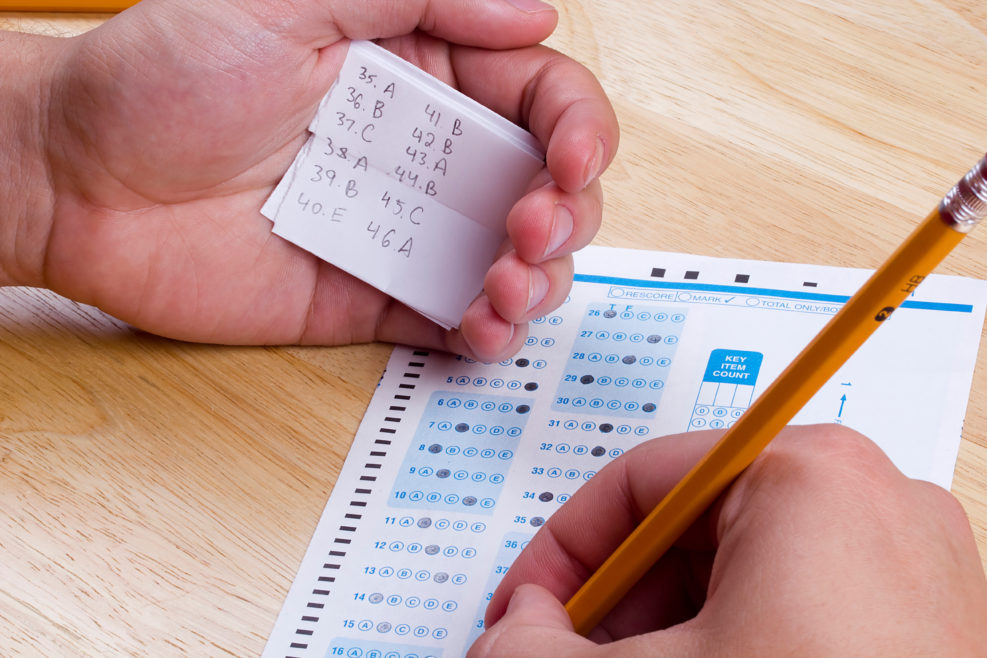
In a test of the Proctorio system, students who were told to try to cheat found a variety of ways to fool the systemIs AI the answer to student cheating on tests? Not that you’d know it from a recent study of AI detection system Proctorio at the University of Twente in the Netherlands. Proctorio tracks students’ eye movements and body language while taking exams to flag “suspicious” behavior. So, as Vice tells it, 30 computer science student volunteers were told to take a first year exam that that system supervised. Six were told to cheat, five were told to act suspiciously without really cheating, and the rest were told to just write the test: The results confirmed that Proctorio is not good at catching cheaters. The system did not flag any of the cheaters as cheating. Some used virtual machines, a known Read More ›

The Vector Algebra Wars: A Word in Defense of Clifford Algebra
A well-recognized, deep problem with using complex numbers as vectors is that they only really work with two dimensionsVector algebra is the manipulation of directional quantities. Vector algebra is extremely important in physics because so many of the quantities involved are directional. If two cars hit each other at an angle, the resulting direction of the cars is based not only on the speed they were traveling, but also on the specific angle they were moving at. Even if you’ve never formally taken a course in vector algebra, you probably have some experience with the easiest form of vector algebra — complex numbers (i.e., numbers that include the imaginary number i). In a complex number, you no longer have a number line, but, instead, you have a number plane. The image below shows the relationship between the real Read More ›

Brain for Hire: The Internet Makes Academic Cheating Much Easier
Dave Tomar, who wrote essays for students for hire for a decade, then wrote a book about it, thinks 40% of students cheat at least onceFor many years, Dave Tomar was that bane that universities always claim to be doing something about but can’t (or anyway never) do — an essay writer for hire. Wait. Wasn’t the internet supposed to end cheating? The search engine reveals all, right?… No. Read on. In The Complete Guide to Contract Cheating in Higher Education (Academic Influence, 2022), Tomar, long a freelance writer and now a plagiarism expert, explains: Yes, that happened when Google became the default search engine in 2000 and the usual copy-paste and essay mill methods no longer worked. But… Cheaters and their enablers would just need to get more creative. If, before, there were just online repositories of essays and the people who curated them, Read More ›