John Stuart Mill: Humans Are Not Automatons
Making rational decisions takes a lot of thought and hard work, says Mill.Mill uses a beautiful contrast in metaphor to show how human nature is qualitatively different from machines.
Read More ›Mill uses a beautiful contrast in metaphor to show how human nature is qualitatively different from machines.
Read More ›
Artificial intelligence that appears to be conscious is a Consciousness Room, an imitation with varying degrees of success.
Read More ›
What makes human beings unique? Will artificial intelligence take over our jobs? The Walter Bradley Center for Natural and Artificial Intelligence, which publishes Mind Matters, was launched largely to respond to questions like these. In a panel discussion at the Dallas launch of the Bradley Center, Baylor Professor of Computer Engineering Robert J. Marks offered some thoughts on the evening’s topic, “Will ‘Smart’ Machines Take Over Our Jobs?” This is a great video to watch if you’re new to Mind Matters or are interested in learning more about the unique perspective of the Bradley Center. Marks doesn’t offer doomsday approximations of the future of AI, but neither does he disregard the challenges it poses. According to him, though, there’s one Read More ›
Shlomo Nedvetzki, CTO of Nanorobotics, discusses the panel “The New Nanocosm” at the COSM Technology Summit 2022, which explored emerging technologies that hold great promise for advancing human prosperity. Nedvetzki focused on nanorobotic machines that can target and kill individual cancer cells. There are some major breakthroughs in nanotechnology that could hold great promise. We’ve been sharing a number of lectures from past COSM conferences. This video is just one of many you can find at the Bradley Center’s YouTube page. There you’ll find several lectures, interviews, and panels dealing with issues that range from economics, Big Tech, and artificial intelligence. Notable speakers include 2022 Kyoto Prize winner Carver Mead, venture capitalist Peter Thiel, and George Gilder, co-founder of Discovery Institute and author of Beyond Capitalism: Read More ›

Artificial intelligence already surrounds us and has made inroads into banking, accounting, and digital technology. It’s ubiquitous. In today’s episode, Robert J. Marks reminds us that AI is like fire: its benefits and value depend on how wisely (or foolishly) we use it. Additional Resources

Andrew Klavan, acclaimed novelist and host of the Andrew Klavan Show at the Daily Wire, wrote a book about his profound encounters with the Romantics of the 19th century, called The Truth and Beauty: How the Lives and Works of England’s Greatest Poets Point the Way to a Deeper Understanding of the Words of Jesus. The Romantics include literary figures like Samuel Taylor Coleridge, William Wordsworth, and John Keats. While it’s common to highlight the Romantics’ veneration of nature, they were also living in the throes of the Enlightenment, in which atheistic materialism was becoming a minority alternative to theism. Klavan writes, “The wonderful success of science at explaining the material world threatens to create in scientists a bias towards Read More ›
Imagine you’re walking through a world-class art museum, and you come across Van Gogh’s “Sunflowers.” (Let’s assume someone hasn’t already thrown tomato soup on it.) The painting isn’t a replication. It’s not a copy of a copy of a copy. It’s the original canvas and paint, the direct object created by the artist himself, shaped by age, visited by thousands of admirers—it’s “vintage.” You stand there admiring the work of a past genius, and get a sense of its beauty and meaning in a whole new way. There’s something unique in witnessing “the real thing.” Why do people travel worldwide to look at Da Vinci’s “Mona Lisa” when they can see a digital recreation through a Google search? Or why Read More ›
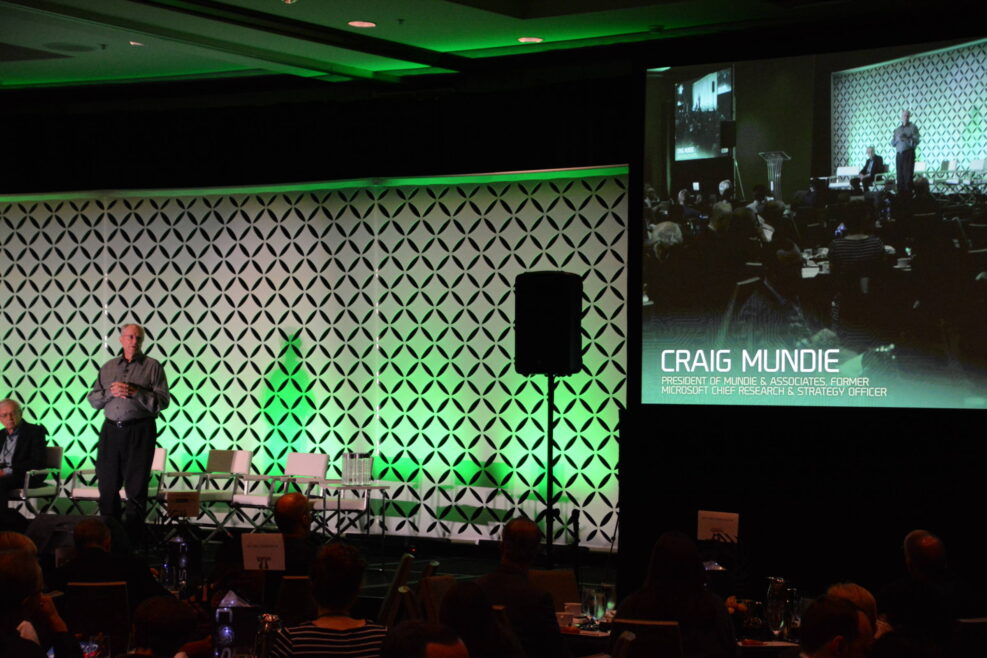
Mundie, former Microsoft Chief Research & Strategy Officer, formerly told his audience that Big Data will enable each person to be “completely understood” by machines that can produce a computer facsimile of each detail. It would be far too complex for human physicians to make sense of, he said.
Read More ›
About the Big Tech companies, he says, “The story is not that they have done a lot of bad things but that they have not done enough good things. That remains the core challenge of Silicon Valley.”
Read More ›
Rumor has it, artificial intelligence and robotics will make humans obsolete. Larry L. Linenschmidt discusses artificial intelligence, job displacement, virtue, and machines with Jay Richards. This interview is about Jay’s book, The Human Advantage: The Future of American Work in an Age of Smart Machines. This interview was originally aired by the Hill Country Institute and is included here in Read More ›

Will infotech and biotech erode human agency, subvert human desires, and render free-market economics obsolete? At first glance, there looks to be a wide gap between the future of AI and the destruction of democracy. Some futurists claim to have jumped that chasm. In a cheery little column published by the Atlantic, Yuval Noah Harari posits AI will ultimately destroy Read More ›