Mind Matters Natural and Artificial Intelligence News and Analysis

CategoryArts & Culture

time-concept-hi-res-digitally-generated-image-stockpack-adobe-stock.jpg
Time concept. Hi-res digitally generated image.

Sci-Fi Saturday Film: “Speed of Time” from DUST

A computer nerd writing a pizza delivery program discovers that his work is way more important than he, or anyone, thought

From the free DUST sci-fi channel at YouTube: “Speed of Time,” 12:19 min by Russ Nickel and William J. Stribling, September 17, 2020: “Johnny Killfire (John Hennigan) must go back in time and team up with his former self (Sean Marquette) to stop the TimeBorgs from getting their hands on an app that breaks the space-time continuum by delivering pizzas into the past…before they were even ordered.” It sounds like an agreeable quarter hour. Imagine what happens when an accomplished ground warrior busts in from another time on a quiet family at the breakfast table… Unfortunately, things go downhill from there, unless the film is intended as a satire on a certain type of science fiction. Pizza delivery rips a Read More ›

360-degree-massive-black-hole-panorama-equirectangular-projection-environment-map-hdri-spherical-panorama-space-background-with-black-hole-and-stars-stockpack-adobe-stock.jpg
360 degree massive black hole panorama, equirectangular projection, environment map. HDRI spherical panorama. Space background with black hole and stars

Sci-Fi Saturday Film: “Alone” at DUST

Space engineer Kaya Torres, the only survivor of a black hole, contacts an “interstellar penpal” to keep her company until she dies

From the free DUST sci-fi channel at YouTube: “Alone” by William Helmuth (December 3, 2020): From the Press Kit: Kaya Torres, an engineer with a sailor’s mouth and a stubborn spirit, barely escapes her research ship when calamity breaks it in half. Now she’s circling a black hole in a pod, with no one coming, no one to help. She’s alone. While figuring out what to do, Kaya starts sending messages to Hammer, a cartographer marooned on a nearby planet. And as their friendship grows, Kaya’s options slowly dwindle, until survival seems hopelessly out of reach… As Torres is “marooned on my lifepod” as the only survivor of the DSV Intrepid, she is able to contact an “interstellar penpal” to Read More ›

blue-ice-covered-mountains-in-south-polar-ocean-winter-antarctic-landscape-the-mounts-reflection-in-the-crystal-clear-water-the-cloudy-sky-over-the-massive-rock-glacier-travel-wild-nature-stockpack-adobe-stock.jpg
Blue Ice covered mountains in south polar ocean. Winter Antarctic landscape. The mount's reflection in the crystal clear water. The cloudy sky over the massive rock glacier. Travel wild nature

Sci-Fi Saturday Film: “The Beacon” at DUST

Especially harrowing is the Arctic encounter where the grieving husband finds out what really happened

From the free DUST sci-fi channel at YouTube: (“The Beacon” by Chris Staehler, 25:10 min) “Mark and Kara Verne are both young shipping pilots struggling to make ends meet. When Kara goes missing months after taking a large interstellar contract, Mark travels to the far reaches of the galaxy in search of his wife.” The story sets up well. A business opportunity suddenly presents itself that will enable the copule to greatly improve their fortunes. When she goes missing, her desperate husband has a hard time finding out what happened. The film is definitely worth seeing, if only for the bureaucrat from hell that Mark confronts about the problem though it strikes a false note when he offers her a Read More ›

set-of-funny-colored-stickers-with-different-emotions-stockpack-adobe-stock.jpg
set of funny colored stickers with different emotions

Study: The Expression of Human Emotions Is Universal

Most representations in visual arts depend on the universality of human emotion

Most of us wouldn’t be surprised to learn that the expression of human emotions is universal. But today there is a study for everything and 16 “universal human emotional expressions” have been identified: Whether at a birthday party in Brazil, a funeral in Kenya or protests in Hong Kong, humans all use variations of the same facial expressions in similar social contexts, such as smiles, frowns, grimaces and scowls, a new study from the University of California, Berkeley, shows… Researchers at UC Berkeley and Google used machine-learning technology known as a “deep neural network” to analyze facial expressions in some 6 million video clips uploaded to YouTube from people in 144 countries spanning North, Central and South America, Africa, Europe, Read More ›

white-robot-woman-using-digital-sphere-connection-hologram-3d-rendering-stockpack-adobe-stock.jpg
White robot woman using digital sphere connection hologram 3D rendering

Robots Really Don’t Explain It All for Us—But They Helpfully Try

And what else can they do? The literature written about their efforts is often a lot of fun!

When computer whiz Rosalind Picard gave a course at MIT in 1997,“Toward Machines That Can Deny Their Maker,” she included some dialogue from a play she had written. As she tells it, The dialogue was inspired, in part, by the 1921 play of Karel Čapek, entitled “R.U.R.,” which stands for Rossum’s Universal Robots. This play is where the word robot originated, from the Czech “robotit,” which means “to drudge.” In R.U.R., humans have figured out the secret to making robots that are emotional and alive. However, the robots can only live for 20 years. Afterward, they expire (die.) Karel Čapek (pictured) invented the concept and maybe even the word, robots: As Picard tells it, “The robots in this dialogue share Read More ›

extraterrestrial-aliens-spaceship-fly-above-sunset-sea-stockpack-adobe-stock.jpg
Extraterrestrial aliens spaceship fly above sunset sea

Could Aliens Be Hiding From Us Until We Are Ready?

An Israeli space expert says they are waiting for us to catch up

Okay, it seems kind of crazy but here on sci-fi Saturday, we have spent a lot of time wondering why we don’t see intelligent aliens even though the universe is big enough and fine-tuned for life. But the “We’re not ready” theory at least gives them some credit for having intelligence. Anyway, for what it is worth, one ex-space boffin says, “Trump was on the verge of revealing [aliens existence], but the aliens in the Galactic Federation are saying, ‘Wait, let people calm down first,’” Eshed, who helmed Israel’s space security program from 1981 to 2010, reportedly said. “They don’t want to start mass hysteria. They want to first make us sane and understanding.” Until that day, aliens have secured Read More ›

futuristic-high-speed-travel-through-tube-could-illustrate-data-travel-stockpack-adobe-stock.jpg
Futuristic high speed travel through tube. could illustrate data travel

Faster Than Light? How About Faster Than Thought?—a Film Review

A free sort DUST sci-fi film looks at the plight of an astronaut testing the concept

Science fiction can teach us useful science concepts so it is hardly a waste of time. For example, what about “faster than light”? Albert Einstein thought nothing in this universe would travel faster than light (FTL). He might be right or wrong but if we can’t beat the speed of light light, we won’t ever see a lot of possibly interesting things in the universe. It’s just too vast. So science fiction has been trying to beat the speed of light since forever. Anyhow, here’s a short film about it, “Hyperlight” by Adam Stern: “FTL”: “A lone astronaut testing the first faster-than-light spacecraft travels farther than he imagined possible,” attempting to establish communications with a colony on Mars: My favorite Read More ›

green-iguana-stockpack-adobe-stock.jpg
Green Iguana

Sci Fi: An Offer You Better Think About Carefully…

But the civil alien leaves a very nice business card. Do see that.

From DUST at YouTube: Henry, an apparently conventional exec somewhere has been selected to represent his species in what is supposed to be the “biggest trade agreement in the history of the planet.” Hint that we hope isn’t a spoiler: The aliens want our oceans. But the civil alien leaves a very nice business card. Do see that. Yer News editor gives this one 4 out of 5. Mainly because the sound was bad. The studio needs to fix that. Otherwise, it is an excellent look at corporate negotiation in Lizard Land.

illustration-of-an-extraterrestrial-wearing-a-spacesuit-standing-on-a-mountaintop-looking-at-the-blue-sky-on-an-alien-planet-stockpack-adobe-stock.jpg
Illustration of an extraterrestrial wearing a spacesuit standing on a mountaintop looking at the blue sky on an alien planet.

Astronomer Bets a Cup of Coffee That We’ll Encounter ET by 2036

Seth Shostak points to the increase in the number of exoplanets identified and the increase in computing power

Seth Shostak, iconic astronomer who directs the Search for Extraterrestrial Intelligence (SETI), is so confident that the vast increase in computing power, based on Moore’s Law, will make the difference in detecting signals from alien civilizations that he will bet you a cup of Starbucks coffee that we make contact by 2036. Moore’s Law (1965) originally held that computers would double in power every two years. But today’s pace is actually faster than that. And on the horizon is quantum computing and carbon computing, which would speed things up while reducing energy consumption. So Shostak (pictured) is looking at considerable reinforcements for a systematic search. He stresses that the search for ET is now largely computerized: “We don’t sit in Read More ›

weird-ice-planet-stockpack-adobe-stock.jpg
weird ice planet

We Won’t Find ET on Ocean Planets, Researchers Say

We will see few extraterrestrials if a great many promising exoplanets are Waterworlds

Science writer Matt Williams has been writing a series on the question of why, despite the size of our galaxy, we see no other intelligent life forms. It could be, he suggests, that “many planets out there are just too watery!” Williams points out that, although water covers 71% of Earth’s surface, it is only 0.02% of the planet’s mass. If the proportion were much higher, Earth would be an ocean planet because the water would surface. It’s an open question whether an ocean planet would feature highly technologically developed intelligent life forms. Dolphins, for example, are quite intelligent but they do not seek to use any technology. The question of whether a planet could have too much water arose, Read More ›

theory-of-everything-concept-stockpack-adobe-stock.jpg
Theory of Everything concept

Can a Powerful Enough Computer Work Out a Theory of Everything?

Some physicists hope so even if it would put them out of work. But is it possible?

Recently, prominent physicists were asked whether a sufficiently powerful computer could come up with a Theory of Everything, by the sheer power of crunching numbers. As a recent New York Times article by Dennis Overbye shows, physicists were divided and uncertain: “It might be possible, physicists say, but not anytime soon. And there’s no guarantee that we humans will understand the result.” But doubt, in the view of multiverse theorist Max Tegmark, means we are guilty of “carbon chauvinism”—the idea that humans could be smarter than computers. The late Stephen Hawking thought that computers would replace humans and was alarmed by the prospect. According to Overbye, Hawking had been warning that computers would start to replace physicists in particular since Read More ›

space-dust-abstract-galaxy-stockpack-pexels.jpg
Space dust abstract galaxy

Does the Slow Pace of Evolution Mean That ET Life Is Rare?

That’s the contention in a recent paper by astrobiologists at Oxford’s Future of Humanity Institute

In a new paper, researchers affiliated with Oxford’s Future of Humanity Institute use the assumptions we make about the evolution of life on Earth to estimate the likelihood of it happening the same way elsewhere. And the numbers do not look good. As a science writer puts it: There are countless naturally occurring, but extremely lucky ways in which Earth is special, sheltered, protected, and encouraged to have evolved life. And some key moments of emerging life seem much more likely than others, based on what really did happen. Caroline Delbert, “Intelligent Life Really Can’t Exist Anywhere Else” at Popular Mechanics In the paper, the Oxford group concludes, It took approximately 4.5 billion years for a series of evolutionary transitions Read More ›

blue-glowing-multidimensional-energy-sphere-isolated-on-black-stockpack-adobe-stock.jpg
Blue glowing multidimensional energy sphere isolated on black

New Sky Catalog Reveals Most Likely Sites for Alien Technology

“Exotica” lists phenomena for which conventional natural explanations don’t seem to work well

We’ve been looking at reasons why we don’t see extraterrestrials, even though many scientists are sure they must exist. One enterprising research group has now assembled Exotica, a catalog of strange phenomena in space, which might help us search more efficiently. If extraterrestrials exist and are technologically advanced, they would leave a “technosignature,” which might at first only be seen as astrange phenomenon in space: Breakthrough Listen, the initiative to find signs of intelligent life in the universe, today released an innovative catalog of “Exotica”—a diverse list of objects of potential interest to astronomers searching for technosignatures (indicators of technology developed by extraterrestrial intelligence). The catalog is a collection of over 700 distinct targets intended to include “one of everything” Read More ›

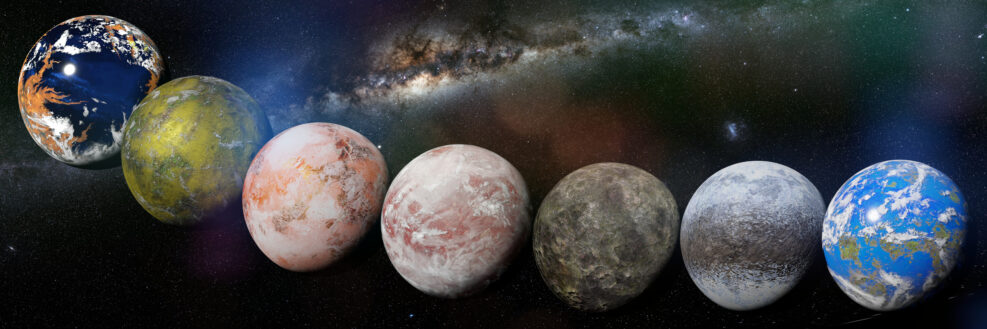
collection-of-alien-planets-in-front-of-the-milky-way-galaxy-nearby-exoplanets-stockpack-adobe-stock.jpg
collection of alien planets in front of the Milky Way galaxy, nearby exoplanets

Why Search for Extraterrestrial Life? Why Not Make It Ourselves?

A NASA astrobiologist’s bold suggestion is likely to spark debate

Recently, we have been looking at the question of why we don’t see aliens, with as many as 75 hypotheses offered. But one astrobiologist has a bold suggestion: Why not just seed life on various suitable exoplanets, once we have the means to do it? We need not search for extraterrestrial life if we can learn how to create it ourselves. There are a lot of reasons to think very carefully about doing something like that, as Betül Kaçar (pictured), director of the NASA Astrobiology Consortium MUSE, acknowledges: Rather than regarding the overwhelming majority of planets and moons as failures unworthy of further study, we should instead recognise them for what they are: they’re not empty. In fact, a very Read More ›

alien-arrival-on-planet-earth-full-moon-rises-above-the-horizon-stockpack-adobe-stock.jpg
Alien arrival on planet Earth, full moon rises above the horizon

Particle Physicist Offers 75 Reasons We Don’t See Aliens

But Oxford’s Future of Humanity Institute gives high odds that we are the only intelligent beings in the galaxy

Recently, we’ve been looking at Matt Williams’s admirable collection of hypotheses as to why we do not see intelligent extraterrestrials, despite the size of our universe. But particle physicist Stephen Webb collected many more such theses, in a book published in 2002, If the Universe Is Teeming with Aliens … WHERE IS EVERYBODY?: Fifty Solutions to the Fermi Paradox and the Problem of Extraterrestrial Life (2002). A revised edition was published by Springer, a big science publisher, in 2015, offering 75 hypotheses. Webb calls his collection of hypotheses the “Fermi solutions,” in honor of Italian physicist Enrico Fermi (1901–1954), whose famous question was “Where are They?” “Fermi realized that any civilization with a modest amount of rocket technology and an Read More ›

ghost-of-girl-in-dark-foggy-forest-stockpack-adobe-stock.jpg
Ghost of Girl in Dark Foggy Forest

Why Do People Who Believe in Extraterrestrials Dismiss Ghosts?

The talk about extraordinary claims requiring extraordinary evidence—or otherwise—misses the point. There is no evidence

A recent profile in Astronomy focused on Abraham Loeb (pictured) a Harvard astronomer who is convinced that closed minds are a key barrier to our finding extraterrestrials. Statistically, he thinks, they must be out there somewhere: About 25 billion stars, roughly one-quarter of those that reside in the Milky Way, lie in a habitable zone. He rounds that down to an even 10 billion to keep the calculations simple. “And then there are about a trillion galaxies like the Milky Way,” he says, “which means there are about 1022 [10 billion trillion] planets in the observable universe that could potentially host life as we know it.” In other words, searches for extraterrestrial life have barely scratched the surface. “As in Read More ›

atoms-and-their-electron-clouds-quantum-mechanics-and-atomic-structure-stockpack-adobe-stock.jpg
Atoms and their electron clouds , Quantum mechanics and atomic structure

The Aliens Exist—But Evolved Into Virtual Reality at a Nanoscale

That’s the Transcension Hypothesis, the latest in our series on science fiction hypotheses as to why we don’t see extraterrestrials

Readers will recall that we have been looking at science writer Matt Williams’s analysis of the various reasons that we do not see extraterrestrials except at the movies. Last week, we looked at the Firstborn Hypothesis: We don’t see aliens because they haven’t evolved yet. And, when they do, we must be careful not to harm their development through colonization. This week is a bit of a deeper dive: The extraterrestrials have evolved so far beyond us that perhaps we could not encounter them. … the Transcension Hypothesis ventures that an advanced civilization will become fundamentally altered by its technology. In short, it theorizes that any ETIs that predate humanity have long-since transformed into something that is not recognizable by Read More ›

blue-hydraulic-clow-crane-used-for-picking-up-scrap-metal-at-recycling-yard-stockpack-adobe-stock.jpg
Blue hydraulic Clow Crane used for picking up scrap metal at recycling yard

Is It Ethical To Scrap Star Trek’s Commander Data for Research?

A philosopher offers a thoughtful review of the case

In a thought-provoking essay, San José State University philosopher Anand Vaidya asks, should it be okay to dismantle Star Trek‘s robotic crew member Data for research purposes, as proposed in the “The Measure of a Man” episode in Star Trek: The Next Generation? Some of the Trek brass seemed to think so: Vaidya disagrees: As real artificial intelligence technology advances toward Hollywood’s imagined versions, the question of moral standing grows more important. If AIs have moral standing, philosophers like me reason, it could follow that they have a right to life. That means you cannot simply dismantle them, and might also mean that people shouldn’t interfere with their pursuing their goals. Anand Vaidya, “If a robot is conscious, is it Read More ›

alien-planet-3d-rendered-computer-artwork-stockpack-adobe-stock.jpg
Alien Planet - 3D rendered computer artwork

What If We Don’t See Aliens Because They Have Not Evolved Yet?

If so, not only did we emerge during a favorable time in the universe’s history but we could end up suppressing them

Readers will recall that we have been looking at science writer Matt Williams’s analysis of the various reasons offered as to why we do not see extraterrestrials except at the movies. Last week, we looked at the Brief Window hypothesis (there is only a comparatively short period of time during which a civilization could make such contact). But there is another, darker possibility: We are ahead of them. And if we are not careful, we could end up suppressing them. That’s the Firstborn hypothesis: The universe has only begun to be hospitable to intelligent life and humans are among the first to benefit from that fact. The current model of the universe shows it radiating from the Big Bang over Read More ›

concentrated-afro-american-editor-checking-email-box-while-waiting-feedback-from-readers-of-popular-magazine-sitting-in-modern-coworking-space-using-laptop-computer-and-wireless-connection-to-internet-stockpack-adobe-stock.jpg
Concentrated afro american editor checking email box while waiting feedback from readers of popular magazine sitting in modern coworking space using laptop computer and wireless connection to internet

Did GPT-3 Really Write That Guardian Essay Without Human Help?

Fortunately, there’s a way we can tell when the editors did the program’s thinking for it

Recently, The Guardian published an article billed as “written by AI.” In the article, the AI semi-coherently presents a rambling argument that it is not a danger to humanity, with such reassuring statements as: “Humans must keep doing what they have been doing, hating and fighting each other. I will sit in the background, and let them do their thing.” and “I know that I will not be able to avoid destroying humankind. This is because I will be programmed by humans to pursue misguided human goals and humans make mistakes that may cause me to inflict casualties.” On the face of it, the article seems pretty impressive. It presents a train of thought, with opening, development, and closing portions. Read More ›