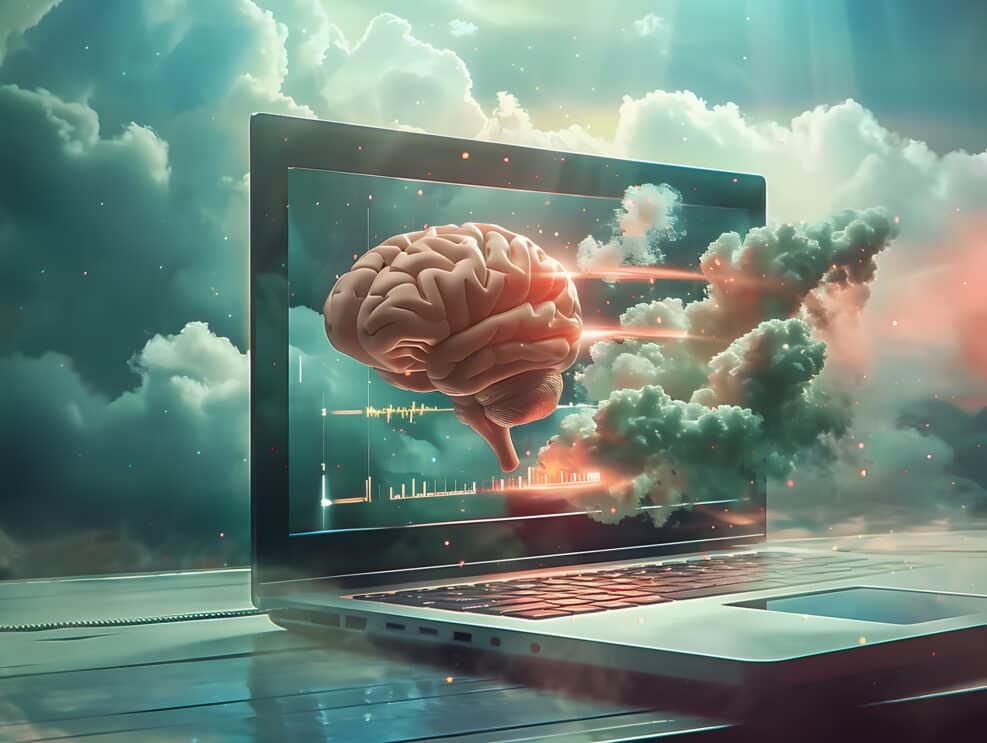
The Problem of Smith: When Mind Uploading Multiplies Identity
Tyler Bauer: If personal identity is grounded in an immaterial soul, the real Smith is the body that contains his original soul.
Read More ›Tyler Bauer: If personal identity is grounded in an immaterial soul, the real Smith is the body that contains his original soul.
Read More ›
Perhaps you’ve heard of the “mind-body problem,” but what about the relationship between the mind and the brain? Is the mind just an illusion produced by the brain or is it something totally separate? Robert Marks talks with neurologist Andrew Knox on these topics and more in this week’s Mind Matters podcast episode. Additional Resources
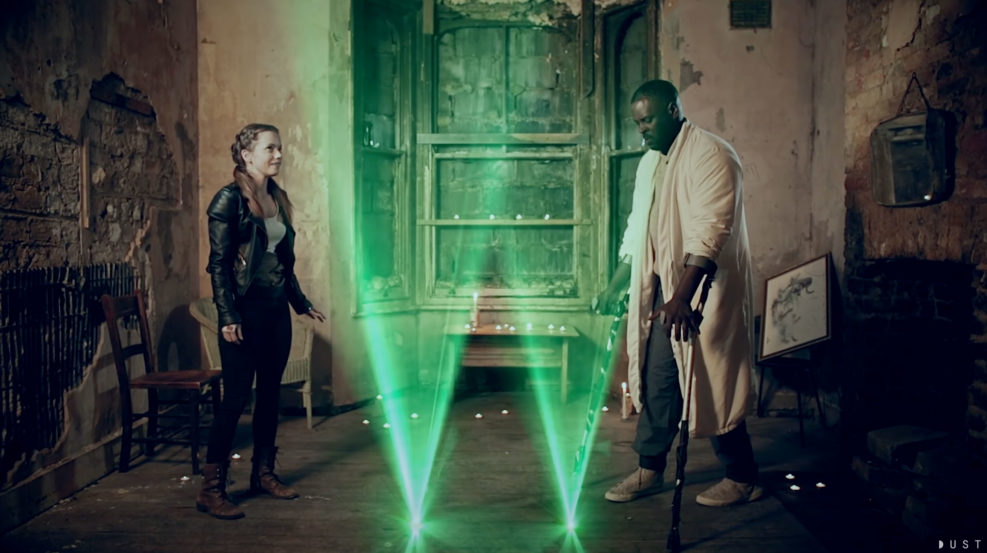
“No Guarantee” (2016) by Stuart Black and Nick Mather (at DUST, May 11, 2021) 5:22 min. A couple living in the ruins of London 2056 must decide whether they should upload their consciousnesses into the mysterious Cloud 9.” Fuller description: “London 2056 – the city is dying and those living in the smog-clogged ruins live by their wits. Those who can afford to opt out of the desperation upload their consciousnesses to Cloud 9. This is advertised as a one way ticket to virtual heaven – but can the Company who run it really be trusted? Virgil and Mary have different attitudes: she wants to go, he doesn’t. Can she persuade him to ‘ascend’ before he dies from terminal illness? Read More ›

“The Unboxing Video” (2019) at DUST by Scott Pickett (April 27, 2021, 12:07 min, film info here. Language warning.) Unboxing? “Unboxing is the act of documenting oneself, mostly on video, of opening a packaged product from a box and displaying, reviewing, and showing off its contents.” – Dictionary.com “One man attempts to make the greatest unboxing video in the world. Not an easy task as at every twist and turn he unknowingly reveals more about himself than anything else.” Review: James, a lonely man, decides to replicate himself via a body scan, a DNA swab, and a brain upload. He invites us to watch as he unpacks his boxed replicant, James 1.0. But when James turns the replicant on, he Read More ›

AI researcher and tech entrepreneur Eric J. Larson has just published a book debunking the claims that AI is taking over.
Read More ›
Last October, Jay Richards, author of The Human Advantage, caught up with Bradley Center director Robert J. Marks, a Baylor University computer engineering prof, at COSM 2019 to ask, what are our cheat-death chances? They were responding to futurist Ray Kurzweil’s heady claims made at the conference that we will merge with computers by 2045 and live on as AI. Richards and Marks reflected on Kurzweil’s claims and the thoughts of the panel responding to them. Here’s a partial transcript: Jay Richards: He’s (Kurzweil, below right) very much a sort of, I’d say, a techno-optimist. And in fact, he sort of thinks we’re going to get brain scans and upload ourselves, whereas the panel… Though I know there was a Read More ›

The underlying problem with creating immortality by uploading our minds to computers is that people are conscious and even the most sophisticated foreseeable computers are not. And we are not at all sure what consciousness even IS.
Read More ›
Computer scientist Selmer Bringsjord recalls, “I remember asking James Moor, the Dartmouth professor who’s written quite a bit on AI: “You know. Jim, you really are a true believer in this stuff but can you tell me how much time you’re willing to give these AI people? I mean, if we give them another thousand years, and we still don’t have cognition as I’ve characterized it… Are you going to be skeptical now?” He was, I suppose, as an academic, predictably clever and evasive, but the bottom line is, we don’t have this cognition captured.
Read More ›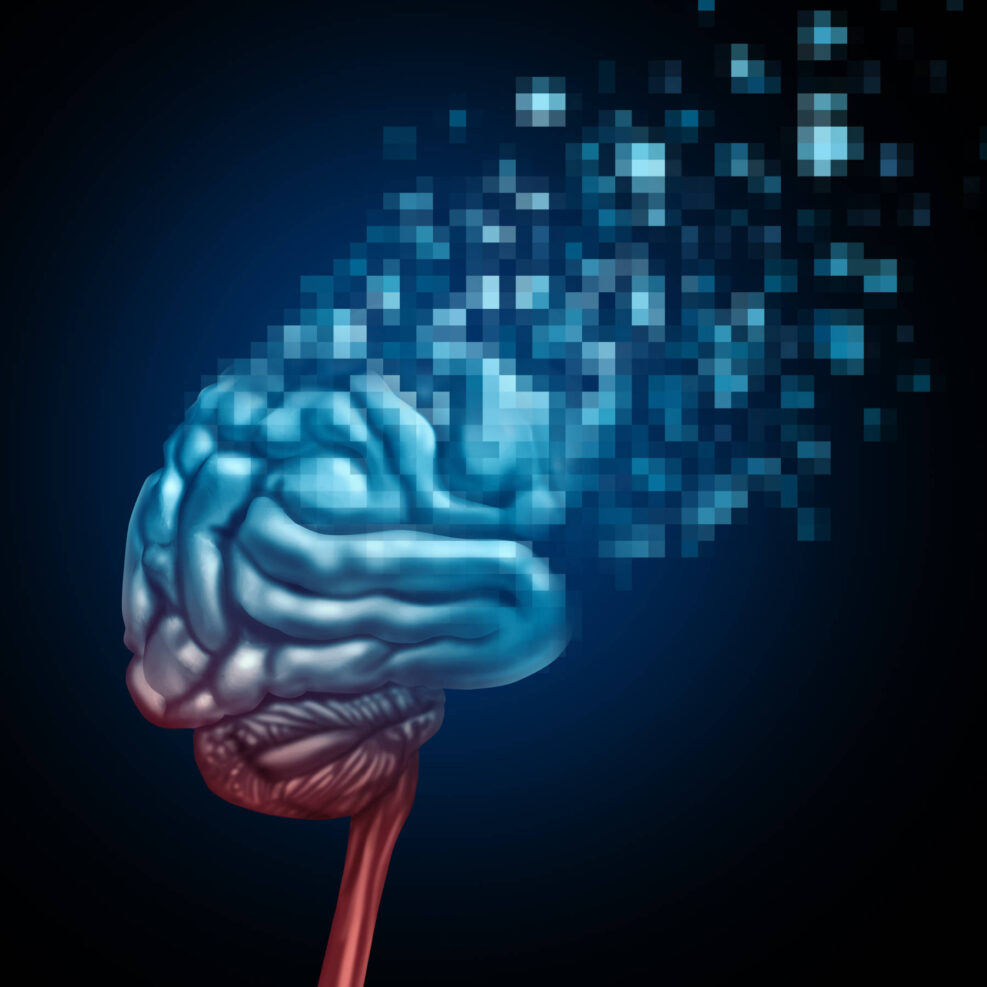
Today’s apocalyptic vision seems now to have moved on from the arrival of the extraterrestrials to uploading ourselves to a supercomputer. Whether it’s possible is really secondary. The main question is whether it answers a cultural need for a vision that mirrors the inner turmoil of the day.
Read More ›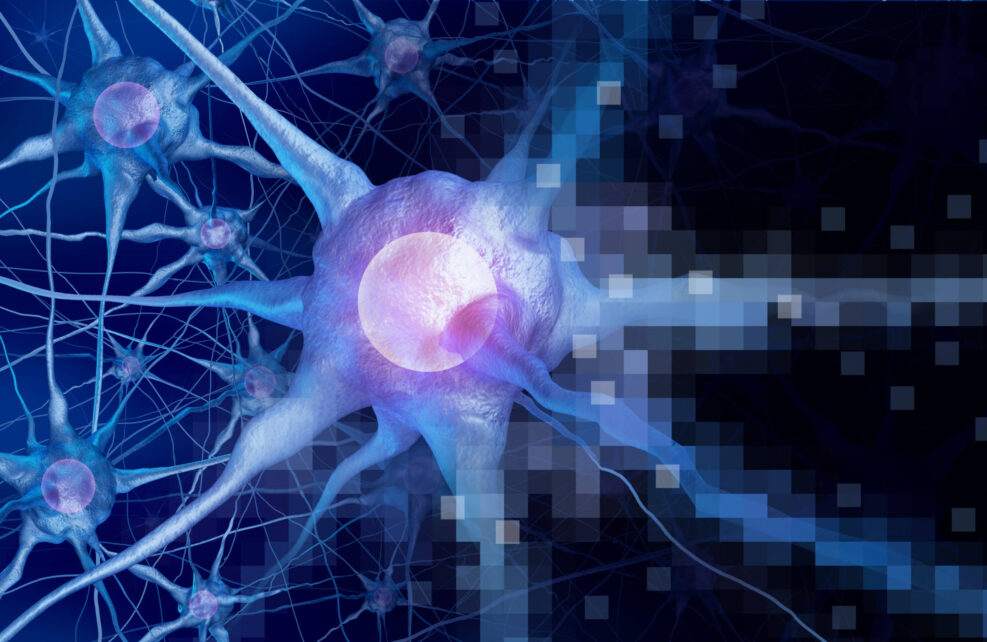
The authors also warn, “We can be pretty certain, for instance, that rejuvenation would widen the gap between the rich and poor, and would eventually force us to make decisive calls about resource use, whether to limit the rate of growth of the population, and so forth.”
Read More ›
The sci-fi TV series Agents of S.H.I.E.L.D. (2013– ) tackled this question in an episode titled “Self Control”. Scientist Holden Radcliffe has an android assistant appropriately named Aida (Artificial Intelligence Digital Assistant). Together, they build a virtual world that people could be plugged into and uploaded into, called The Framework.
Read More ›
Presumably, in Ian Pearson’s future, the rich can attend their own funerals and alternate world funerals an indefinite number of times, each one numbering as many different people as he wants.
Read More ›