
TagQuantum Computing
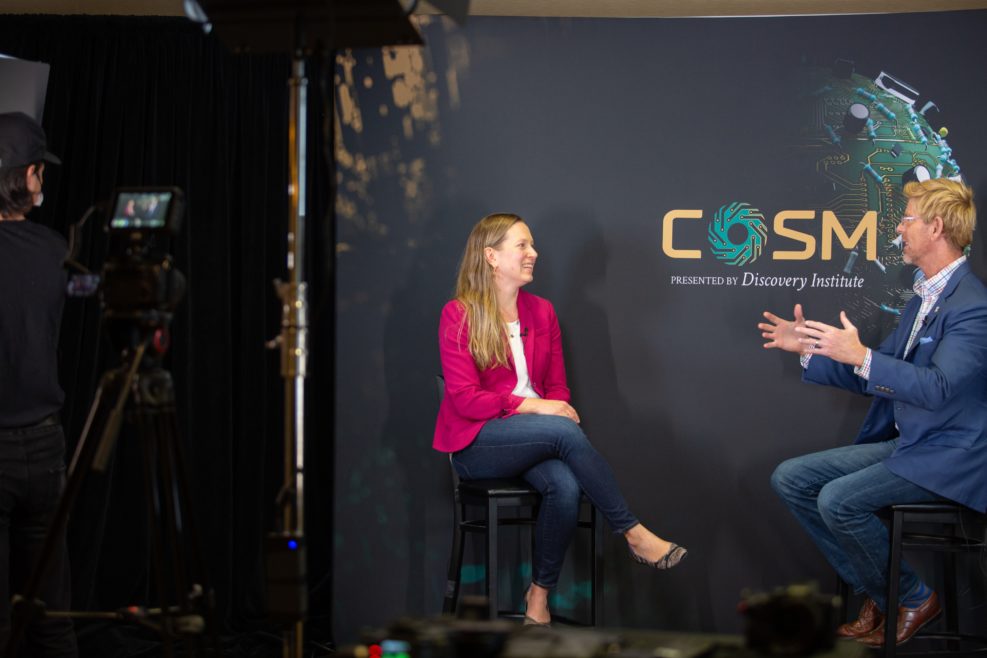
Microsoft’s Julie Love on Quantum Computing
How might quantum computing change the technology in the future?In today’s featured video from a past COSM conference, Discovery Institute Senior Fellow Jay Richards interviews Julie Love, Director of Quantum Computing Business Development at Microsoft, about how quantum computing differs from classical computing and what the future holds for this technology. (REGISTER NOW FOR COSM 2023) COSM is an exclusive national summit on the technologies remaking the world as we know it. The mission of the conference is to stimulate debate and deliberation amongst industry leaders, illuminating the synergy between Seattle and the world and providing a scene of civilized conversation and exchange. (REGISTER NOW FOR COSM 2023) We’ve been sharing a number of lectures from past COSM conferences. This video is just one of many you can find at Read More ›

Did Physicists Open a Portal to Extra Time Dimension, as Claimed?
That’s the way the story reads at Scientific American. But experimental physicist Rob Sheldon says not so fast…This story was #8 in 2022 at Mind Matters News in terms of reader numbers. As we approach the New Year, we are rerunning the top ten Mind Matters News stories of 2022, based on reader interest. Here’s #8, from our news division, for those of us who wonder how best to interpret science news at the cutting edge: “Did physicists open a portal to an extra time dimension, as claimed?: An experimental physicist explains. (August 6, 2022) At Scientific American, we were told last month: “Physicists have devised a mind-bending error-correction technique that could dramatically boost the performance of quantum computers”: “It is very exciting to see this unusual phase of matter realized in an actual experiment, especially because the mathematical description Read More ›
What AI Machines Won’t Be Able to Achieve
Computer scientist and AI expert Selmer Bringsjord provides a wide-ranging discussion of artificial intelligence (AI) and its capabilities. Bringsjord, a professor at Rensselaer, addresses three features humans possess that AI machines won’t be able to duplicate in his view: consciousness, cognition, and genuine creativity. Additional Resources
Did Physicists Open a Portal to Extra Time Dimension, As Claimed?
That’s the way the story reads at Scientific American. But experimental physicist Rob Sheldon says not so fast…At Scientific American, we were told last month: “Physicists have devised a mind-bending error-correction technique that could dramatically boost the performance of quantum computers”: “It is very exciting to see this unusual phase of matter realized in an actual experiment, especially because the mathematical description is based on a theoretical ‘extra’ time dimension,” says team member Philipp Dumitrescu, who was at the Flatiron Institute in New York City when the experiments were carried out. A paper describing the work was published in Nature on July 20. Opening a portal to an extra time dimension—even just a theoretical one—sounds thrilling, but it was not the physicists’ original plan. “We were very much motivated to see what new types of phases could Read More ›

Seth Lloyd Will Take Us Into the Quantum Realm at COSM 2021
Dr. Lloyd, an MIT physicist, will tackle "Quantum Computing: Does it Change Everything, or Anything?"Quantum physics has captured the imagination of culture, despite the fact that it upends everyday physics. Take, for instance, Marvel’s Ant Man (2015), whose creators consulted with physicists in their seemingly-absurd application of quantum physics to a fictional superhero universe. Quantum science will be one of the many topics explored at COSM 2021 this November. To aid in that exploration, physicist Seth Lloyd will be joining to discuss, “Quantum Computing: Does it Change Everything, or Anything?” Dr. Lloyd earned his Ph.D. from Rockefeller University, and is currently a professor of mechanical engineering at MIT. His research interests lie in quantum information and control theory. He has authored and co-authored over 200 scientific publications, and is the author of Programming the Read More ›

Quantum Physicist Julie Love to Speak at COSM 2021
She fell in love with physics in high school, and continues to pursue that love today at MicrosoftShe may not be a household name, but Dr. Julie Love works with technology that could have massive implications on our economy, in our industry and agriculture, and on society at large: Quantum computing. At this year’s COSM conference in Bellevue, Washington, Love will be addressing quantum computing and the question, “Does it change everything, or anything?” First, what exactly is quantum computing? “Quantum computing applies the properties of quantum physics to the processing of information,” Love explains in a Youtube series produced by Microsoft exploring the impact of the technology. “This exponentially faster and more powerful computing will accelerate the development of new sustainable materials, improved healthcare, methods to address food production, and combat climate change.” You can watch Read More ›

Researchers Make a Trillion Aluminum Atoms Behave as Single Wave
Such demonstrations show that quantum computers, which could solve much bigger problems much faster, are viableJust recently, researchers managed to “entangle” two very tiny aluminum drums as if they were merely quantum particles — a first that helps pave the way for quantum computing. But it’s an unsettling first because the world above the level of the electron (macroscopic world) is supposed to behave according to Newton’s classical physics rules, not weird quantum rules under which two entangled particles sync no matter how far apart they are (non-locality). Like conductors of a spooky symphony, researchers have ‘entangled’ two small mechanical drums and precisely measured their linked quantum properties. Entangled pairs like this might someday perform computations and transmit data in large-scale quantum networks. National Institute of Standards and Technology (NIST), “Quantum drum duet measured” at Read More ›

How Spooky “Quantum Collapse” Can Give Us More Secure Encryption
If entangled photons linked to random numbers are transmitted, parties on either end can know, via high error rates, that they’ve been intercepted.In a recent podcast, “Enrique Blair on quantum computing,” Walter Bradley Center director Robert J. Marks talks with fellow computer engineer Enrique Blair about why quantum mechanics is so strange but important to our future. They discussed “quantum communication” (generally, quantum encryption) and why safer quantum encryption might be easier to achieve than general quantum computing. https://episodes.castos.com/mindmatters/Mind-Matters-110-Enrique-Blair.mp3 The discussion of quantum communication begins at approximately 55:32. The Show Notes and transcript follow. Robert J. Marks: I know there’s lots of interesting quantum communication today. The NSF and the Department of Defense are throwing big bucks at it. What is it, just roughly? Enrique Blair: Quantum communication really is the use of quantum mechanics to share information in a secure manner. Read More ›

Why Google’s “Quantum Supremacy” Isn’t Changing Much—Not Yet
Quantum computing was suggested by physicist Richard Feynman in 1982; the supremacy battles are quite recentIn last week’s podcast, “Enrique Blair on quantum computing,” Walter Bradley Center director Robert J. Marks talks with fellow computer engineer Enrique Blair about why quantum mechanics is so strange but important to our future. One thing they discussed was Google’s claim to quantum supremacy. What does it mean? Does it matter? https://episodes.castos.com/mindmatters/Mind-Matters-110-Enrique-Blair.mp3 The discussion of quantum supremacy begins at approximately 47:55. The Show Notes and transcript follow. Excerpts from the transcript: Robert J. Marks (pictured): Google recently announced they had achieved quantum supremacy. What is quantum supremacy, and how does that relate to the quantum computer and the other computers that we use today? Enrique Blair: It’s a pretty interesting buzzword. Maybe the first thing to mention is what Read More ›

How Quantum Computing Can and Can’t Help Us Here in Macro World
Quantum computing could easily break down current encryption schemesIn last week’s podcast, “Enrique Blair on quantum computing,” Walter Bradley Center director Robert J. Marks talks with fellow computer engineer Enrique Blair about why quantum mechanics is so strange, yet an intrinsic part of the way our universe works. They discussed whether quantum computing will be in our future any time soon? In our cell phones? What difference will it make? https://episodes.castos.com/mindmatters/Mind-Matters-110-Enrique-Blair.mp3 The discussion of quantum computing begins at approximately 37:31. The Show Notes and transcript follow. Excerpts from the transcript: One significant thing that quantum computing could do is enable more secure encryption. Robert J. Marks: Let’s get to quantum computing. This is the thing that’s in the news everywhere. There was the announcement that Google has built Read More ›
Bingecast: Enrique Blair on Quantum Computing
What is quantum mechanics? What can quantum computers do that classical computers can’t? Has Google achieved quantum supremacy? Robert J. Marks discusses the weird world of quantum mechanics with Dr. Enrique Blair. Show Notes Additional Resources

Does Schrödinger’s Cat Think Quantum Computing Is a Sure Thing?
It might lead to more security, though not to thinking computersSome hope that a move to quantum computing—qubits instead of bits, analog instead of digital—will work wonders, including the invention of the true thinking computer. In last week’s podcast, futurist George Gilder and computer engineer Robert J. Marks looked at, among other things, what’s really happening with quantum computing: https://episodes.castos.com/mindmatters/Mind-Matters-108-George-Gilder.mp3 (The quantum computing discussion begins at 15:04.) Robert J. Marks: What’s your take on quantum computing? It seems to me that there’s been glacial progress in the technology. George Gilder (pictured): I think quantum computing is rather like AI, in that it moves the actual problem outside the computational process and gives the illusion that it solved the problem, but it’s really just pushed the problem out. Quantum computing is Read More ›
Why AI Geniuses Haven’t Created True Thinking Machines
The problems have been hinting at themselves all alongAs we saw yesterday, artificial intelligence (AI) has enjoyed a a string of unbroken successes against humans. But these are successes in games where the map is the territory. Therefore, everything is computable. That fact hints at the problem tech philosopher and futurist George Gilder raises in Gaming AI (free download here). Whether all human activities can be treated that way successfully is an entirely different question. As Gilder puts it, “AI is a system built on the foundations of computer logic, and when Silicon Valley’s AI theorists push the logic of their case to a “singularity,” they defy the most crucial findings of twentieth-century mathematics and computer science.” Here is one of the crucial findings they defy (or ignore): Read More ›

Six Limitations of Artificial Intelligence As We Know It
You’d better hope it doesn’t run your life, as Robert J. Marks explains to Larry LinenschmidtThe list is a selection from “Bingecast: Robert J. Marks on the Limitations of Artificial Intelligence,” a discussion between Larry L. Linenschmidt of the Hill Country Institute and Walter Bradley Center director Robert J. Marks. The focus on why we mistakenly attribute understanding and creativity to computers. The interview was originally published by the Hill Country Institute and is reproduced with thanks. https://episodes.castos.com/mindmatters/Mind-Matters-097-Robert-Marks.mp3 Here is a partial transcript, listing six limits of AI as we know it: (The Show Notes, Additional Resources, and a link to the full transcript are below.) 1. Computers can do a great deal but, by their nature, they are limited to algorithms. Larry L. Linenschmidt: When I read the term “classical computer,” how does a computer function? Let’s build on Read More ›

Bingecast: Robert J. Marks on the Limitations of Artificial Intelligence
Robert J. Marks talks with Larry L. Linenschmidt of the Hill Country Institute about nature and limitations of artificial intelligence from a computer science perspective including the misattribution of creativity and understanding to computers. Other Larry L. Linenschmidt podcasts from the Hill Country Institute are available at HillCountryInstitute.org. We appreciate the permission of the Hill Country Institute to rebroadcast this Read More ›
Devs Both Grips and Challenges Hulu Viewers
I had fully expected Devs to be yet another series about sentient AI but it is something fresherAlex Garland departs from conventional sci-fi themes to create a thought-provoking film, packed with action and based on a challenging underlying philosophy.
Read More ›
Enrique Blair on the Future of Quantum Computing
Google has claimed quantum supremacy. What does that mean? What is the future of quantum computing? Robert J. Marks discusses quantum communication, supremacy, and computing with Dr. Enrique Blair. Show Notes 00:49 | Introducing Dr. Enrique Blair, a professor of electrical and computer engineering at Baylor University 01:14 | Problems with quantum computing 01:54 | What is quantum supremacy? 03:06 Read More ›

Quantum Dots, Bits, and Computing: Oh My!
On the road to quantum computing, you’ll become entangled with the wildest entities. Will we ever make it to a land where quantum computing is available for everyone? Robert J. Marks continues his odyssey through the quantum world with electrical and computer engineer Dr. Enrique Blair. Show Notes 00:33 | Introducing Dr. Enrique Blair, a professor of electrical and computer Read More ›
2019 AI Hype Countdown #3: Quantum Supremacy? Less Supreme Than It Sounded
It’s possible that Google’s result can be generalized to more useful scenarios than the test case though it isn't immediately obvious howWhat Google really achieved was increased stability in its quantum computing platform—keeping qubits stable has been a hard problem in quantum computing for a long time. That was certainly a step forward, but advertising it as “quantum supremacy” was certainly a classic exercise in hype.
Read More ›