Sally Rooney, Censorship, and the Purpose of True Art
Should art go beyond politics?An older perspective on the arts offers a respite to those who might be starved for something that outlasts the controversies of the age.
Read More ›An older perspective on the arts offers a respite to those who might be starved for something that outlasts the controversies of the age.
Read More ›
If in today’s culture, modern art is soul-destroying and solely based on “a name”, then think twice about the next time you make your bed and tidy your room if you believe fame is on the horizon.
Read More ›
The challenge today is finding the quiet apart from the online world needed to create valuable work while leveraging the new digital ecosystem for its benefits.
Read More ›
The concept art of the crescent moon, the stars resembling sparks against a flush blue expanse of the heavens, and the fiery, rainbow sash of ignited atmosphere compel the eye upward.
Read More ›
Consider the following scenarios and compare: Leilani considered the images on the screen … choose five, copy them, and paste them from the AI generator to the AI evaluator. Two to choose from … creative juices flowing, Leilani chose one and started working on the type. Which typeface would represent the playful air the client was looking for? Back to the AI selector to describe each face. All of them were playful, but one was fun, too — that’s the right match! After a few more minutes of creative release, Leilani leaned back to consider the result. Paste a copy of the final to her local friend’s group and wait a minute … the first response was: “Wow! You’re as Read More ›

If you’ve been online at all for the last few weeks, chances are you’ve come across headlines about the folk/country singer Oliver Anthony, whose song “Rich Men North of Richmond” went viral in August. The song, a broad critique of elite power in Washington D.C., (Democrat and Republican) has gained both applause and fierce critique, but for the most part, seems to have deeply resonated with the general American public. Psychologist Jordan B. Peterson recently had Anthony on his podcast, discussing music, entrepreneurship, and virality. One thing is clear about Anthony’s songs: they’re honest, and people are attracted to that. Peterson noted in their conversation that authenticity is a sign of brilliance in artists, and how that sort of honesty Read More ›
One non-computable aspect of great literature is evident: a personal consciousness was responsible for creating it.
Read More ›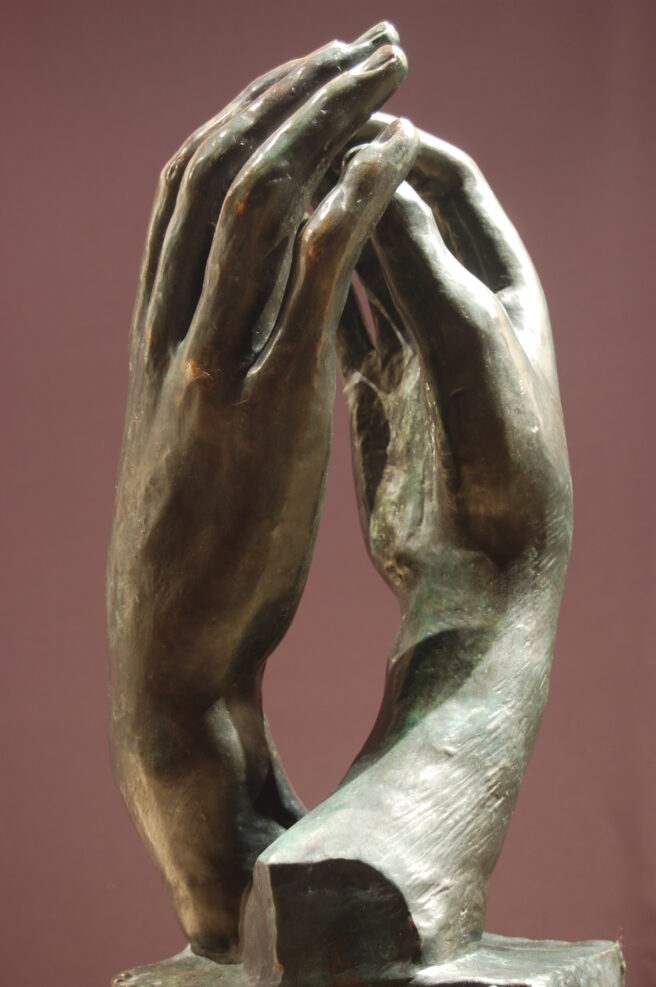
AI image generators like Midjourney or DALL-E are generally adept at capturing the accuracy of the human form. The concerns over copyright, job infringement, and general degradation of the visual arts via such AI are ongoing concerns for many artists and practitioners. However, a new New Yorker article by Kyle Chayka identifies a noticeable flaw in AI artwork: human hands. Missing the Big Picture Chayka begins by recalling an art class where he was asked to draw his own hand. It’s an assignment for beginners, and as behooves a novice, tempts the artist to focus more on the specific contours of the hand instead of the overall structure and form. The forest gets lost in the trees, so to speak. Read More ›

In the wake of the notorious ChatGPT chatbot from OpenAI, many are asking, “What’s going to happen to people who make their living as writers?” We’re talking journalists, novelists, academics, etcetera. It’s a valid question given the dexterity of the new technology. OpenAI’s DALL-E image generator poses the same question to visual artists. If a machine can generate a skillfully crafted piece of text or an image, the need for human writers and artists turns opaque. That is if we actually think artificial and natural intelligence are comparable competitors. Cynics are claiming a doomsday for writers. Sean Thomas of the Spectator thinks doomsday is upon us. He wrote in a January 10th article, I’ve done writing of all kinds Read More ›

By the very nature of collaborative work, if simple fraud for financial gain is not in question, many much harder questions remain, questions where AI might provide information that enables better judgment. But it’s hardly the stuff of “AI Is Taking Over.”
Read More ›
New AI is much more sophisticated but the old and new AI share the property that the final result is nothing more than an interpolation of the training images used to train the AI.
Read More ›
In this third part of their reflection on Yuval Harari’s Atlantic piece anticipating technology’s march toward tyranny, Jay Richards and Robert J. Marks discuss the many assumptions therein. At the root of these speculations is an overestimation of the power of information processing systems and an underestimation of the human ability to be the true governors of their creations, not their docile “pets”. Harari rightly points to a better understanding of the mind as the way forward, but fails to appreciate its true nature, resulting in a dismal prognosis for art, religion, and democracy.
Read More ›