Mind Matters Natural and Artificial Intelligence News and Analysis

CategoryPsychology

cute-artificial-intelligence-robot-with-notebook-stockpack-adobe-stock
cute artificial intelligence robot with notebook

Psychology Researchers: AI Showed Imitation, Not Innovation

Testing children and adults against chatbots, the researchers found that the chatbots could match things up but struggled to solve problems on their own

As computer engineering prof Robert J. Marks puts it, AI is no more creative than a pencil. You can use it like a pencil — but the creativity comes from you.

Read More ›
a-close-up-handshake-between-a-doctor-and-a-patient-in-a-medical-office-with-clean-stockpack-adobe-stock
A close - up handshake between a doctor and a patient in a medical office with clean

Do Scientists Need to Learn to Lie More Believably?

As public trust in science diminishes, one serious proposal that scientists should manipulate our beliefs for our own good

Why should we believe what materialists say anyway? Generally, the sciences whose ultimate message is meaningless void-ism are running aground.

Read More ›
Independent Thinking

The Free Will Debate Really Heated Up This Year

Many commentators are weighing in; surprisingly, perhaps, well-known materialists are disputing the claim that there is no free will

Given that both Pinker and Horgan are Darwinian materialists, their coldness toward the idea that there is no free will is worth keeping an eye on.

Read More ›
robot-machine-cyborg-droid-android-artificial-intelligence-ai-computer-chatgpt-technology-internet-technology-advanced-digital-circuit-futuristic-network-light-communication-inform-stockpack-adobe-stock
Robot, Machine, Cyborg, Droid, Android, artificial intelligence, AI, computer, chatGPT, technology, internet, technology, advanced, digital, circuit, futuristic, network, light, communication, inform

Exopsychology: The Psychology of No One We Ever Knew

The academic attempt to establish a psychology of alien intelligences — for whose existence we have no evidence — tells us something about ourselves

Many people have a hard time accepting the fact that we may never know if we are the only intelligence in the cosmos. Unusual psychologies may result.

Read More ›
brain flowers water
brain made from water and flowers on pastel background concept art, photo, Shot on 65mm lens, Shutter Speed 1 4000, F 1.8 White Balance, 32k, Super-Resolution, Pro Photo RGB, Half rear Lighting, Backl

The Left and Right Brain Both Want Pop Science Media to Chill

Neuroscience is not an especially rewarding field for the pursuit of dogma

The risk with neuroscience that tries to encompass Mozart is not that we will know nothing but that we will know just enough to get it all wrong.

Read More ›
aerial-perspective-of-a-crop-circle-with-mathematical-symbols-stockpack-adobe-stock
aerial perspective of a crop circle with mathematical symbols

Does Deep Social Change Underlie the War on Math?

Why is the universal language of science sinking under the weight of claims about trauma and privilege?

Ours is an age of private truth but math and science both took hold in ages of public truth. Neither of them can survive private truth for long.

Read More ›
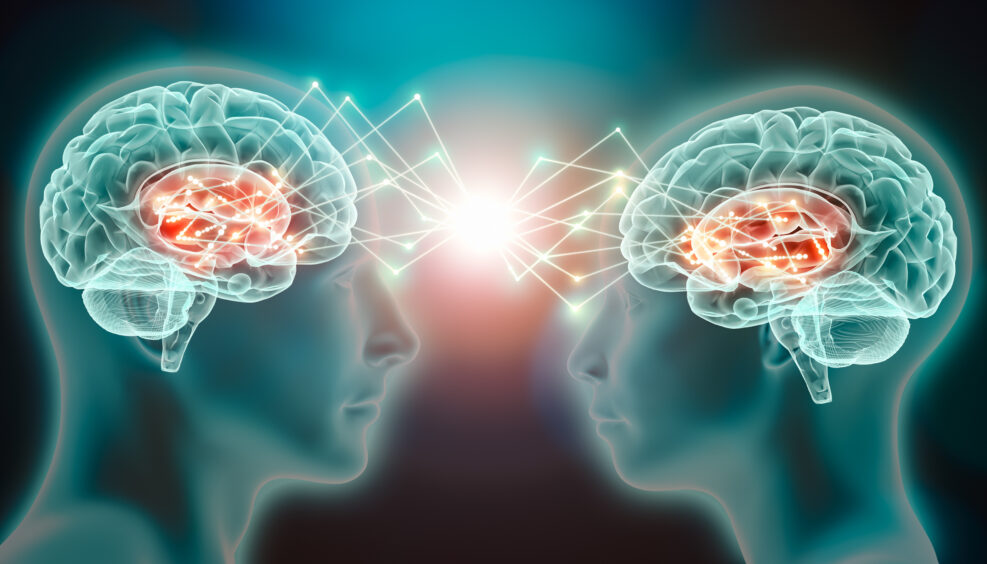
love-emotion-or-empathy-cerebral-or-brain-activity-in-caudate-nucleus-interaction-and-connection-between-two-people-conceptual-3d-illustration-of-interactive-neurological-stimulation-or-telepathy-stockpack-adobe-stock
Love emotion or empathy cerebral or brain activity in caudate nucleus. Interaction and connection between two people. Conceptual 3d illustration of interactive neurological stimulation or telepathy.

When You Sync With Someone, Your Brains Wave Together

Neuroscientists have found that co-operation results in brain wave synchrony

At Scientific American, Lydia Denworth brought up an interesting topic earlier this month: The way that brain waves synchronize between two people who are communicating successfully: Neurons in corresponding locations of the different brains fire at the same time, creating matching patterns, like dancers moving together. Auditory and visual areas respond to shape, sound and movement in similar ways, whereas higher-order brain areas seem to behave similarly during more challenging tasks such as making meaning out of something seen or heard. The experience of “being on the same wavelength” as another person is real, and it is visible in the activity of the brain.” – Lydia Denworth, “Brain Waves Synchronize when People Interact,” Scientific American, July 1, 2023 For example, Read More ›

twin-african-girls-are-interested-and-playing-kalimba-or-thumb-piano-acoustic-music-instrument-from-africa-twins-little-african-girls-with-her-braided-hair-african-hair-style-stockpack-adobe-stock
Twin African girls are interested and playing Kalimba or Thumb Piano acoustic music instrument from Africa, twins little African girls with her braided hair, African hair style

That “Mirror Image” Myth About Identical Twins… What Happened?

Researcher of identical twins hoped to prove that Genes Rule! But there were ethics slippages along the way

For some decades, we heard claims from studies of identical twins (formed when one fertilized egg splits) that everything from exam results to homosexuality might hinge on genetics. Therefore, any similarity in later choices or behavior might be due to genetic factors (read “predetermined” or “inevitable” here). How has that assumption held up, especially in the age of genome mapping? Identical twins comprise roughly 1 in every 250 births. Studies of twins who were separated at birth, have been especially prized because the twins were assumed to grow up in different environments. Thus any significant similarities pointed to genetic influences. Several problems emerged though. For one thing, what about the assumption that separation at birth means that twins experience different Read More ›

mannequin narcissus
white man mannequin with broken crack reflection mirror in crime or violence scene

The “Conscious Machine” Is Just Real Enough to Scare People

The ancient Greek hunk Narcissus could tell us about the risks — if he hadn’t been turned into a daffodil…

Theologian and philosopher David Bentley Hart turns to an ancient folk tale to explain the danger of coming to believe that artificial intelligence is real human intelligence. Narcissus, as he tells us, was a young Greek hunter who fell in love with his own reflection in still water. He was entranced by the image but frustrated by the fact that it never did anything he didn’t do himself. He pined away and was eventually transformed into a flower — still called narcissus today. His name also found its way into psychology as a term for extreme self-absorption, narcissism. And that’s where Dr. Hart fears that an attraction to AI products as “machine selves” is taking us. While we’ve always been Read More ›

hands-of-a-man-tearing-a-piece-of-paper-with-inscription-free-will-stockpack-adobe-stock.jpg
Hands of a man tearing a piece of paper with inscription free will

Free Will: What Are the Real Reasons to Believe in It?

Some say that free will might be a useful delusion but neuroscience provides sound reasons to believe that it is real.

University of Missouri psychology professor Kennon Sheldon’s message is neatly summed up in an opening statement: “Regardless of whether humans do or don’t have free will, psychological research shows it’s beneficial to act as if you do”. The author of Freely Determined: What the New Psychology of the Self Teaches Us About How to Live (Basic Books, 2022) responds to philosophers who say that we do not have free will: All my life, I’ve struggled with the question of whether humans have ‘free will’. It catalysed my decision to become a psychologist and continues to inspire my research to this day, especially as it relates to the kinds of goals people set for themselves, and the effects of goal-striving on Read More ›

iguana-eye-stockpack-adobe-stock
Iguana Eye

Look Out! The “Reptilian Brain” Is Still Here!

Many psychology students are subjected to this day to an exploded pop neuroscience myth endorsed by celebrity scientist Carl Sagan

Do we have a three-part brain — reptilian, mammalian, and human? Curiously, psychology textbooks teach us that we do and neuroscience studies teach us that we don’t. Who to believe? And how did that happen anyway? In the 1960s, Yale University physiologist and psychiatrist Paul D. MacLean (1913–2007) offered the triune brain theory. On that view, the reptilian brain (brain stem) controls things like movement and breathing; the mammalian brain controls emotion (limbic system); and the human cerebral cortex controls language and reasoning (neocortex). That might have been just another theory except that it was widely promoted by celebrity astronomer Carl Sagan (1934–1996) in his book, The Dragons of Eden (Random House, 1977). Praised in The Atlantic as “a rational, Read More ›

old-man-painting-stockpack-adobe-stock
old man painting

Sparks and Flashes of Remembrance

An expert in memory-loss treatment recalls some tender stories about memory in the midst of forgetfulness

In a recent Mind Matters podcast episode, neurosurgeon Michael Egnor (Mike), a frequent contributor to the site, interviewed friend and colleague Stephen Post, an expert in memory-loss-related disorders. Here’s a snippet of their conversation, which you can enjoy in full by following this link. Mike Egnor: So to begin, your new book, Dignity for Deeply Forgetful People, why did you use that title and what do you mean by deeply forgetful people? Stephen Post: Well, that’s a fabulous question to begin with because the title doesn’t quite say it all, but it’s close. I’ve been working with deeply forgetful people and their caregivers since I went out to Case Medical School in 1988, and I have never felt comfortable with Read More ›

doctor-helps-get-up-sick-elderly-patient-stockpack-adobe-stock
Doctor Helps get up . Sick . Elderly Patient.

When It’s Not Clear If a Disorder Is From the Brain or the Mind…

Neurologist Andrew Knox explains to Robert J. Marks that some psychological problems appear as if they were brain problems — yet there’s nothing wrong with the brain

In the podcast released last Thursday, Walter Bradley Center director Robert J. Marks interviewed pediatric neurologist Dr. Andrew Knox from the University of Wisconsin School of Medicine and Public Health on “Ways the brain can break” (#220, January 5, 2023). What follows is Part 4 of the discussion, “When it’s not clear if a disorder is from the brain or the mind…” Here are Part 1: How our brains are — and aren’t — like computers, Part 2: What is happening when children have strokes or dementia signs?, and Part 3: How do strokes, dementia offer insight into how the brain works? https://mindmatters.ai/wp-content/uploads/sites/2/2022/12/Mind-Matters-220-Andrew-Knox-Episode-1.mp3 This portion begins at roughly 25:15 min. A partial transcript and notes, and Additional Resources follow. Epileptic Read More ›

chat-bot-and-future-marketing-concept-chatbot-icon-hand-holding-mobile-phone-with-automatic-chatbot-message-screen-with-abstract-background-stockpack-adobe-stock
Chat bot and future marketing concept , Chatbot icon , Hand holding mobile phone with automatic chatbot message screen with abstract background

Let’s Call AI What It Really Is: Faux Intelligence

Gary Smith at Salon: While GPT-3 can string words together in convincing ways, it has no idea what the words mean

Pomona College business and investments prof Gary Smith warns Salon readers not to be too gullible about what human-sounding chatbots really amount to. He notes that in the 1960s, a pioneer chatbot called ELIZA convinced many psychiatric patients that they were interacting with a real psychiatrist. The machine simply repeated back their statements as questions, a popular psychiatric technique at the time because it generated more and more discussion — from the patient. The patients’ belief that they were interacting with a human being came to be called the Eliza effect. Has much changed? If you play around with GPT-3 (and I encourage you to do so) your initial response is likely to be astonishment — a full-blown Eliza effect. Read More ›

depression-and-sadness-concept-artwork-stockpack-adobe-stock
Depression and sadness concept artwork

Is Depression an Altered Global State of Consciousness?

Cecily Whiteley and Jonathan Birch from the London School of Economics and Political Science argue that altered consciousness prevents depressed people from just "seeing the bright side"

PhD student Cecily Whiteley and philosophy prof Jonathan Birch, both of the London School of Economics and Political Science, think that depression is often misunderstood. In this 2021 article, noted again at Psyche, they point out that it is not just “feeling low”; it is an altered form of consciousness: The psychologist Andrew Solomon hints at some of these transformations in his memoir The Noonday Demon (2001): “When you are depressed, the past and future are absorbed entirely by the present moment, as in the world of a three-year-old. You cannot remember a time when you felt better, at least not clearly; and you certainly cannot imagine a future time when you will feel better. Being upset, even profoundly upset, Read More ›

evolution-theory-on-old-paper-stockpack-adobe-stock
Evolution theory on old paper

When Scholars Simply Don’t Want To Believe Something Obvious…

… they are very good at developing clever arguments to avoid seeing it

This article was originally published in Salvo 62 (Fall 2022) under the title “The Whitewashing.” In Hitler’s Ethic: The Nazi Pursuit of Evolutionary Progress (Palgrave Macmillan, 2009), University of California historian Richard Weikart demonstrated painstakingly that the Nazis had developed an ethic based largely on applying Darwinian evolution principles to government. Scholars have since tried hard to obscure the connection, most likely because they believe in Darwinism and see it as science. Any suggestion that the Nazis were avid Darwinists too is unseemly and must be refuted by any and all means. With racism very much in current news, Weikart has focusing in Darwinian Racism: How Darwinism Influenced Hitler, Nazism, and White Nationalism (Discovery Institute Press, 2022) on the way Read More ›

dog-does-trick-for-treats-stockpack-adobe-stock
Dog does trick for treats

Researchers: Dogs Evaluate How Competent Humans Are

Provided that a treat is involved. Females pay more attention to competence in humans than males, they say

At Scientific American’s “60-Second Science” podcast (with transcript), science writer Karen Hopkin interviewed Kyoto University psychologist Hitomi Chijiiwa on her team’s recent finding that female dogs actively evaluate human competence. Because one their previous studies showed that dogs avoid people who refuse to help their human friends, the team decided to also test whether dogs form judgments about people based on their apparent skilfulness or competence: Chijiiwa: We showed 60 dogs two persons manipulating transparent containers. One person is competent. Hopkin: That person was able to pop open the top after just a couple of twists. Chijiiwa: Whereas the other person is incompetent and they failed at this task. Hopkin: That person tried to open the lid, then gave up. Read More ›

sign-requesting-no-profanity-stockpack-adobe-stock
sign requesting no profanity.

Researchers: Profanity Has Some Elements of a Universal Language

They found that, in a number of languages, profanity omits certain sounds and stresses others

In a study, researchers found that, across different languages, swear words tended to lack soundssuch as l, r, and w: Shiri Lev-Ari and Ryan McKay from Royal Holloway, University of London conducted a pilot study with speakers of five unrelated languages (20 individuals per language) and asked them to list the most offensive words they knew in their language, excluding racial slurs. The initial study revealed that swear words were less likely to include approximants, which include sounds like l, r, w and y. The authors suggest that approximants may be less suitable than other sounds for giving offense and investigated this in two further studies. Springer, “The universal sound of swearing across languages” at Eurekalert (December 5, 2022) The Read More ›

annoyed-black-woman-having-video-chat-on-smartphone-at-home-stockpack-pexels
Annoyed black woman having video chat on smartphone at home

Sorry! I Take It Back (But Only With iOS 16)

The new iOS lets you edit messages, but only within 15 minutes of sending them, and guess what—the recipient can see all your edits…

This article by Texas State University engineering prof Karl D. Stephan is republished with permission from MercatorNet November 1, 2022) Everybody has said something they later regret saying. If the person you’re talking to is right there in front of you, there’s nothing you can do to unsay it. As country singer Jon Langston says in one of his song titles, “I Can’t Take Back Words.” But according to tech guru Kim Komando, the new iOS 16 operating system for iPhones (version 8 and later) lets you do that with text messages—sort of. Ever since commercial text messaging became available on mobile phones in the mid-1990s, it has shared with verbal interchanges the fact that once you send a text, it’s Read More ›

press-and-media-camera-video-photographer-on-duty-in-public-new-stockpack-adobe-stock
press and media camera ,video photographer on duty in public new

Polls: Trust in Mainstream U.S. Media Still in Free Fall

Both the New York Times poll and Gallup poll illustrated that this week

A Canadian commentator has noticed a little-publicized fact about last week’s New York Times–Siena College poll of 792 registered voters. While the poll focused on the US mid-term elections next month, the information about how typical voters view mainstream media was most revealing. A majority not only don’t trust media but see them as a threat to democracy: A New York Times-Siena College poll published Tuesday found 59 percent of voters view the media as a “major threat to democracy,” while 25 percent said the press is a “minor threat” and only 15 percent said it poses no threat. The divide fell sharply along partisan lines, with 87 percent of voters who supported former President Trump in 2020 indicating they Read More ›