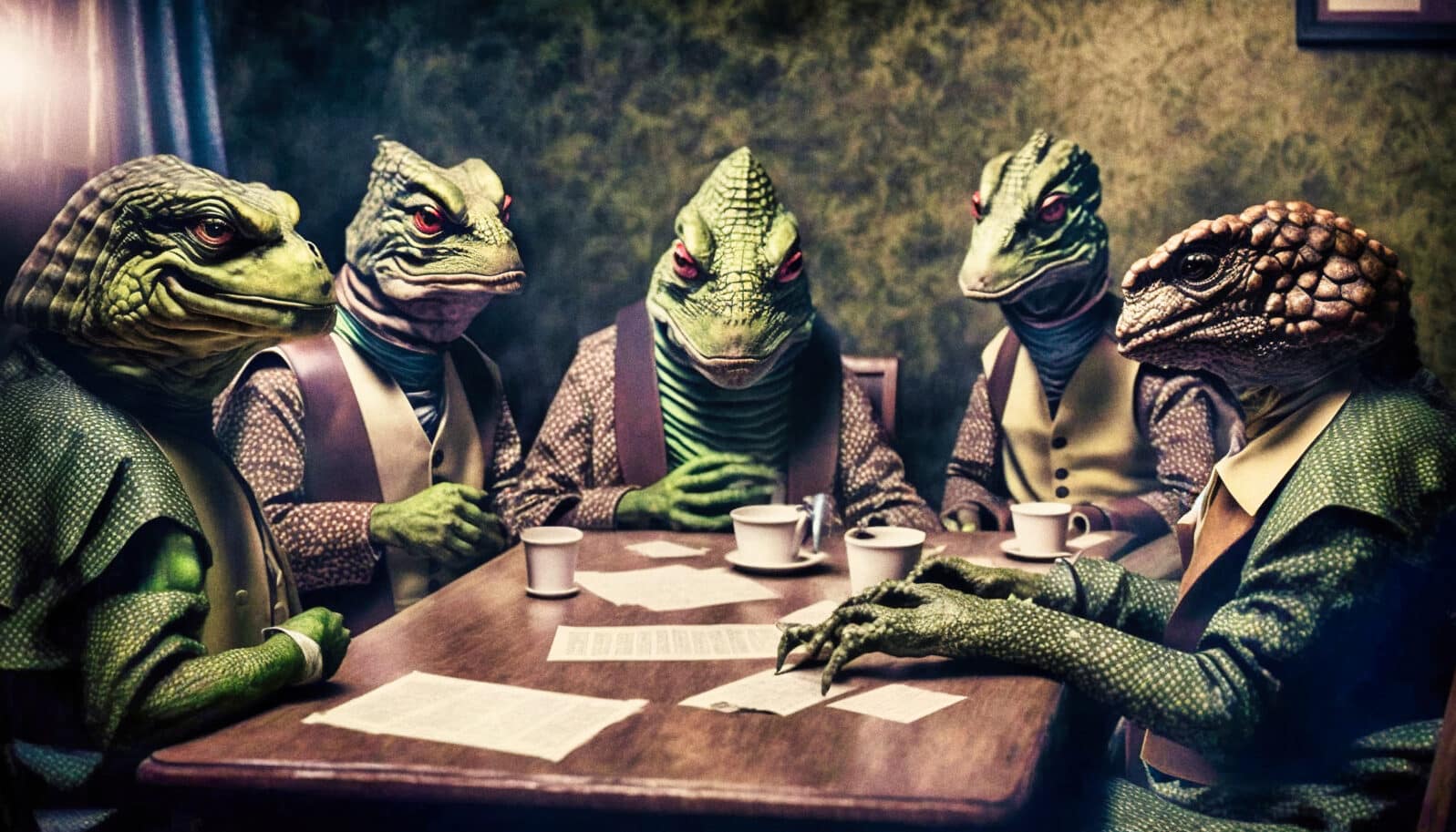
Not This Again?! The Lizard Brain Is Back? Wait. It’s NOT Back…
A useful item from Georgia Tech examines the claim that an ancient lizard brain controls our emotionsYes, the lizard brain is a staple of pop psychology. For example, did you know that your lizard brain “fuels overthinking and social anxiety”?
The claims that we have a reptilian brain underlying our human one is a staple of undergrad psychology textbooks and many other venues, probably because it feels just too good to give up.
Feeling cold-hearted? Blame your lizard brain.
Neuroscientist Paul D. MacLean (1913–2007) developed this theory in the 1960s. His 1990 book The Triune Brain in Evolution posited three successive layers of brain: the reptilian one (physiology), the early mammal one (emotion), and the late mammal one (smarts).
It’s easy to see why people might latch onto the idea of a reptilian brain as an explainer for complex topics. But the neuroscience underpinning it is just not that persuasive. A recent article in Science Advances, sponsored by Georgia Tech, helps us understand some of the issues:
Many important choices seem to pit reason against emotion. Popular culture often describes that tension as a contest between two parts of the brain: a newer, more advanced center for rational thought and an ancient “lizard brain” that runs on instinct. P But the evolutionary history of the brain appears to be far more complicated than a simple struggle between old and new.
Georgia Tech. “Scientists challenge a 70-year-old “‘lizard brain’ myth,” ScienceDaily, 31 August 2026.
Animal brains differ, the researchers found, in how much space is allotted to the neocortex (the “smarts”) and the limbic system (the “feels”), depending on practical needs:
This trade-off may help explain striking differences between real animals. The nine-banded armadillo, which depends heavily on smell, has a very large limbic system. The squirrel monkey, which relies strongly on vision, has a brain dominated by the neocortex.
Across the 182 species included in the study, the findings suggest that brain evolution is less about adding progressively newer layers of “logic” and more about shifting space between different wiring systems according to what helps an animal survive.
From the open access paper:
Nabil Imam, Matthew Kielo, Brandon M. Trude, Barbara L. Finlay. Dual computational systems in the development and evolution of mammalian brains. Science Advances, 2026; 12 (17) DOI: 10.1126/sciadv.aec6112
. We found that networks optimized for visual, somatosensory, and auditory representations develop ordered spatiotopic maps where units draw information from localized regions of the sensory input. In contrast, networks optimized for olfactory and relational memory representations develop fractured maps with distributed patterns of information convergence.
Animals, it turns out, have widely varying brains that are consistent with what the rest of their bodies need to live. And there is no simple explanation for the complexity of the human brain, possibly the most complex item in the universe.
