What Can We Learn From the Chinese Housing Bubble?
Anyone can use our theory, which has been confirmed by events in foreign real estate markets, when determining whether to buy a homeI recently argued that the correct way to assess the existence of a housing bubble is to compare market prices to the cash flow from home ownership— the savings on rent minus the mortgage payments and other expenses. By this metric, the U.S did not have a nationwide housing bubble in the mid-2000s, as often supposed. Wesley Liang and I applied a similar analysis to Chinese housing in 2019 and came to a very different conclusion.
In China, all land belongs to the state. Prior to the housing market transition, the government and state-owned entities provided living accommodations and there was no private home buying, selling, or renting. In 1998 the Chinese State Council decided to privatize the property market because housing was continuing to deteriorate under state control. This decision also was intended to establish the real estate sector as a new engine for economic growth in the aftermath of the 1997 Asian Financial Crisis.
This constitutional amendment unleashed a wave of state firms selling homes to their employees at highly discounted prices, followed by a surge in housing construction as private demand for housing escalated. In China, property developers buy “land use rights” from local governments for several decades (typically 70 years) and then construct properties to sell to the public. When land-use agreements expire, homeowners can apply for extensions. But land-use renewal contracts are expected to require fees, either a lump sum or annual payments, much like property taxes.
Along with the property-construction boom, residential housing prices increased by 81 percent between 2005 and 2019 while consumer prices increased by 44 percent. This disparity led many to argue that China was in the throes of a housing bubble. For example, in 2016 Chinese billionaire and real estate magnate Wang Jianlin warned that Chinese real estate is the “biggest bubble in history.” Some bubble skeptics countered that higher home prices could be accounted for by China’s rapid income growth and the migration of tens of millions of people to first-tier cities.
What was different in China?
In addition, China’s housing boom was very different from the U.S. boom in the mid-2000s. The latter was fueled by lax loan requirements, subprime lending, and the securitization of questionable mortgages. In 2008, more than half of all U.S. mortgages were subprime and had down payments of near zero percent.
China’s housing market does not have the same issues because there are much stricter mortgage lending standards and higher down payment requirements — 30 percent for the purchase of a first home and 60 to 80 percent for subsequent home purchases, depending on the purpose of the home.
As I argued previously, home prices are only half of what drives the bubble question. For example, the price of Berkshire Hathaway stock is very high (nearly $800,000 a share) and has increased greatly over the years. But that doesn’t mean there is a Berkshire Bubble. It is only a bubble if the stock price is not justified by Berkshire’s profits. Berkshire price‒earnings ratio is a relatively low 13.
What inflates a bubble — an example from Japan?
Bubbles are created by speculators who do not care about an asset’s income. They buy because they expect the price to keep rising. This is the Greater Fool Theory — buyers pay foolish prices, hoping to be able to sell at even higher prices to even greater fools.
 Image Credit: SeanPavonePhoto -
 To judge whether there is a residential real estate bubble, we need to compare home prices with the income from a home, which is the rent savings net of the expenses associated with home ownership. Housing bubbles occur when home prices become untethered from this income.
During the Japanese real estate bubble in the late 1980s, when apartment prices were 50 times annual rents and a small two-bedroom apartment in Tokyo sold for more than $1 million, The Wall Street Journal argued that there was little relationship between real estate prices and rents because “investors count on capital gains, not rental income, to make a profit.” Spoken like a true Greater Fool.
Various rationalizations fueled the delusion. A March 1990 front-page story in The Wall Street Journal began by quoting a Japanese real-estate agent:
The only real question is how quickly you buy property. Land will never come down. Banks are dying to lend money, so you can borrow easily. Don’t worry. If they thought prices would come down, they wouldn’t lend.
An analyst at the Long-Term Credit Bank argued that the government would not let home prices fall because most of the nation’s voters would lose money. These rationalizations ignored the reality that a real estate investment with a 2 percent cash flow before expenses doesn’t make financial sense unless prices continue to rise rapidly.
They didn’t. By April 1992, Japanese real estate prices were down 30% from their peak in downtown Tokyo and by 40 percent in Kyoto and Osaka. In July 1995 Japanese land prices were 50 to 80 percent below their peaks.
Now back to China…
In the summer of 2019, Liang and I tackled the China bubble question. In order to compare similar prices and rents, we had to find matched pairs of homes — a property that was recently purchased and an identical or nearly identical property that was recently rented.
It was hard work but we were able to find more than 400 matched pairs of apartments in Beijing and Shanghai. The table shows that these homes were typically small and expensive:
Average number Median Median Median Median Price
of Rooms Square Feet Monthly Rent Price per Square Foot
Beijing 1.75 662 $954 $707,750 $1069
Shanghai 1.64 598 $611 $409,750 $685
As in the earlier Japanese real estate bubble, apartment prices were more than 50 times annual rents, before expenses. Using plausible assumptions about home ownership expenses, we found that the implied rates of return were very low, often negative. This was true even if we did not take into account that homeowners are likely to be subject to substantial land-use renewal fees. We concluded that
the Beijing and Shanghai housing markets are in a bubble, where market prices are significantly above intrinsic values. We should not anticipate continued double-digit annual increases in real property prices; if they do occur, the Chinese real estate bubble will become even larger and more ominous.
However, we also speculated that
the possible consequences of a housing crash in China are so frightening that the Chinese government is unlikely to stand by and let it happen. The real estate market is too big to fail….If the air begins leaking out of the bubble, the government is likely to intervene through laws, regulations, or outright purchases to prevent a collapse. The Chinese real estate bubble will most likely end with a whimper, not a bang.
Since we did our research, Chinese real estate prices have been deflating, particularly in China’s first-tier cities, and the Chinese government has used a variety of policies to stabilize the market. The figure shows an index of inflation-adjusted residential property prices in China compiled by the Bank for International Settlements. These data are not as reliable as U.S. data but they confirm our conclusion that Chinese home prices were bubbly in 2019:
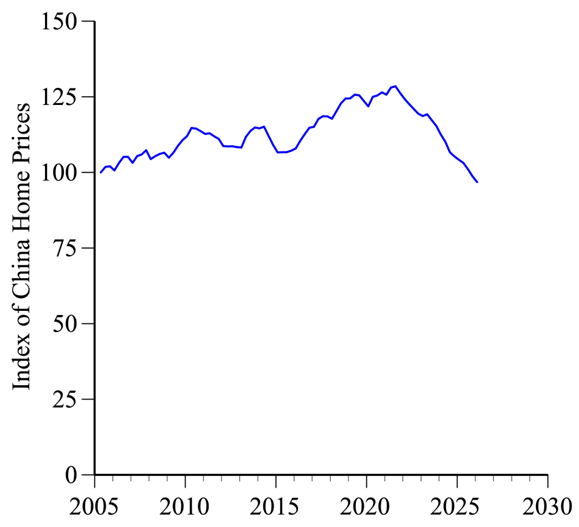
Again, a compelling theory was confirmed by events. Even better, it is a theory anyone can use when deciding whether to buy a home.
