Pooley on Superabundance and the Time Price Revolution
We live with more and work less than ever beforeHow human knowledge and the “time price revolution” have led to an era of unprecedented abundance.
Read More ›How human knowledge and the “time price revolution” have led to an era of unprecedented abundance.
Read More ›
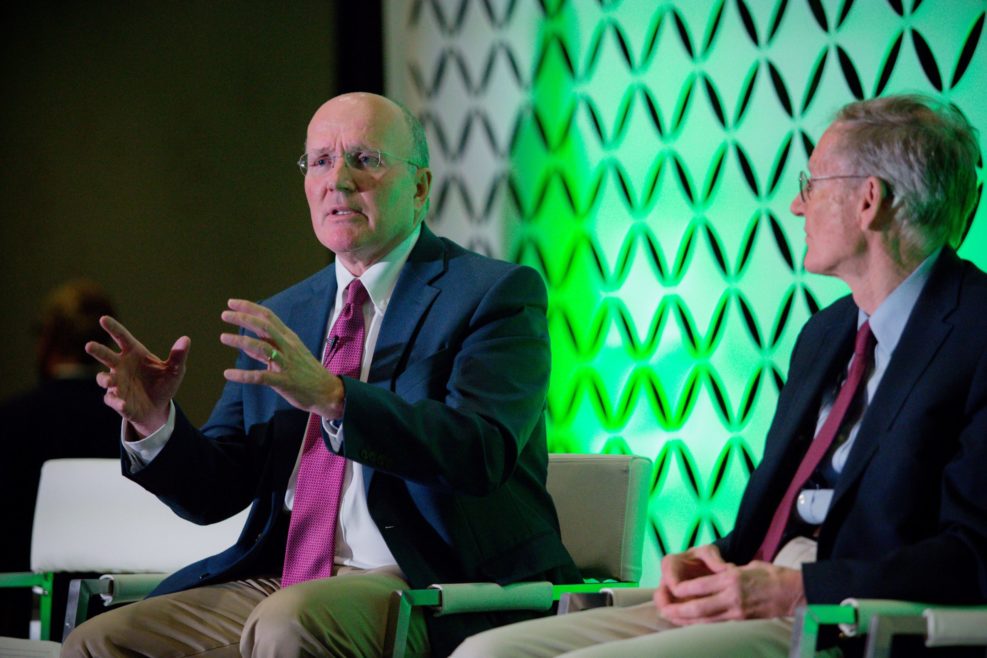
Countering the prevailing narrative of doom, economist Dr. Gale Pooley shows how the incredible power of learning curves has instead brought about an era of unprecedented abundance. Based on his research into time prices (the money price divided by one’s hourly income), Pooley demonstrates that virtually every commodity is substantially cheaper today than it was decades or centuries ago. We are truly in a time-price revolution. We’ve been sharing a number of lectures from past COSM conferences. This video is just one of many you can find at the Bradley Center’s YouTube page. There you’ll find several lectures, interviews, and panels dealing with issues that range from economics, Big Tech, and artificial intelligence. Notable speakers include 2022 Kyoto Prize winner Read More ›

We’ve cited the groundbreaking book Superabundance several times here at Mind Matters, mainly in connection to its co-author, Gale Pooley, a Senior Fellow of Discovery Institute’s Center on Wealth & Poverty, and a speaker at the 2021 COSM conference, the yearly technology summit that has attracted speakers like Carver Mead, Peter Thiel, and others. Pooley’s co-author, Marian Tupy, who lectured at COSM 2022 on the book, does work on human progress at the Cato Institute, and published a post showing the many ways humanity has benefitted over the last century. He stands opposed to the mainstream approximations of doom that declare our world’s swift-approaching expiration date, writing, The chance of a person dying in a natural catastrophe — earthquake, flood, Read More ›

The idea that the higher the human population the scarcer earth’s resources become is prevalent and mainstream. It is behind many of the doomsday alarmist calls for population control and influences much of economic theory and practice. But what if it’s wrong? Marian Tupy, co-author with Gale Pooley of the 2022 book Superabundance: The Story of Population Growth, Innovation, and Human Flourishing on an Infinitely Bountiful Planet, offers a different account. The earth’s resources and innovation actually increase the more people there are on the planet. Bringing their innovation and creativity to the table, joined with earth’s resources, humans find ways to create “superabundance.” Marian Tupy spoke at the COSM Conference back in November 2022, and his lecture on his Read More ›

At COSM 2021, business studies prof Jay Richards of the Catholic University of America spoke with Gale Pooley, also a business studies prof at Brigham Young University-Hawaii, on a fact we don’t hear much about in popular media focused on current events: Increasing knowledge and the subsequent dropping over of time prices have ushered in a vast improvement in standards of living. Many will ask, what about rising prices? Well, for example, we must compare rising prices due to various global events today to what things cost in the past: At COSM 2021, Pooley focused on the fact that, in real-world economics, the value of our time is the most critical factor we need to figure in: Brigham Young University Read More ›

Brigham Young University business prof Gale Pooley figures that not only does time drive the bus but economics is much easier to understand if we take that fact seriously. That was one key point in his wide-ranging talk at COSM 2021 yesterday, “Knowledge vs. Doom.” As we all struggle with inflation, it’s worth looking at the money we earn simply from the perspective of how much of our time was spent earning it: “Money is time” essentially means that we buy things with money but we really pay for them with our time. Instead of dollars and cents, we can use hours and minutes to price things. We can use “time prices.” As he told the audience, Yale University economist Read More ›

COSM 2021 is fast approaching. On the weekend of November 10-12, titans of the tech world will descend on Bellevue, Washington, to discuss the future of technology. Topics to be covered include blockchain, NFTs, quantum computing, artificial intelligence, and Big Questions like “Is Technology Soaring or Slumping?” This year, COSM will include Discovery Institute’s own Gale Pooley, senior fellow at the Center on Wealth & Poverty. This isn’t Pooley’s first round at COSM. He addressed the COSM crowd in 2019 with a talk entitled, “Killing Thanos – Defeating the Ideology of Scarcity” (video posted at the end of this article). This November, Pooley’s topic is “The End of Inflation.” The economics professor has spent his career lifting our spirits about Read More ›

Recently, Jay Richards interviewed Dr. Gale Pooley, Professor of Economics at BYU-Hawaii, on the myth that we are running out of resources and doomed to future scarcity. Even though media pundits often claim it is true, the numbers say it is a myth. The story begins with a famous bet between two professors… From the interview: The bet was whether basic commodity prices would rise between September 29, 1980 and September 29, 1990. The professors who made the bet were Stanford insect biologist Paul Ehrlich (1932–), author of bestseller The Population Bomb (1968), and economist Julian Simon (1932–1998) Ehrlich bet yes and Simon bet no. Gale Pooley: First of all, what was interesting about Julian Simon, he reads Ehrlich’s book Read More ›