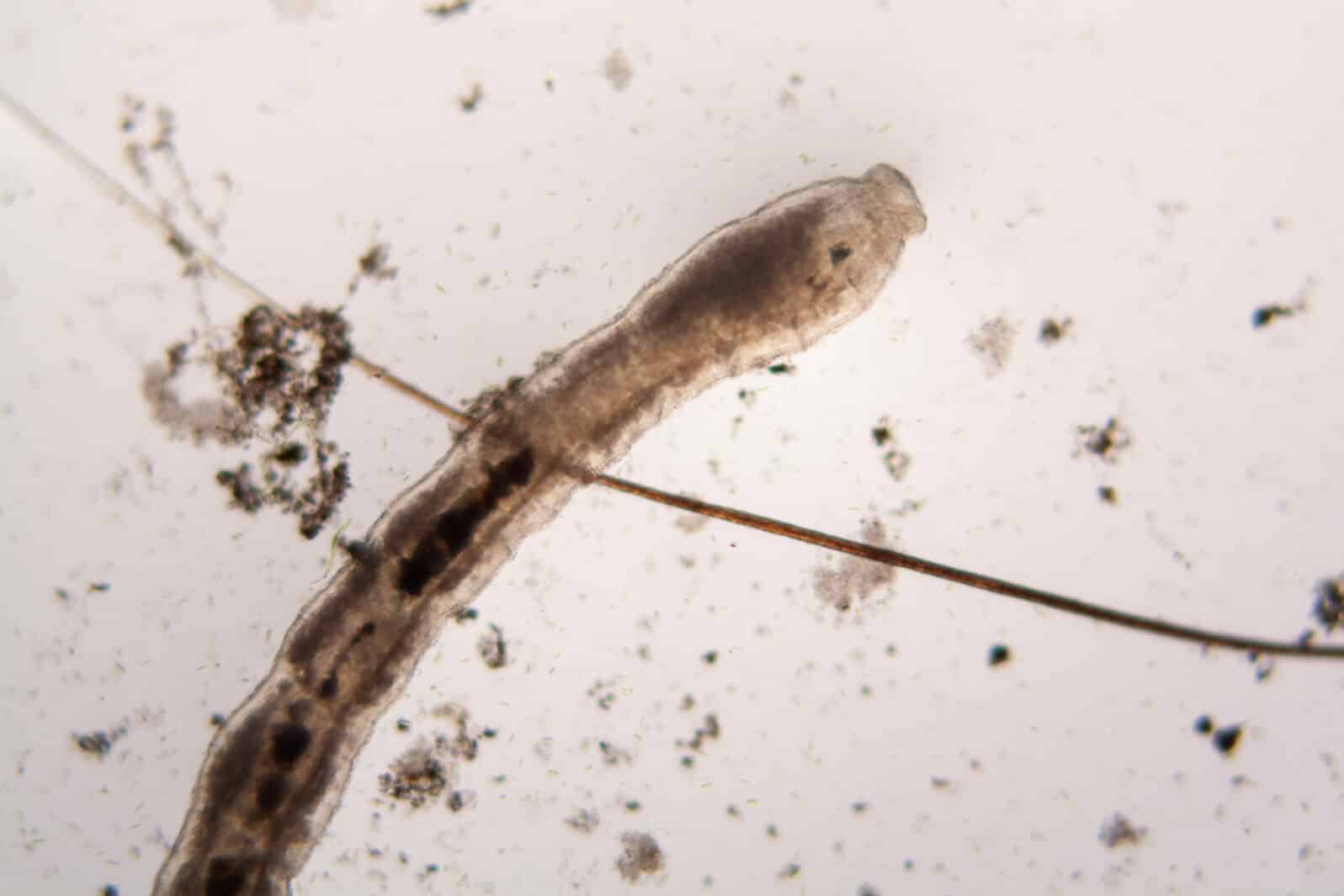
Even a worm’s brain proves hard to explain
At New Scientist, Karmela Padavic-Callaghan reports
Comparing a map of the neurons in a nematode worm – the connectome – with a map of how signals travel across those neurons has revealed a surprising number of differences, suggesting that the structure of the brain alone doesn’t explain how it works
“Mapping the structure of the brain doesn’t fully explain its function,” September 23, 2025
The nematode worm is chosen for this sort of research because it has roughly 300 neurons. Thus the neurons can be more easily tracked than, say, those of a mouse which has 70 million brain neurons alone. The researchers stimulated each worm neuron and tracked the way its signal moved through the connectome (a map of the nervous system).
[Sophie] Dvali says that there were some examples of overlap for high connection density and signal exchange, such as for groups of neurons responsible for how the worm eats, where the two networks matched really well, or neurons involved in how it moves backwards, which is an important manoeuvre for a worm escaping danger. In the latter case, the neurons were very connected in both networks though not in an identical way. But, more generally, there were enough discrepancies that the team says the connectome of an organism isn’t enough to predict all of its behaviour.
Team member Andrew Leifer, also at Princeton University, says that the difference may be because signals between neurons don’t always take the shortest path, and there are also known cases where neurons can communicate in ways beyond the “wires” that connect them. “We’re used to using the connectome for guiding our research, and often it’s very helpful and informative, but in many cases there’s so many connections that we wished we had more information,” he says. “Doesn’t fully explain”
The paper is open access.
Almost no one thinks that much underlies the nematode brain. But if even its brain proves a challenge to account for quickly in simple materialist terms, consider the human brain, which contains about 86 billion neurons intersecting with an immaterial mind.
Re the human brain, pioneer neurosurgeon Wilder Penfield (1891–1976) famously concluded in Mystery of the Mind, (1975), after many thousands of operations and much philosophical reflection, “The brain has not explained the mind fully.”
