
Is The AI Bubble Really Popping Now?
The bond (and stock?) market says yesI realized years ago that many different skills were required to understand AI’s impact on the economy and to make it work. Some people understand the technical aspects of AI while others understand how to use it to write code or articles, or produce pictures or videos. Other people are good at implementing AI in organizations.
What constitutes a bubble?
In my own work, I have focused on the economics of AI, its different applications, how improvements change the economics, and what constitutes a bubble.
Bubbles are complicated because almost every bubble is different. Unlike the 1929 or even the 2000 dotcom bubble, the AI bubble involves a small number of companies in a simple value chain in which the end users only get value if the use of the AI models improves corporate or individual productivity. Those models are processed by data centers that are comprised of many types of semiconductors including Nvidia’s GPUs.
Don’t focus on Nvidia
Many investors focus on Nvidia and other semiconductor companies (and the so-called hyperscalers who manage the data centers) because they are the most profitable and they are publicly traded companies that release audited income statements. These companies purportedly enjoy unlimited demand. But that demand is mostly for chips, particularly Nvidia’s chips, something that can’t be eaten, driven, or lived in. The uncomfortable fact is that Nvidia’s GPUs mostly provide value in combination with something else such as AI models so we should obviously focus on the demand for the AI models.
A key question is how much demand there is at a price that covers the cost of processing the AI models. The AI labs, such as Anthropic and OpenAI, have mostly set prices far below their costs. Thus many claim there is unlimited demand when, of course, big demand only exists when the price is set very low. That leads to huge losses for the AI labs.
But what happens when those prices do cover the costs? There were a few months in early to mid-2026 when the AI labs raised prices, thus profits seemed possible. But then the Chinese models increased their market share and the AI labs cut their prices again. Thus, their losses continue to be large, despite Anthropic’s claims about “adjusted profitability.”
My definition of a bubble is very simple

A bubble exists when companies are valued privately or publicly higher than their future profits warrant. There are of course no profits for the AI labs so investment people have been forced to look at revenues and at how many revenues are needed to justify the investments in data centers, assuming that profitability can eventually be achieved.
Jim Cavello of Goldman Sachs started the public side of this argument in 2024. Assuming 50% margins, those calculations suggest that almost $1 trillion in revenues are now needed ($2.5 trillion by 2031). But the AI labs only have about $100 to $200 billion depending on which numbers you believe.
Many AI skeptics such as myself have pushed this argument for years and I have wrongly believed that at some point in time investors will believe it and start selling shares. One reason for my mistaken opinion is something Nobel Laureate Robert Shiller emphasizes in his award-winning publications, including Irrational Exuberance (2000). He claims that a narrative emerges to explain the growth of the bubble and later to explain the deflation of the bubble. But what happens during the change in narrative?
Determining that AI is a bubble and determining when it pops are two different questions.
The bond market behaves differently from the stock market
This brings me to the final key skill, one that I admit that I probably still don’t have. I am talking about movements in stock and bond prices. What I have learned over the last year is that the bond market identifies over-valued companies and the risk of a bubble long before the stock market does. That is because the bond market is concerned with the risk of default, unlike the stock market that is mostly concerned with potential profits.
And over the last year, the bond market has identified the risk of default and raised the interest rates for many AI-related companies, particularly for Oracle, Softbank, and the neo-clouds, and less so for the hyperscalers. Oracle operates data centers, Softbank has been a big investor in OpenAI, and CoreWeave and Nebius are so-called neo-clouds that rent out GPU time to those who want to process their AI models. Whereas the AI labs commit to most of the output from a new data center built by hyperscalers, neo-clouds rent GPUs in smaller increments.
Those interest rates spiked suddenly in the last few months and then again in the last few weeks, sparking a recent decline in stock prices for not only Oracle, Softbank, CoreWeave, and Nebius, but for semiconductor suppliers and hyperscalers. CoreWeave’s interest rate now exceeds 16% (and Anthropic’s rate exceeds 10%). These are very high rates and it is unlikely that these companies can escape them because even Nvidia or Broadcom do not have enough money. Thus, they may be caught in a death spiral in which some form of recapitalization, e.g., bankruptcy, will be necessary.
Which company’s bankruptcy will spark the fire?
Such a recapitalization will likely lead to problems for many other companies, including investors (remember Situational Awareness), suppliers and customers — particularly in a small industry with so much circular financing. Furthermore, such a recapitalization would likely cause investors to become concerned with other debt-ridden companies and thus sell those stocks.
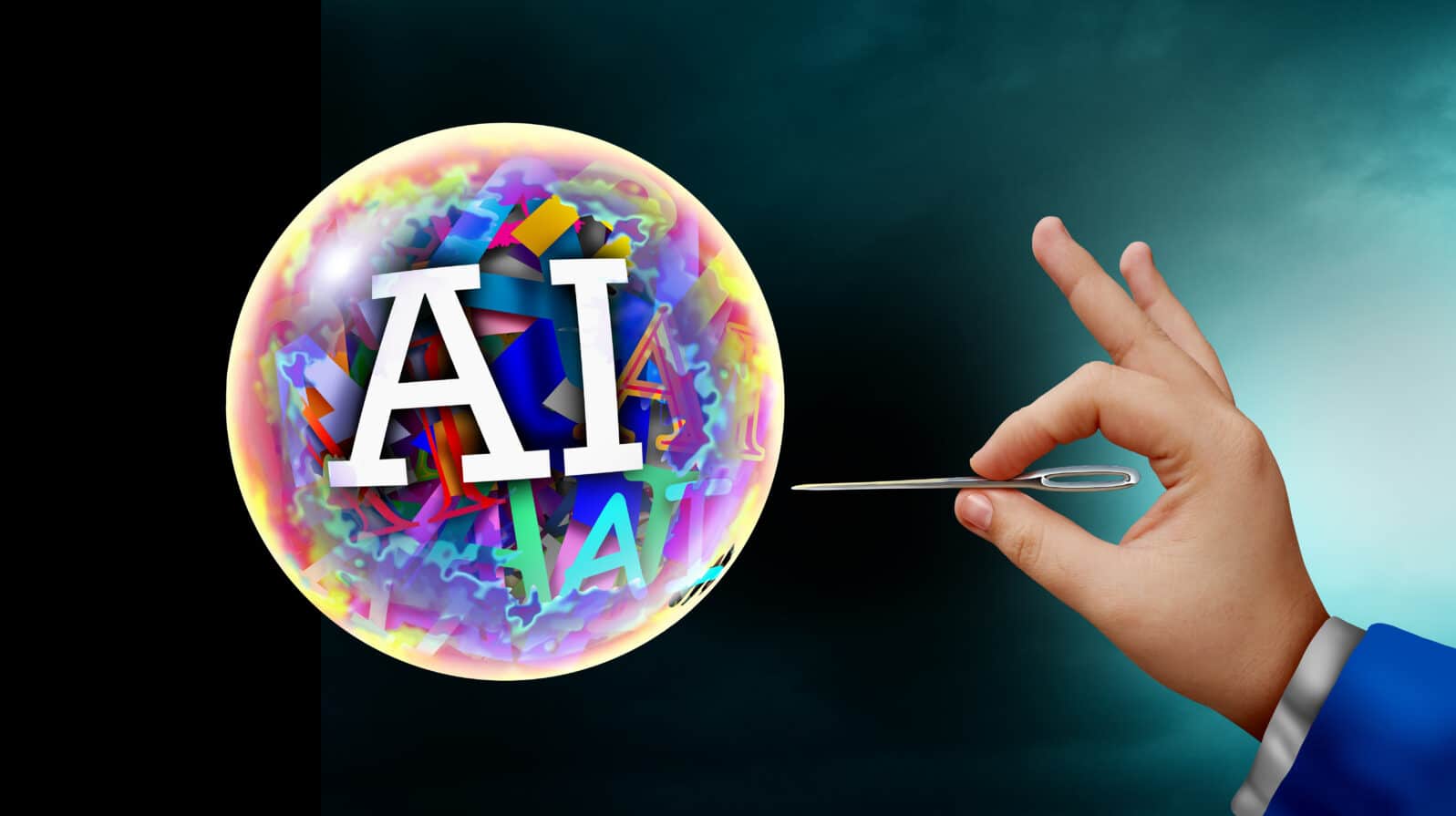 Image Credit: freshidea -
For one thing, many point to the recent cancellation of the IPO for Firmus Technologies, another neo-cloud, as one reason for the recent spike in interest rates for CoreWeave from 12% to 15%. By the way, I don’t claim to understand all the causal linkages and sorting them out will take years.
Nevertheless, it is the increases in these bond yields that are likely increasing the chances of the bubble popping, not a new narrative that has emerged from a debate within the AI industry, the media, and elites. A good debate is needed, and a new narrative is emerging. But that is probably not the biggest cause of the recent share price declines; rather, it is a result of them.
Instead, it is mostly financial fear that will likely cause investors to sell their shares in AI companies, as they realize that they could lose everything if the bubble completely pops and the government doesn’t bail them out, as it did in 2008. Some readers will remember that the 2008 bubble did not pop until after the forced sale of Bear Stearns in March 2008 and declined further following the bankruptcy of Lehman Brothers in September 2008. The question is still open: Which bankruptcy (Softbank, Oracle, CoreWeave, Nebius) or failed IPO (Anthropic or OpenAI) will completely pop the bubble?
