COSM 2026: Tackling a Big Question — What Makes a Mind?
AI has turned an old philosophical question into an urgent one. A COSM 2026 panel will feature the claim that the mind is like a computerFor most of history, the question “What makes a mind?” belonged to philosophers. And then one day, machines started talking back. A chatbot today can draft a sermon, explain a proof, or tell you it understands how you feel. Whether anything stands behind those words is no longer an academic puzzle. It shapes how we build these systems, how we use them, and how we think about ourselves.
At COSM 2026 in Scottsdale, Arizona, on Thursday, November 19, at 11 a.m., I’ll moderate a panel on exactly that question. Our panel features Gaurav Suri, a computational neuroscientist and associate professor of psychology at San Francisco State University, and Jay Richards, a philosopher and senior fellow at Discovery Institute.
Over the next two weeks, I’ll be preparing for that conversation here via a short series built around Suri’s recent book, co-authored with Stanford cognitive psychologist Jay McClelland, The Emergent Mind: How Intelligence Arises in People and Machines (Basic Books, 2025)
A book worth engaging
Suri and McClelland state their case plainly. “Interactions between neurons are the engine of the mind,” they write. Perceiving a face, worrying about missing a train, and feeling an emotion are all, in their words, “patterns of activation over an ensemble of neurons in our brains.” What we know is stored in the strengths of the connections between those neurons, shaped by experience.
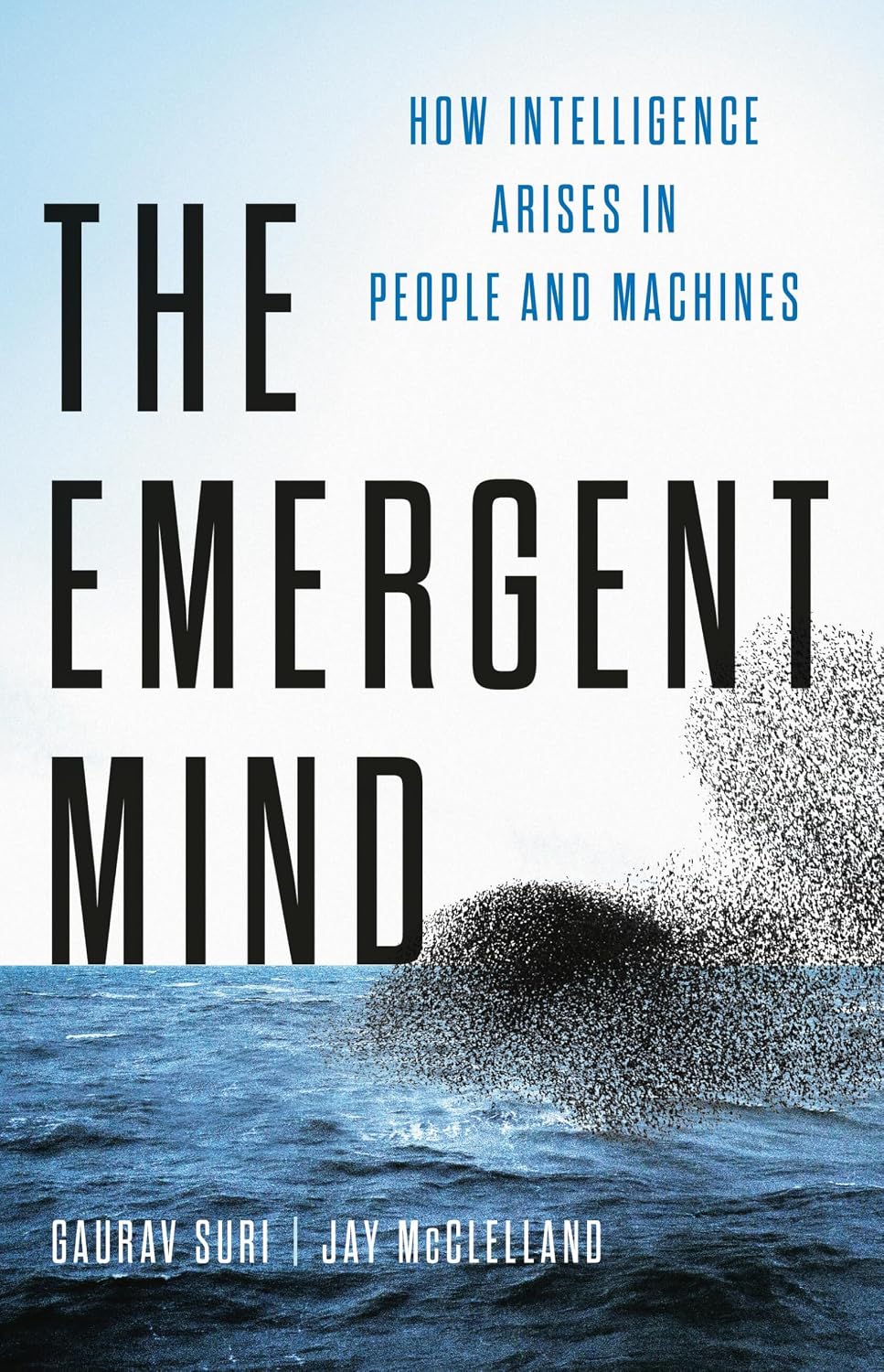 Published October 21, 2025 by Basic Books.
Today’s AI systems, they argue, are built from the same basic ingredients: artificial networks that learn by adjusting connections. Thus, the authors see human and machine intelligence as two versions of one phenomenon. Neither, they write, “relies on a touch of ineffable magic or spirit stuff.”
That doesn’t mean the authors think brains and chatbots are equivalent. By their own estimate, today’s AI learns from roughly 100,000 times more text than a person encounters in a lifetime, and the brain can’t use the learning method that powers modern AI. Even so, they argue that the similarities run deep enough that studying one helps us understand the other.
What makes the book worth reading, even for those who will disagree with its premise, is its candor. The authors don’t claim to have solved everything. They acknowledge that how humans learn so efficiently “remains a mystery,” and that understanding how neural processes produce conscious experience “remains elusive.” That honesty makes for a better conversation, because it shows exactly where the hard questions lie.
A map of the territory
To get our bearings, our panel will open with a map. The philosopher Paul Churchland’s widely used textbook Matter and Consciousness sorts the major theories of mind into a handful of families:
- Substance dualism: the mind is a non-physical substance distinct from the body. Descartes’ thesis is the classic example.
- Property dualism: only matter exists, but some mental properties are not physical.
- Behaviorism: talk about the mind is really talk about how we tend to behave.
- Identity theory: mental states simply are brain states.
- Functionalism: the mind is like software; what matters is what it does, not what it’s made of.
- Eliminative materialism: everyday ideas like “belief” and “desire” will eventually be replaced by neuroscience.
Where do Suri and McClelland land? Mostly in the functionalist family, with a twist: they insist that “the mechanisms do matter,” not just the abstract program. On consciousness, as we’ll see later in this series, the options they take seriously don’t all fit in the same box.
A question underneath the others
One question runs beneath all the others. Is the claim that thinking is purely physical a finding of the research, or its starting point? The authors are admirably direct. They “remain committed to the fundamental principle” that thinking processes in humans and machines “can be understood as physical processes.”
That is a reasonable place to begin an investigation. Whether it is also the place where it ends is a question I’ll put to both panelists in Scottsdale, and their answers will be worth hearing in person.
What’s ahead in this space
In coming articles, I’ll introduce the threads our panel will pull on, though the real exchange will happen in the room:
- whether “emergence” explains the mind or only names it;
- consciousness, and how a pattern of neural activity can be about anything;
- what today’s AI does and doesn’t tell us about minds;
- why there are minds at all;
- and what the authors’ view implies for kindness and free will.
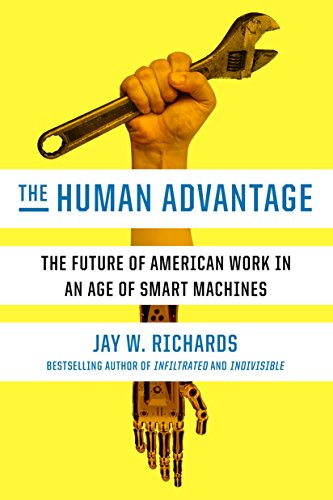
Jay Richards will bring a very different perspective to these questions. Jay is a philosopher with a Ph.D. from Princeton Theological Seminary. He is also a senior fellow at the Heritage Foundation and the author of The Human Advantage (2018) which argues that people have qualities no smart machine can replace.
I won’t predict how the conversation will go, as that’s the point of having it live. Join us at COSM 2026 in Scottsdale, November 18–20, where we expect the weather to be great this time of year. Our panel is Thursday, November 19, at 11 a.m. I will preview each thread here, one at a time, prior to the conference. Here’s the agenda, the other featured speakers, and the venue (Westin Kierland Resort & Spa) Register here.