COSM 2026: Neuroscientist Argues That the Mind Is a Machine
Philosopher Jay Richards, author of The Human Advantage, will have some questions for computational neuroscientist Gaurav Suri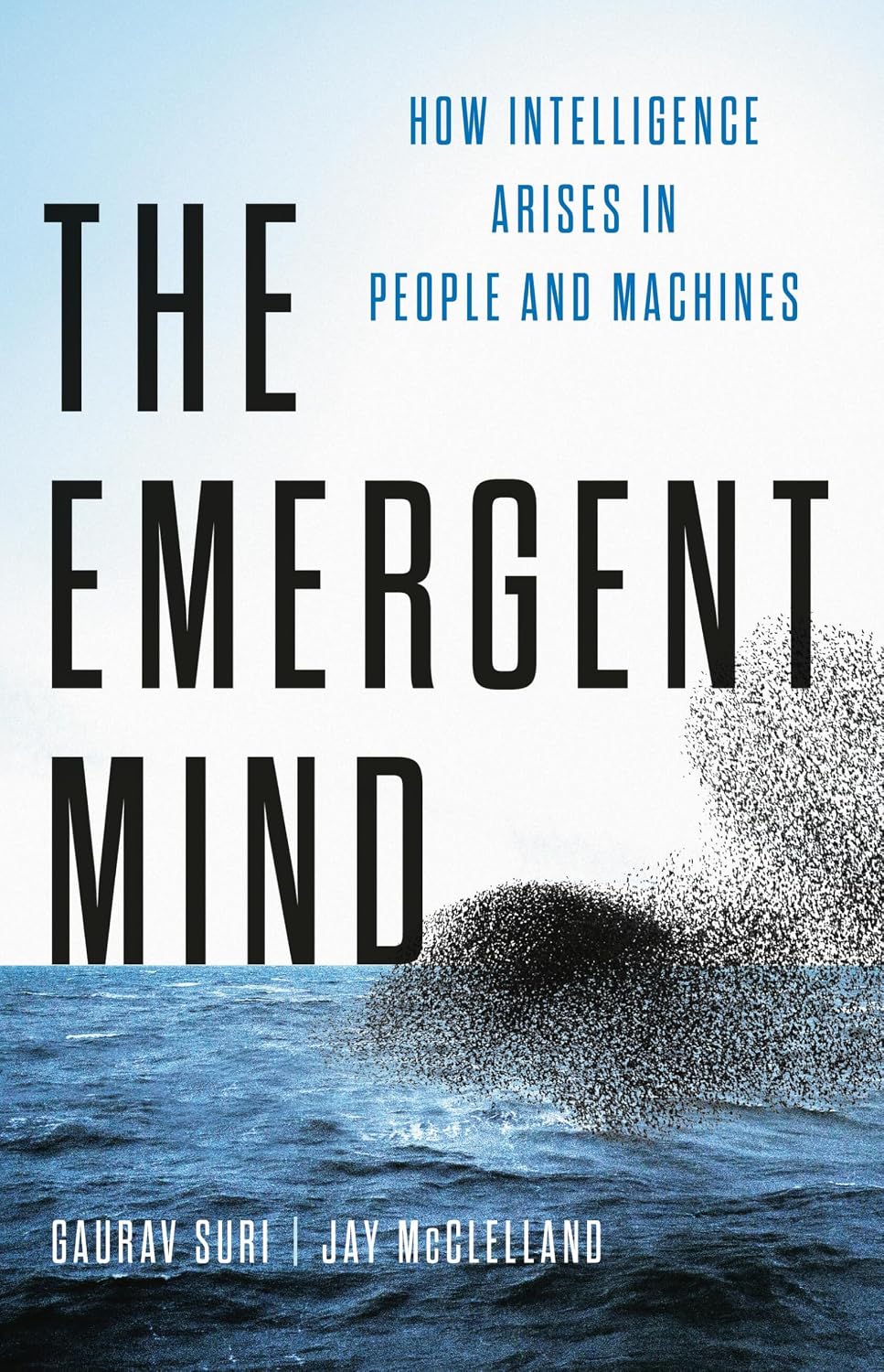
Gaurav Suri pursues an interesting quest at San Francisco State University: He proposes that “the mind emerges from the interaction of simple processing units and that these interactions can be modeled using neural networks.” He is especially interested in motivated actions and decision making, which raise perennial questions around issues such as free will.
Along those lines, he is the author of The Emergent Mind: How Intelligence Arises in People and Machines (2025), co-authored with cognitive psychologist Jay McClelland.
At COSM this year (November 18–20) in Scottsdale, Arizona, he will be speaking on the topic of “What makes a mind?”
It’s a big topic. There are, at last count, over 325 theories of the mind on offer. Computational theories like Suri’s — the view that the mind can be understood as a machine — are among the most popular, according to Standard Encyclopedia of Philosophy.
Even poetry can be “mechanistically understood”
In a discussion with Cole Smead at the A Book with Legs Podcast, Suri noted that the philosopher René Descartes (1596–1650) attributed mathematics, poetry, love, and other human higher human cognitions to “the divine.” By contrast, he says, “The view that we take in The Emergent Mind is that even those aspects can be mechanistically understood.”
[9:32 min] But I want to be clear: Mechanistic understanding is not the opposite of divine. It is divine. Sure. It is the highest form of human connection with nature.
The mind is made of these cells; there’s about a 100 billion of them. They’re called neurons. And these neurons, they’re complicated. But at a high level they do very simple things. They have a jolt of electricity. It’s called an action potential that they fire sometimes and they connect with other neurons at a high level… Now, that’s far from poetry or mathematics, right? So the challenge is, how do you go from these neurons to understanding the mind?
Many people will tell you that, whoa, that doesn’t seem possible. The idea of The Emergent Mind is that no, we can understand the mind in terms of these simple operations that neurons are doing.
Let me give you a quick example. Let’s say a bus is coming at me and I move out of the way and we’re together out on the street. And you say, “Gaurav, what did you do? Why did you get away from the moving bus?”
And I’ll say, “Isn’t it obvious? I don’t want to be hurt and so I moved away.” That explanation that I’m giving you is an explanation about the conscious mind.
Doubts about computationalism
Stony Brook neurosurgeon Michael Egnor acknowledges that “the theory offers a certain economy and elegance, fit for the computer age, especially when computers can sometimes seem, in an eerie way, to behave like human beings— and when AI is training them to behave even more so.” (Immortal Mind, p. 158).
But he goes on to critique computationalism, noting that “Nothing about the interaction between simple mechanical steps in a computer appears to generate mental states.” Thus Stanford Encyclopedia notes, “A key task facing computationalists is to explain what one means when one says that the mind ‘computes.’”
The human mind was acknowledged in Scientific American earlier this year to be the hardest problem in science, with no theory emerging as genuinely persuasive at present. But that’s all the more reason to give a respectful hearing to a widely held position, even if one disagrees. That’s why this year’s COSM is subtitled “Reality Check.”
Sign up to hear the rest!
Suri will be speaking on Thursday, November 19 at 11:00 am. The moderator will be Walter Myers, Principal Engineering Manager at Microsoft. Philosopher Jay Richards, author of The Human Advantage (2018), will be a fellow guest — with some probing questions.
Register here. Here are the agenda and the other speakers. The venue is the Scottsdale Westin Kierland. Act soon to avoid the late registration fee.
Incidentally, Suri has been in private business as a Managing Director at Deloitte Consulting. And, like fellow COSM participant Andrew Mayne, he is also a novelist. His award-winning book, A Certain Ambiguity (2007), coauthored with Hartosh Singh Bal, explores the clash between the certainty of mathematics and the uncertainties of life.