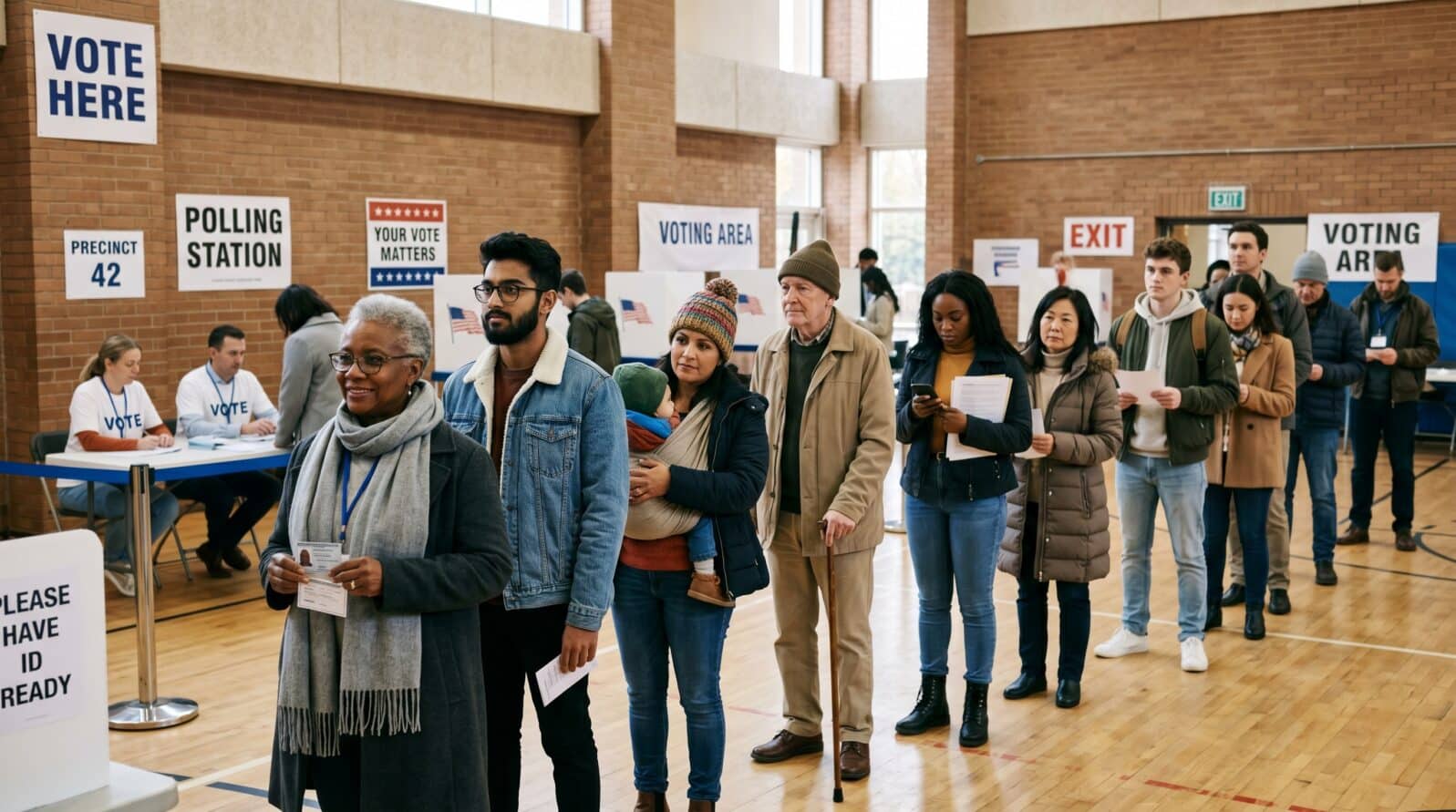
Information?: Fake Pollster Offers a Real-Life Lesson
The tendency to err in a consistent direction is probably due to average industry bias. For that at least, the data seem reliableinformative take on the US polls scandal.
Many people instinctively distrust opinion polls, especially around elections. The information — predictions, really — is so easily distorted on all sides. But what can anyone prove?
Now, a recent scandal has demonstrated some sobering facts.
Upstart Wedgewood Polls recently announced on X that its polls are deliberate fakes. Then it deleted its account. Other info on Wedgewood, which appeared suddenly last June, is hard to find.
The New York Times, among other media, had to delete many polls from its tracking project as a result, as has Decision Desk.
So why did the Wedgwood crew do it?
That’s a question Wedgwood’s Jack Sims and Andrew Prater addressed while advertising their online exit:
Wedgewood described it as an experimental project to demonstrate vulnerabilities in the polling industry. It said that the vast majority of its releases had not been supported by genuine survey data, though that one survey, covering Nebraska’s Senate race and financed through crowdfunding, had been genuine. Wedgewood added that its success illustrated a failure of scrutiny by news organizations and polling aggregators.
“Fake Polling Firm Duped Media in ‘Social Experiment’,” Newsweek, October 21, 2026
Lucy Campbell quotes them at The Guardian:
“Our fabricated numbers were given instant credibility across national media platforms,” the statement said. “The ease with which unverified figures were absorbed into mainstream political narratives highlights a systemic breakdown in media vetting and data aggregation.”
“Pollster admits to fabricating data for ‘social experiment’ to expose flaws of industry,” October 21, 2026
Newsweek had to retract three articles and correct others as a result. Many other news outlets face the same decision, the Newsweek editors say, including The Hill, Breitbart, The Daily Beast, and the Washington Examiner.
The Wedgewood team revealed its game in response to queries from FiftyPlusOne, a pollster vetting group which had previously rated it as legitimate.
But was it really just an experiment? Columbia University statistician Andrew Gelman pointed out to Newsweek that the partners only came forward with that story when FiftyPlusOne was about to expose their deception. Absent further information, other interpretations are possible.
Is there a pattern here that was easy for them to fake?
An industry that is reeling from an immense credibility blow tends to react defensively, often with a blizzard of statistics, only some of which are worth knowing (and those may be obfuscated).
Still, here’s a snippet worth knowing from a political science group at The Conversation:
… the systematic underestimation of Trump’s support across three consecutive election cycles suggests a deeper issue, such as sampling biases or other methodological shortcomings, rather than mere random error.
The polls were much better at estimating support for the Democratic candidates in all three presidential election cycles. The average Democratic polling error is 0.4 percentage points, and the change from year to year resembles the random error you would expect to see in polling – random fluctuations around zero.
Spencer Goidel, Eliana DuBosar, Zoe Nemerever, “Polling in the age of Trump highlights flawed methods and filtered realities,” November 26, 2024
So yes, there seems to be a systemic bias to account for. If pretend pollsters simply echo the almost invisible bias, they might not be detected immediately.
But there are other, deeper issues as well
The “polling accuracy crisis” has been percolating for some time. Recent analyses provide food for thought:
● From Quantus Insights: “American political polling is in a death spiral. For three presidential cycles (2016, 2020, 2024), polls have consistently overestimated Democratic support by an average of 4.2 points in battleground states, creating a false reality that misguides campaigns, manipulates voters, and erodes trust in democracy. This is no accident—it’s a structural failure driven by collapsing response rates, nonresponse bias, industry gatekeepers and flawed grading systems propped up inaccurate pollsters while discrediting innovators.” “The Polling Crisis: Accuracy, Bias, and Reform” (April 23, 2025)
● From Max Greenwood at Campaigns & Elections: “When a virtually unknown polling shop called Median Strategies revealed last week that it had fabricated surveys in Wisconsin and Los Angeles as a “short-term social experiment,” the news sparked a mixture of anger and fingerpointing among the political pollster community.” “Fake Surveys and Big Misses: Pollsters Face Challenges in 2026” (August 28, 2026)
What? Wedgwood wasn’t even a one off? How many other times has this happened, without publicity?
Details re Median from Noah Goldberg at the LA Times: “A poll claiming Los Angeles Mayor Karen Bass was leading Councilmember Nithya Raman by a wide margin — and picking up support from most voters who backed Spencer Pratt in the mayoral primary — was bogus, the company behind the poll acknowledged Monday.” (August 17, 2026)
● Earlier this month at Washington Monthly, Ann Kim asked “Is political polling broken?” She noted, “Back in the early 2000s, it would take about 25 calls to reach a willing respondent, Stefan says. Now it takes 100 to 125 calls or more. Polls that took three days to field now take five or six. More time means more money, which means greater temptation to take shortcuts.” (October 4, 2026) Call display did that of course.
Nevertheless, if information consumers allow a modest correction for industry bias, we might come up with a fairly good idea of what might happen in an election anyway. We shall see.
