
COSM 2026: Meet the Guy Who Made the Internet Seamless
Bob Metcalfe will be there to listen to offer some thoughts on where we are now and where we are headed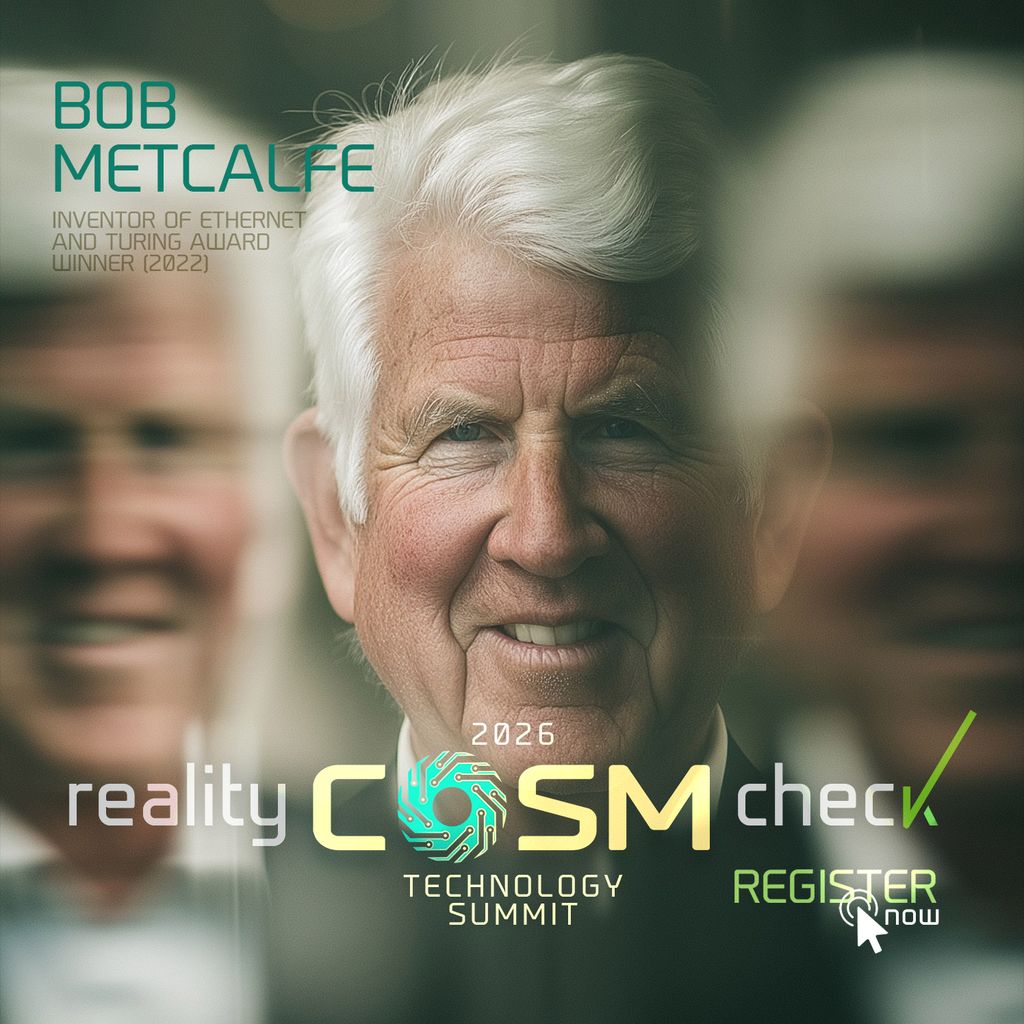
When Bob Metcalfe won the the Turing Award in 2022 — the “Nobel Prize of Computing” — the Harvard School of Engineering and Applied Science media release quoted one of his classmates. Harry Lewis, a computer science professor, on his colleague’s achievements:
Today, we all walk around with pocket-sized computers and many of us work on keyboards all day long. But we barely know or notice where our computing is actually being done or where our data are stored, because all these personal devices are so seamlessly connected to each other and to big machines in unknown locations.
Metcalfe himself is a large part of the reason the system works, he added: “Few people can lay claim to that kind of birth-to-maturity influence over a world-changing and now ubiquitous technology.”
But he started out by flunking his dissertation at Harvard
According to his Turing award autobiography, Metcalfe “had no idea what a network was” early in his career. But he had taken undergrad courses in digital design and computer engineering so he helped set up ARPANET, a predecessor to the internet. However, his doctoral thesis on ARPANET was rejected because there was “not enough math” in it.
He rescued his thesis by adding a statistical element that he gleaned from the study of failures in the AlohaNET system created by the University of Hawaii: Two devices could not transmit at the same time without introducing rising wait times and the resulting degradation of network performance introduced “an interesting statistical problem.” That satisfied the examiners. Everyone else was just tapping their toes, waiting for a solution.
The new connectivity started with a memo he wrote…
Those of us who remember the early internet will recall how slow it was. “Faster than the post office” was a grumbling admission, not a stunning accolade.
On May 22, 1973, while working at the Xerox Palo Alto research center, Metcalfe wrote a memo describing a new system he called the “Ethernet,” which would enable faster and more reliable communications.
Remarkably, not only did the new approach work but it is still a standard over fifty years later. In an article at Wired last April, senior tech writer Simon Hill commented,
It is still widely used because sending data along cables is usually faster, and always more reliable and secure than sending it as radio waves, as Wi-Fi does.
If you want to get the best from your internet connection, Ethernet is still a great way to do it, and it’s an obvious choice for any organization that prizes high speed, security, and reliability.
“Everything You Need to Know About Ethernet,” Apr 27, 2026
You win! You are the lucky owner of the world’s only phone!
Metcalfe is perhaps best known for Metcalfe’s Law: The value of a network is proportional to the square of the number of users.
Techopedia explains “owning a single fax machine is useless. When there are two fax machines, you can communicate with one other person, but when there are millions, the device gains significant value.”
The same principle applies, of course, to phones of all kinds and to the internet generally. Its power lies in the way it enables billions of people to be potentially connected.
What does Bob Metcalfe see as the challenges facing us today?
It will be most interesting to hear his reaction, along with that of philosopher of technology George Gilder, to the speakers at COSM 2026: Reality Check (on November 18 at 4:30 pm).

By then, attendees will have heard about the future of semiconductor manufacturing
from Ken MacWilliams, President of the Multibeam Corporation, with decades of experience in the industry.
They will also have heard from former Intel CEO Pat Gelsinger, on Moore’s Law, of computer tech growth: “Is It the End, or Is It Just Beginning?”
As well as a panel on Arizona as the epicenter of chip innovation. The “silicon miracle,” as the panel calls it, is creating new industries — in places far from Silicon Valley.
Then Andrew Mayne, a prompt engineer from OpenAI, will argue, contra Elon Musk, that AI will create a jobs boom for humans.
Finally, with the issues in play, Bob Metcalfe, who did so much to provide the infrastructure, will offer some thoughts about the progress and its challenges.
If the AI industry means a lot to you…
Don’t miss this chance to network with computing greats and aspiring achievers on November 18-20 at the Westin Kierland in Scottsdale, AZ. Register here to (still) get the standard rate. Here are the agenda and the speakers. Also, the venue, the Westin Kierland Resort & Spa.