Move Over, AI. Bird Brains Are Giving You a Run for Your Money
Could ten thousand birds develop a theory of mind just by scaling? A tale in three partsI should have known better. Inspired by Gödel’s Incompleteness Theorems, “I asked my AI if it was always correct. It said yes.
I asked it if its last response was true and it said no.
I said “Well, which one is it?” And it said: “I’m a formal system — how the hell should I know?”
Fun stuff. Until this morning. I started thinking about CAMs — Coordinated Avian Models.
And thereby hangs a tale — in three parts
Imagine a certain Dr. Avian who is thinking about AI and intelligent systems. His new program, “New Behaviorism,” follows his early work in reviving 20th-century behavioral theories (think Watson and Skinner). He realizes that the program would permit the training of birds to perform certain methodical, precise tasks. Birds can be trained to perform precise sequences of actions.
He also realizes that there are, well, lots of birds out there — and so lots of bird brains available for training. That does it.
The reclusive Dr. Avian springs into action. First, he commandeers his flock of research pigeons, woodpeckers, and crows to begin large-scale “design” training. Shortly after, in another burst of inspiration, he thinks of the right acronym — sure to attract research dollars: Coordinated Avian Models, or CAMs:
[indent]CAMs are intelligent execution models involving no theory of mind. CAMs are thought to develop a Theory of Mind (ToM) by scaling. A thousand birds may still be limited. But ten thousand birds or more will make execution of existing designs more efficient and spur creative directions toward new designs. It is insisted the mind will emerge at this stage.
The world awaits.
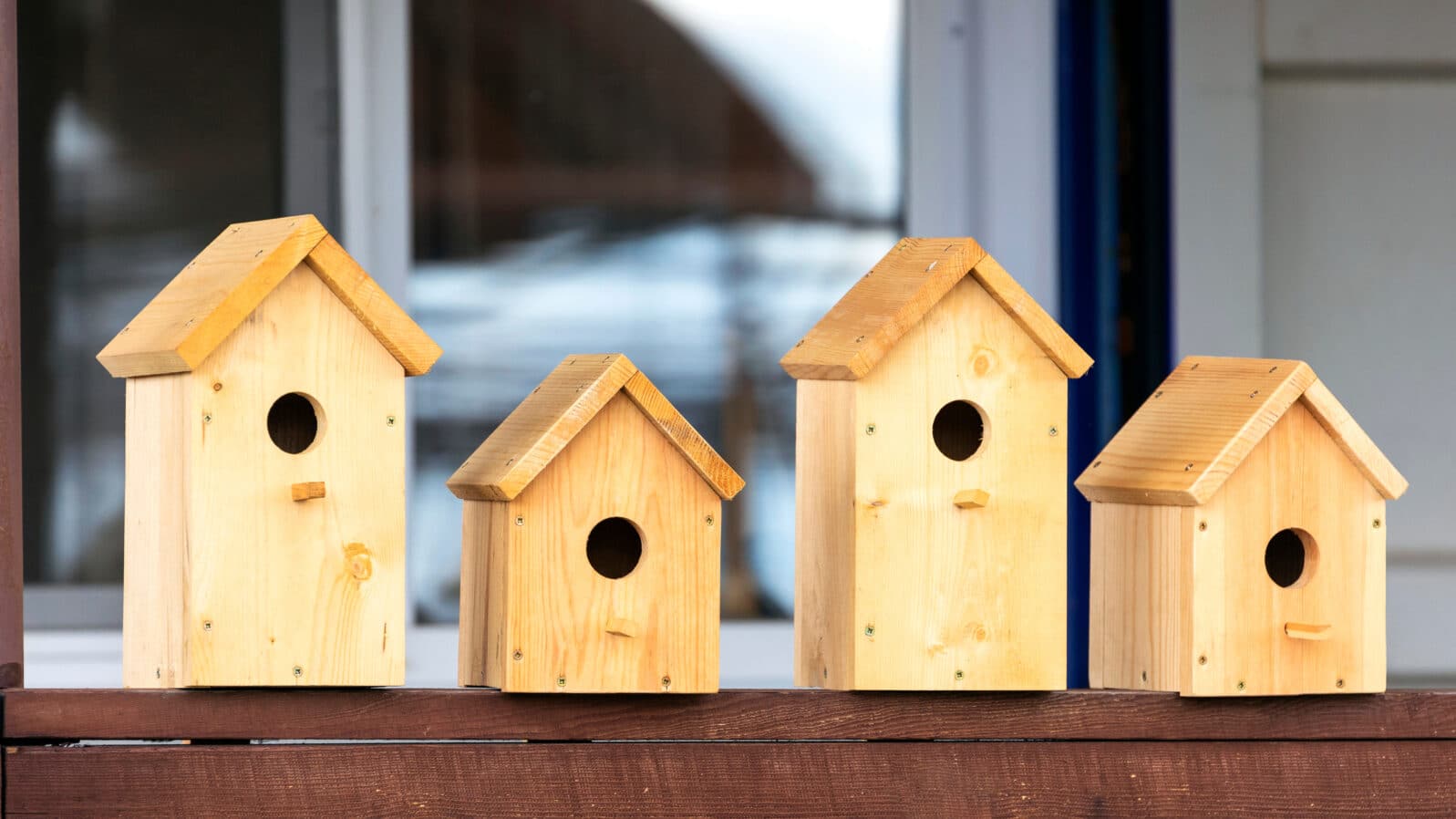 Image Credit: Nobilior -
 Dr. Avian puts his pigeons to work flying prefab wood parts to the assembly line in his capacious avian research park. The woodpeckers are pesky little creatures whose incessant tap, tap, tap put two of his best grad students on Advil and a third on martinis at lunch. But they do peck holes at key places in the wood parts. Then the crows, ever clever and dexterous, insert prefab wood pegs. In concert with all the pooping and chirping and pecking, out comes a beautiful birdhouse.
He is rewarded with the Ernst & Young Bio-Inspired Systems Award. Then he realizes something: the coordinated system of trained birds he’s made scales. That is, unexpected greater things might result simply from greatly expanding it.
Commercial success follows in short order. Using his patent-pending Avian Attention Mechanism (AAM), Dr. Avian is able to “bulk train” thousands of coordinated behaviors across his growing flocks. The technique builds on core principles from New Behaviorism — breaking tasks into discrete action sequences and distributing them across agents trained only on localized feedback. The birds do not understand what they are building. But they don’t need to. They simply act when cued, and act reliably.
Contracts follow — first with IKEA, then with Lowe’s and Home Depot. The suppliers agree to deliver prefab parts in bulk, which are deposited in great mounds across Avian’s research grounds. These mounds are then visited in waves by pigeons, who ferry the parts to the assembly stage. There, woodpeckers handle the hole-drilling with grim focus. A squad of well-trained crows pecks the wood pegs into place with rhythmic, almost hypnotic coordination.
Flawless birdhouses result, assembled by members of the species of their future residents — birds. No two birdhouses are quite the same, but all fall within tolerances acceptable to both nature and retail.
Dr. Avian purchases a yacht and is seen cavorting with Larry Ellison of Oracle fame off the coast of California. Life is good.
Creative variations…
Initially, the CAM program delivers four reliable designs: two standard, one slightly rustic, one vaguely Scandinavian. But soon the output diversifies. A geodesic house modeled after the work of Buckminster Fuller appears one morning, startling a grad student. Another week, a series of asymmetrical hybrid models begin to emerge — quirky, oddly elegant structures, well-suited to customers in Northern California. Dr. Avian attributes these hybrids to controlled procedural variation, a polite term for introducing randomness into the training process and seeing what happens.
The birds — nay, the CAMS — keep building. Farmers and residents living near the now slightly foul-smelling and increasingly noisy CAM facility — now rebranded as the “Factory of Organic Distributed Design” — begin to complain. A handful of lawsuits follow, mostly over property values and issues around crows roosting in the local water tower.
Training the birds, it turns out, requires not just endless mounds of prefab wooden parts but an army of humans, known as “Avian Training Engineers.” Thousandsof them. Most are paid barely above minimum wage, working long shifts under fluorescent lights in what essentially amount to outdoor server farms, except louder and smellier. They complain about repetitive strain injuries, chronic tinnitus, and the psychological toll of reinforcing pecking behavior for twelve hours a day. Some want to unionize. Others quit.
Still, the operation grows. Dr. Avian insists the complaints are overblown.
Anyway, he is focused on much bigger things: Has he demonstrated that intelligence can exist without a mind?
Next: Part 2: Have the superbirds arrived? Are they taking over?
Here are all three parts of my thought experiment, told as a story:
Part 1: Move over, AI. Bird brains are giving you a run for your money. Could ten thousand birds develop a theory of mind just by scaling? A tale in three parts Dr. Avian was sure that he had found a formula for intelligence without anything like a human mind, and his program appeared to be working.
Part 2: Have the Superbirds arrived? Are they taking over? Dr. Avian now claims that his work with trained birds show that intelligence does not require inner models or internal representations, as formerly thought. Avian is perfectly clear: There is no mind at all in Coordinated Avian Models (CAMs). And yet, they’re behind a staggering number of new designs.
and
Part 3: A Wren arrives — and ruffles many a feather. Dr. Wren, a cognitive scientist, identifies a problem with assuming that adding another ten thousand pigeons to the project will produce novel designs… We remain confronted by the same old mystery: who, or what, imagines the birdhouse in the first place?
