
Campus Civil Rights Advocate: Free Speech Makes Us Safer
Greg Lukianoff stresses the importance of listening to people to know what they thinkGreg Lukianoff, author along with Jonathan Haidt of The Coddling of the American Mind (Penguin 2018), appears in a TED talks video released earlier this month:
“Too many people believe in something closer to freedom from speech rather than freedom of speech,” says attorney Greg Lukianoff. In a timely talk, he warns against the rise of “mob censorship” — and reminds us why free speech is the best check on power ever invented.”
“Let’s Get Real About Free Speech” Greg Lukianoff, TED, July 8, 2025, 12:23 min
Here’s the transcript. Some highlights:

[0:04]”Shut it down.” That was the order given by angry students in response to a pro-Israel speaker. This is UC Berkeley, 2024, and pro-Palestinian students were determined not to let this talk happen. A call to action went out on social media urging students to shut down the event, and nearly 200 students showed up. They attacked the venue, they broke down a door, they broke a window, and they forced the speaker to flee …
Now I have defended the free speech rights of literally thousands of students and their right to protest. But you do not have the right to shut down someone else’s talk and decide for everyone else who they are allowed to hear.
[01:01] That is mob censorship, not freedom of speech. But unfortunately, 2023 and 2024 were the two worst years for mob censorship and shout downs on record …
Four Truths
[03:25] … I believe that there are four truths that everyone needs to understand that can help get us back to understanding and appreciating free speech. And they are: one, free speech makes us safer. Two, free speech cures violence. Three, free speech protects the powerless. And four, even bad people can have good ideas.
[04:06] So let’s start. Free speech makes you safer. My mentor is a civil libertarian named Harvey Silverglate, and he spent his career in part defending freedom of speech, both on and off campus. But when the idea started to hit campus, maybe back in the ’80s, that bigoted or hurtful or hateful speech had to be banned, he would say, “I’d prefer to know who the Nazis in the room are. So I know who not to turn my back to.” Now Harvey was right. It’s about knowledge. Simply, you are not safer for knowing less about what people really think.
[11:46]Young people used to be the great drivers of free speech, and they can be again. But for that to happen, we all must remember that to understand the world, it’s crucial to know what people really think. And that is only going to happen in a situation in which people feel like they can be their authentic selves. And for that, we need free speech.
For the rest of the talk and transcript, go here.
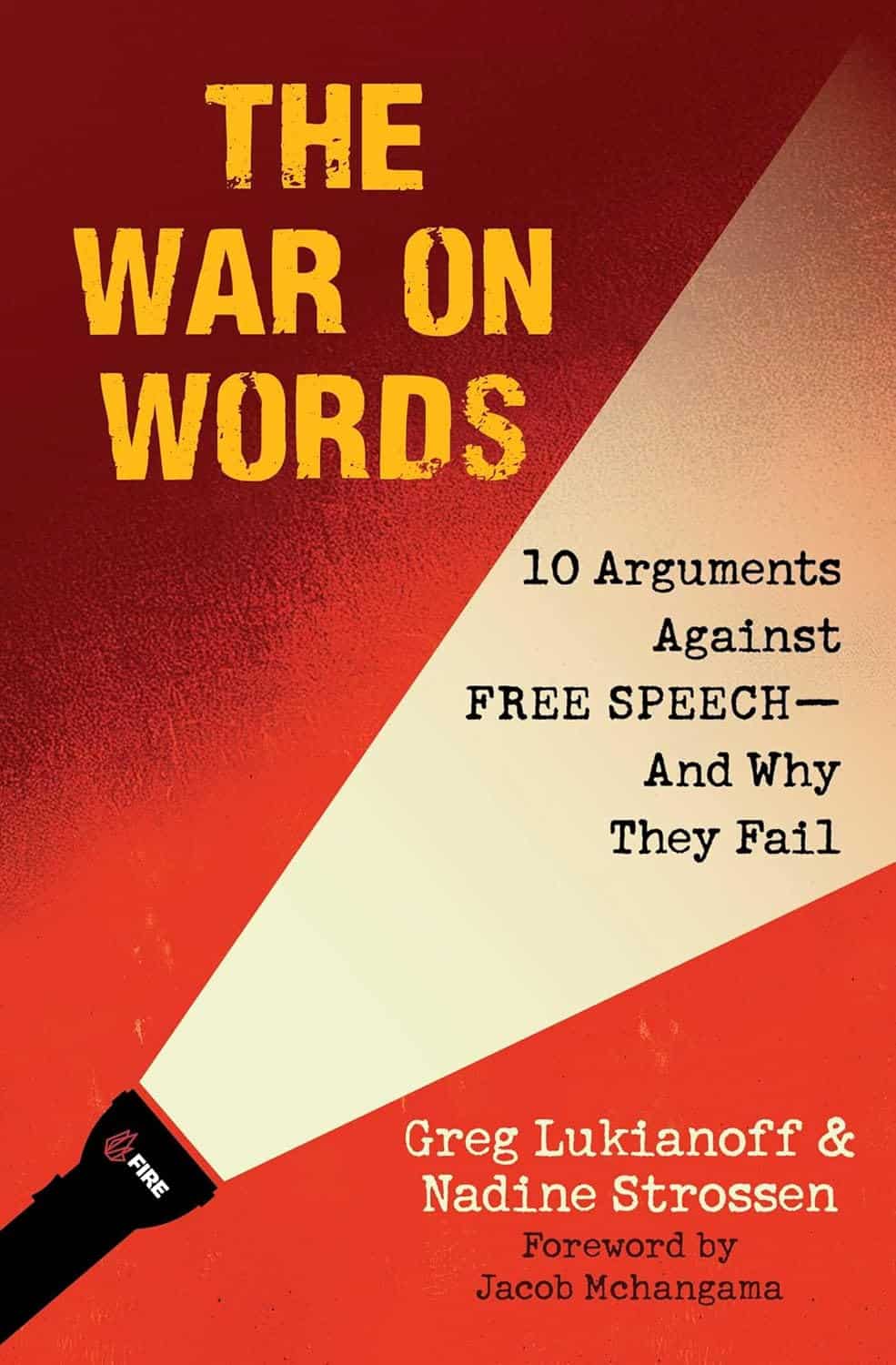
Lukianoff’s just-released book, co-authored with civil libertarian law prof Nadine Strossen, is War On Words: 10 Arguments Against Free Speech—And Why They Fail (Heresy Press, 2025). From Chapter 1:
The whole point of freedom of speech, from its beginning, has been to enable people to sort things out without resorting to violence. A quotation often attributed to Sigmund Freud (which he attributed to another writer) conveys this: “The first human being who hurled an insult instead of a stone was the founder of civilization.”
On campus, I often run into people—not only students, but professors—who seem to think they’re the first to notice that the distinction between what we deem to be appropriate responses to speech and violence, respectively, is a social construct; in other words, this distinction has meaning only because we collectively decide it should. Those who stress that this distinction is a social construct then conclude that this makes the distinction arbitrary, so that they can draw the line where they please.
Yes, a strong distinction between how we legitimately respond to harm caused by speech versus how we respond to it as a result of violence is a comparatively recent social construct, but it’s one of the best social constructs for peaceful coexistence, innovation, and progress that’s ever been invented. (p. 17)
More on the book later.
You may also wish to read: New Angel Studios documentary: Live Not by Lies The four-part series discusses the way that the totalitarianism that Soviet dissidents warned about is emerging in Western society today. (March 20, 2025)
