
Monday Micro Softy 80: The Digits of Least Significance
The patterns found in numbers can be useful as well as fascinatingEngineers, mathematicians, and computer scientists need to know some number theory, the branch of mathematics that studies the way numbers behave. Number theory is needed to understand modern data encryption, for example.
This week’s Micro Softy is about number theory and least significant digits (the last digit of a large number is its least significant one). It builds on the solution of last week’s puzzle. So let’s reveal that solution first.
Solution to Micro Softy 79: The Last Digits in Fermat’s Last Theorem
It’s a tough puzzle.
My mathematics friend Professor Dave Johns texted me that he believed Wiles’ celebrated proof of Fermat’s Last Theorem was incorrect. Here’s the math behind the theorem again:
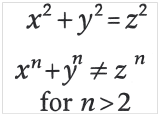
Remember, one counter example is all that is needed to disprove Fermat’s theorem. Johns said he had found a counter example. He provided three numbers.
x = 321,232,430,786,123,860
y = 487,367,975,876,123,125
z = 4,534,432,154,871,543,981
But poor Professor Jones lost his memory before he announced the value of n in the equation above, where n>2 — the number of times each number is multiplied by itself.
Meanwhile, Pythagoras “Pithy” Smith, born in Muleshoe, Texas, got his PhD in math from Baylor University at the age of fourteen. He looked at Jones’ numbers for thirty seconds and, without the use of a computer, announced that none of them could be counter examples to the theorem. The question is, how could Pithy know?
This puzzle is a tough one. Here’s how he knew:
Any number ending in 0, multiplied by another number ending in 0, results in a number ending in 0. For example, 50 × 150 = 7500. Since Dave Jones’ x ends in 0, no matter how many times you multiply it by itself, the result will end in 0.
A similar property holds for numbers ending in 5. Multiplying any number ending in 5 by another number ending in 5 will result in another number ending in 5. For example, 65 × 155 = 10,075. Since Jones’ y ends in 5, the result of multiplying it by itself a number of times will always end in 5.
So no matter what the value of n, the value of xn will end in 0 and yn will end in 5. Adding these two numbers together will result in a number ending in 5.
Lastly, z ends in 1. Multiply any two numbers ending in 1 together and the result is another number ending in 1. For example, 61 × 191 = 11,651. Therefore, no matter how many times you multiply z by itself, the result will be a number ending in 1.
The sum on the left side of Fermat’s equation ends in 5. The number on the right side ends in 1. Thus the two sides are not equal and Dave Johns did not provide a counterexample for Fermat’s Last Theorem.
Footnotes:
- Note that the title of this Micro Softy: “The Last Digits in Fermat’s Last Theorem,” contained a hint. The solution focuses on the least significant digit (the last one) of the three numbers proposed by Dave Johns.
- Fun fact: A musical was written about Wiles’ proof of Fermat’s Last Theorem. Math meets Broadway in Fermat’s Last Tango, a musical spun from Wiles’s proof. If you enjoy offbeat, nerdy musicals, it’s worth a watch.
Now on to the Digits of Least Significance
So, following on last week’s solution, here is this week’s Micro Softy for the nerds among us:
We saw from the solution to last week’s Micro Softy that repeatedly multiplying any list of numbers that all end in 0 results in a number ending in 0. This is also true for numbers ending in 5. For example, 5 × 125 × 15 × 25 × 55 = 12,890,625. All the numbers here end in 5. Numbers ending a one also have this property. An example is 11 × 121 × 31 × 21 × 101 × 91 = 7,963,826,871. Everything ends in 1.
The numbers thus far considered are 0, 1 and 5. Numbers not yet considered are 2, 3, 4, 6, 7, 8 and 9. Not all these numbers have this repeating property but they do have other interesting features. What can we conclude, for example, from multiplying a large list of numbers all ending in a 7?
Examine each of these numbers: 2, 3, 4, 6, 7, 8. One of them shares the repeatability property seen for 0, 1 and 5. The others generate a repeated sequence of least significant numbers. That’s your Micro Softy assignment this week. Find this repeated sequence for each remaining number.
The results are interesting. If you’re a nerd, that is.
The Monday Micro Softy is a weekly feature of Mind Matters News. Here are the links to all the puzzles and answers to date:
Monday Micro Softy 79: The Last Digits in Fermat’s Last Theorem. Did Andrew Wiles really prove Fermat’s Last Theorem? Today we offer you a chance to decide. About last week’s MicroSofty: Think of the probability issue as just a distraction…
Monday Micro Softy 78: Card Sharks That Bite Harder. You can beat the odds in some card games if you understand probability theory. Try your chances! Last week’s puzzle, like several others, is easy to solve if we use inclusive thinking about relationships.
 Image Credit: Александр Татаев -
 Monday Micro Softy 77: Two Proud Texans I’m aware of no other state where businesses and citizens proudly fly their state flag. I live in McGregor, Texas, where Elon Musk’s Space X has a testing center, and occasionally, the testing of their rocket engines gently rattles the dishes on the shelves in my home.
Monday Micro Softy 76: The Smoking Gun explains a computer scientist or engineer, a law enforcement officer often relies on abductive reasoning to crack a case, so with this in mind, you will have to crack last week’s puzzle. You can find puzzles 55 through 75 here as well.
Monday Micro Softy 55: “It happens every spring.” Baseball, that is. Here’s a puzzle that takes in baseball’s summer. To solve last week’s puzzle, you don’t need to know the distance. Check the problem again for the number you do need to know. You can find puzzles 51 through 54 here as well.
Monday Micro Softy 50: Cutting through the cornbread. How did Yuri Senior cut the cornbread into eight identical portions using only three straight cuts? You can guess the answer to Microsofty 49 if you try the test question yourself at home, using a small mirror. Links to Microsofties 46 through 49 are here as well.
Monday Micro Softy 45: Can Tony beat the fast-food curfew? An early curfew on fast food service motivated a boy to exercise more vigorously. But how fast was he pedalling? To solve Micro Softy 44, recall that Tony doesn’t need to take the individual pills each day, only the prescribed amount of each. You will find links here to Micros Softies 41 through 44 as well.
 Image Credit: Burlingham -
 Monday Micro Softy 40: The fate of a false prophet. He wasn’t actually fired for being a false prophet but for something that his prophecy unintentionally revealed. The solution to Micro Softy 39 lies in considering an alternative possible meaning of a word commonly used in sports. You will also find links to Micro Softies 30 through 39 and their answers here as well.
Monday Micro Softy 29: A funeral lament in four lines. The funeral director was puzzled by Dan’s description of his relationship to the deceased but there was no question that his grief was sincere Here, you will also find links to Microsofties 22 through 29.
Monday Micro Softy 21: Finding More of the Deadly Fentanyl Pills. Here, you will also find links to Microsofties 11 through 20 as well.
Monday Micro Softy 11: What Happened to That Other Dollar? Here you will find links to the first ten Micro Softies. Have fun!
