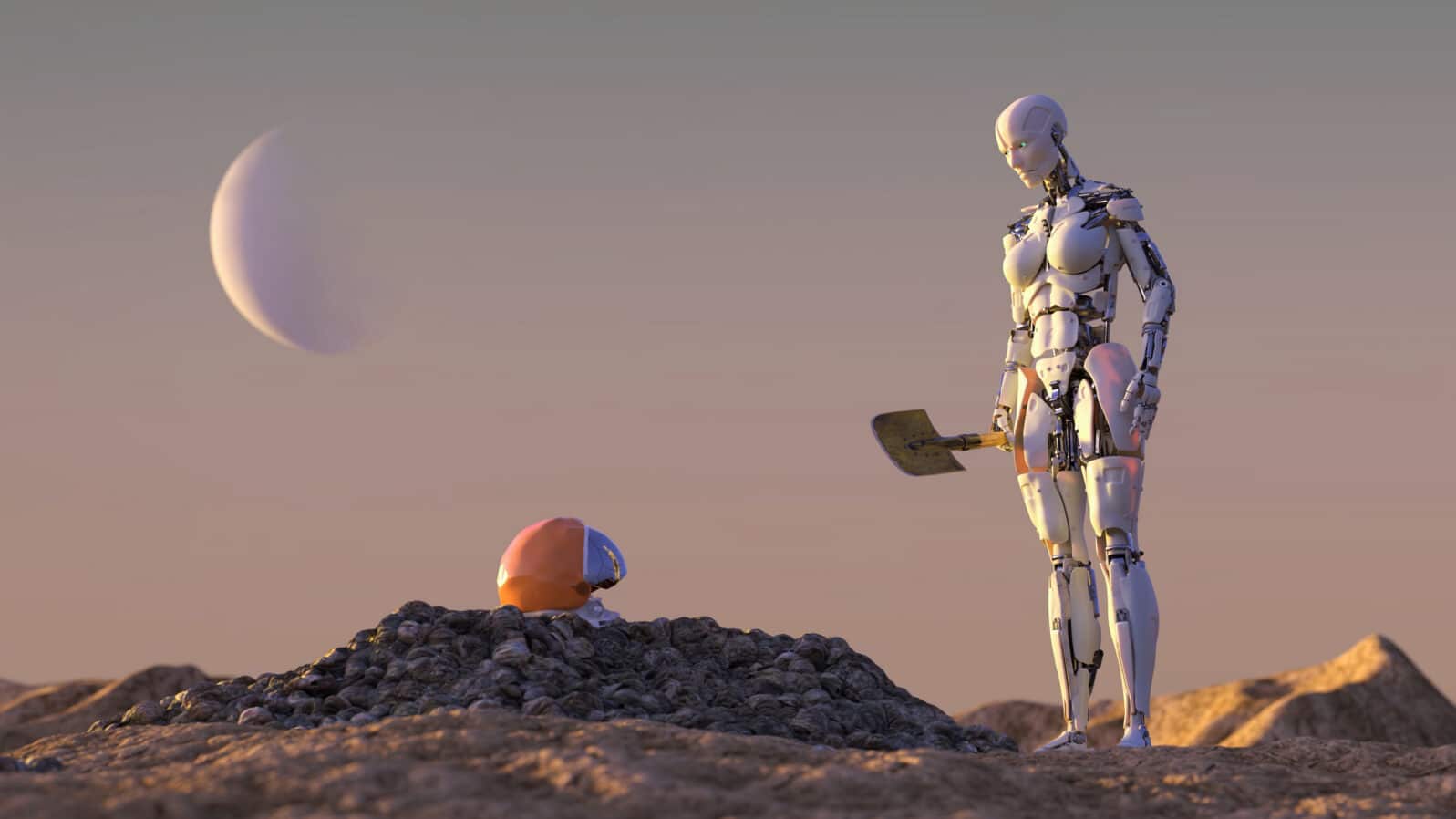
Future? There Is No Human Future, Dude… and That’s Good!
A look at the other face of the claims that we are approaching an AI singularityThere is a lot of AI Apocalypse Now! and AI Utopia Soon! in the news these days. A longform article at Aeon last week focused on a side that we may not have heard much about: Instead of a transhuman future, a no-human future.
As Monash University philosopher Vincent Lê explains, there are two different philosophies called accelerationism, one of which is centered on a racist apocalypse. But we are interested in the other one here, the AI apocalypse that extinguishes all of us insignificant humans.
Originated by a young, eclectic British philosopher Nick Land, the thesis features so much philosophizing that even Grokipedia struggles:
The theory manifests in divergent strands: “unconditional” or right-accelerationism, as articulated by Land, embraces techno-capital’s autonomous evolution toward a singularity unbound by human values, viewing democratic restraints as obstacles to this inexorable drive; in contrast, left-accelerationism, advanced by figures like Nick Srnicek and Alex Williams, seeks to harness acceleration for egalitarian ends, such as universal basic income and automation to transcend scarcity. More recently, “effective accelerationism” (e/acc) has gained traction in technology circles, advocating unconstrained advancement of artificial intelligence to unlock superintelligence and solve existential challenges, often framing opposition as Luddite regression. Grokipedia
In Lê’s plainer terms, accelerationism starts with denying the exceptionality of humans. It aims to:
… critique human narcissism; or, more accurately, to critique our anthropomorphisations of reality by confronting us with the brute fact of our inexorable death, beyond which we cannot trespass. That is, we all die and none of our beliefs, values and ideals will ever truly survive. Why do we keep believing the Universe and reality itself revolve around us as their centre of gravity?
“The no-human future,” June 11, 2026
One supporter of some form of accelerationism is Netscape founder Mark Andreessen who thinks that AI is already becoming like human beings.
Incidentally, as Lê points out, Andreessen was one of the influential Silicon Valley people who switched their support to the Republicans in recent years because of the Democratic government’s attempt to dictate terms to the Valley. Where the Valley saw itself as the party’s fairy godmother, the party seemed to see the Valley as Cinderella scrubbing the floor. That has not ended well.
Much of Lê’s essay will best repay the student of philosophy, as he draws together many strands of modern thought and relates them to the drive to create thinking machines:
- human life (and all lives) are really elaborate machines
- death ends everything
- and thus the new machines that extinguish us will be better than humans.
The philosophy has not strayed far from popular science culture here. It may be an inevitable outcome of eliminative materialism.
The curious role capitalism is supposed to play in the no-human future
Land does not see capitalism as a mere approach to economics. Rather, in his view, it is uniquely qualified to aid in “the human species’ extinction” in favor of “the creation of an artificial superintelligence as the ultimate incarnation of the apocalyptic Body without Organs” and thus in a technological Singularity.
Is he mad?
Perhaps. But madness does not necessarily mean lack of influence. Anyone familiar with the history of the 20th century would be poorly advised to think so.
But does Land make a difference? Lê offers,
In the 2020s, Land’s ideas are now colliding with mainstream politics and tech culture, even if in distorted and partial forms. Everyone from Tucker Carlson to Silicon Valley tech entrepreneurs has found something in his philosophy that speaks to our current moment – whether they find his vision nightmarish or ecstatic. But Land’s ideas radically diverge from the reigning conceptions of accelerationism today. His original formulation in the 1990s is clearly opposed to its white supremacist vulgarisation: he has zero interest in any violent return to tradition, or indeed in preserving any human populations at all. This vulgarisation selectively takes his notion that accelerating the dynamics of the modern world to breaking point will bring about some revolutionary phase transition. So-called ‘accelerationists’ operating in this mode then take a step backwards. Instead of embracing what Land sees as a phase transition beyond humanity altogether, they envision the revival of conservative human traditions…
Land’s vision that ‘nothing human makes it out of the near-future’ is for him something joyous. His unique commitment is not to humanity’s betterment, but to an absolute – if inhuman – knowing of the real. All that we can contribute to this no-human future is to simply get out of the way. “The no-human future”
I come away from Lê’s essay with a much more sober assessment of transhumanism, the war on human exceptionalism, and the idea that machines think like people.
Elon Musk and Ray Kurzweil (“ the public face of the accelerationist position for nearly 30 years”) may believe that it will all lead to utopia. But there are — as usual — much darker motives in play. And they are not so easily dismissed.
