
What AI Has and Hasn’t Solved Recently in Math
We need to look at the distinction between horizontal and vertical innovationOpenAI recently announced that one of its AI models autonomously tackled a prominent open problem in mathematics associated with Hungarian mathematician Paul Erdős’s Problem #90. It concerns the unit distance problem in discrete geometry.
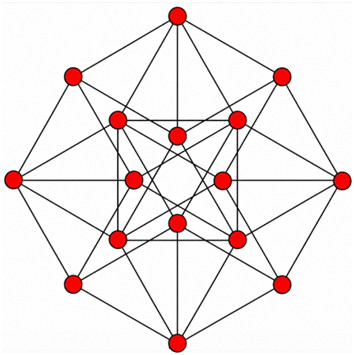
Note the plethora of equilateral triangles.
Erdős’s problem #90 asks for the maximum number of unit distances that can occur amongn points in the plane. For small values of n, this problem is easily solved. For n is equal to 3, the answer is an equilateral triangle. For n = 4, the answer is a rhombus of two conjoined equilateral triangles. The problem gets more difficult as n increases.
Getting past the hype
First, let’s clear some possible misconceptions from the media.
- Contrary to any implication, the unit distance problem has not been solved. In #90, Erdős (1913–1996) believed his bound, an unproven educated hunch, was accurate. The OpenAI solution improved on that bound, but did not prove that that was the optimal solution.
- Open AI writes “This proof … marks the first time that a prominent open problem, central to a subfield of mathematics, has been solved autonomously by AI.” That’s not true. Scientific American reports that AI tools have helped transfer about 100 Erdős problems into the “solved” column since October 2025. A few months ago, Field’s medalist1 Terrence Tao reported that many open math conjectures “were solved more or less autonomously by an AI tool.”
These clarifications should in no way detract from the jaw-dropping job the OpenAI model did. What I find even more astonishing is that the model was not trained specifically for mathematics, but rather for more general applications.
Who was Paul Erdős?
Knowing a bit about Paul Erdős helps us understand his truckload of mathematical conjectures better.

Erdős, the man behind conjecture #90, was a brilliant Hungarian mathematician who led the eccentric lifestyle of a nomad genius. Having no permanent home, he traveled constantly from university to university, collaborating with hundreds of mathematicians worldwide and authoring over 1,500 papers, He was known to use stimulants like amphetamines, joking that when he stopped for a month because of a bet, mathematics had been set back by a month.
His name is legendary in the field of mathematics. One’s “Erdős number” is a measure of “a degree of separation.” It is determined by the number of papers for which a mathematician is listed as an author separated from the number for which Paul Erdős is listed as an author. (My Erdős number is three.2 About 33 thousand others share my distinction.3)
He left behind over a thousand unsolved conjectures and problems, including #90.
Horizontal Innovation Versus Raw “Flash of Genius” Creativity
Some mathematical discoveries result from horizontal innovation rather than the raw creativity required for vertical innovation. By horizontal innovation, we mean the fusion of ideas that are already known, combining existing concepts in novel ways to generate new insights. By contrast, vertical innovation4 requires raw creativity.
Here’s an example of horizontal innovation:
Flash of Genius is a 2008 film based on the true story of Robert Kearns (1927‒2005), an engineering professor at Wayne State University. He invented the intermittent windshield wiper system.
Kearns reportedly became annoyed driving in light rain because conventional windshield wipers only operated continuously at fixed speeds, either too fast or too slow for drizzle. He drew an analogy to the human eyelid, which blinks intermittently rather than continuously washing over the eye. That observation inspired the idea of a windshield wiper that pauses between sweeps. Kearns’ innovation emerged from the fusion of two familiar realities: the annoyance of conventional windshield wipers in light rain and the natural intermittent blinking of the human eye.
The title of Robert Kearns’ biopic, Flash of Genius, used to be a requirement for patenting in the United States.5 The criterion that patents must display a “creative flash of genius” was abandoned by the Patent Act of 1952. Today’s lower standard requires only that an invention be novel, useful, and non-obvious to a person having ordinary skill in the relevant art. Kearns met these criteria and patented his idea.6 After many grueling years of litigation, he successfully sued Ford and Chrysler for infringement.
Kearns’ patent shows that horizontal innovation, the combining of two disparate ideas, meets the patent office’s current criteria. Patent requirements can be loose — in fact, dare I say, comical. In 1999, Jeff Bezos had his name on an Amazon patent7 protecting “1 click” buying.
The AI solution of the unit distance problem was conventionally explored using only the mathematics of discrete combinatorial geometry, but this led to no solution. OpenAI, in exploring different approaches, introduced harmonic analysis to the problem and helped improve the bound which was suggested by Erdős. This was a wonderful marriage of ideas. It was horizontal innovation using existing mathematical tools.
Horizontal innovation in math
Being a human math expert is difficult. In the last century, there have been over five million publications in mathematics, written by over one and a quarter million authors. This does not include millions of more papers in the highly mathematical areas of engineering and physics. In recent years, about 125,000 math articles are added annually . That’s over 300 per day. A human being cannot keep up with this tsunami of articles. AI can.

Terence Tao, a brilliant mathematics professor at UCLA, is working with AI to solve math problems. At the end of last year before the AI result for Erdos #90 was announced, he wrote,
In recent weeks there have been a number of examples of Erdős problems that were solved more or less autonomously by an AI tool,8 only to find out that the problem had already been solved years ago in the literature.
He continues,
… AI tools are now becoming capable enough to pick off the lowest hanging fruit amongst the problems listed as open in the Erdős problem database, whereby `lowest hanging’ I mean `amenable to simple proofs using fairly standard techniques’.
How should mathematicians view LLM’s? “They are now useful research assistants,” says MIT mathematician Andrew Sutherland. They can compress months of literature search into minutes.
Even so, LLM answers typically require separating the wheat from the chaff. Even when generative AI produces flawed proofs, they often look perfect on the surface. Tao points out,
the errors [are] often really subtle and then when you spot them, they’re really stupid. No human would have actually made that mistake.
He notes that good mathematicians have an intuitive “metaphorical mathematical smell” that raises a flag when something doesn’t add up. “[It’s] not clear how to get the AI to duplicate that eventually.”
As a graduate student, I took a course taught by a student of Nobel Prize winner Richard Feynman (1918–1988). We were taught Feynman’s philosophy that, if you were pursuing mathematics and you were going down the wrong road, the mathematics would talk to you and let you know there was a problem. I’ve been down that road, and it’s true.
What about true creativity?
According to Nobel Prize winner Roger Penrose9, true human creativity comes from a flash of genius documented in fields of mathematics, engineering, science, and even the performing arts. Both Nikola Tesla (1856–1943) and Friedrich Gauss (1777‒1855) independently used the term “a flash of lightning” in describing their epiphanies.
Isaac Newton (1642–1747 ) famously said, “If I have seen further, it is by standing on the shoulders of giants.”10 Horizontal innovation comes from using tools created by those whose backs you are standing on. Creativity, by contrast, is vertical innovation. It adds height to the backs of the giants. Think of the abacus, then of Blaise Pascal’s Pascaline, of calculators, spreadsheets and beyond.
Here are some examples of extraordinarily true vertical integration in mathematics built on the backs of giants:
- Newton created calculus to describe the mathematics of what we now call Newtonian physics.
- By assuming that light speed was independent of moving observers and abandoning the idea of luminiferous ether in space, the mathematics of relativity was born.
- John von Neumann (1903–1957) created game theory,11 a whole new area of mathematics used in studies like economics and war games.
- In a remarkably influential paper, Claude Shannon (1916– 2001) launched modern information theory.12 He introduced the term bit into the technical lexicon and revolutionized the way we think about computation, communication, and the transmission of information.
These are all clear, creative, mathematical contributions. For other examples, the boundary between horizontal and vertical innovation can be fuzzier. As AI continues to develop, we’ll need to keep an eye on this area to better understand the limits of a computer versus the raw creative ingenuity of the human mind.
I will concede that AI displays vertical innovation when it has the equivalent of a true flash of genius. Thus far, I see no such evidence. Only (very impressive) horizontal innovation.
1 The Fields Medal is considered the Nobel Prize of Mathematics.
2 Here’s my Erdős number genealogy: (3) Robert J. Marks II coauthored with Donald C. Wunsch: D.C. Wunsch II, R.J. Marks II, T.P. Caudell and C.D. Capps, “Limitations of a class of binary phase-only filters,” Applied Optics, vol. 31, no.26, pp.5681-5687 (1992). Donald C. Wunsch coauthored with Frank Harary: Frank Harary, Meng-Hooi Lin, Amit Agarwal, Donald C. Wunsch, “Algorithms for derivation of structurally stable Hamiltonian signed graphs,” Int. J. Comput. Math. 81(11): 1349-1356 (2004) (1) Frank Harary coauthored with Paul Erdős: Paul Erdős, Frank Harary and M. Klawe, “Residually-Complete Graphs,” Annals of Discrete Mathematics, Vol. 6, pp 117-123 (1980).
3 At this writing, there are 514 people who are direct coauthors of Paul Erdős, 13,782 people with an Erdős number of 2, and 33,605 with an Erdős number of 3.
4 The term “vertical innovation,” as a contrast to “horizontal innovation,” was suggested to me by William A. Dembski.
5 The Flash of Genius standard arose from the 1952 Supreme Court case Cuno Engineering v. Automatic Devices (1941), where invention was described as requiring a “flash of creative genius.”
6 Kearns, Robert W. Intermittent Windshield Wiper System. U.S. Patent 3,602,790, issued August 31, 1971.
7 Hartman, Peri; Bezos, Jeffrey P.; Kaphan, Shel; Spiegel, Joel. Method and System for Placing a Purchase Order via a Communications Network. U.S. Patent 5,960,411, issued September 28, 1999.
8 This contradicts OpenAI’s claim that its solution of Erdős #90 “marks the first time that a prominent open problem has been solved autonomously by AI.”
9 R. Penrose, The Emperor’s New Mind: Concerning Computers, Minds, and the Laws of Physics. New York, NY, USA: Oxford Univ. Press, 1989.
10 Robert J. Marks, “AI Ascends But Not Above Its Teachers” Newsmax, May 16, 2025.
11 J. von Neumann and O. Morgenstern, Theory of Games and Economic Behavior. Princeton, NJ, USA: Princeton Univ. Press, 1944.
12 C. E. Shannon, “A mathematical theory of communication,” Bell System Technical Journal, vol. 27, no. 3, pp. 379–423, Jul. 1948; vol. 27, no. 4, pp. 623–656, Oct. 1948.
