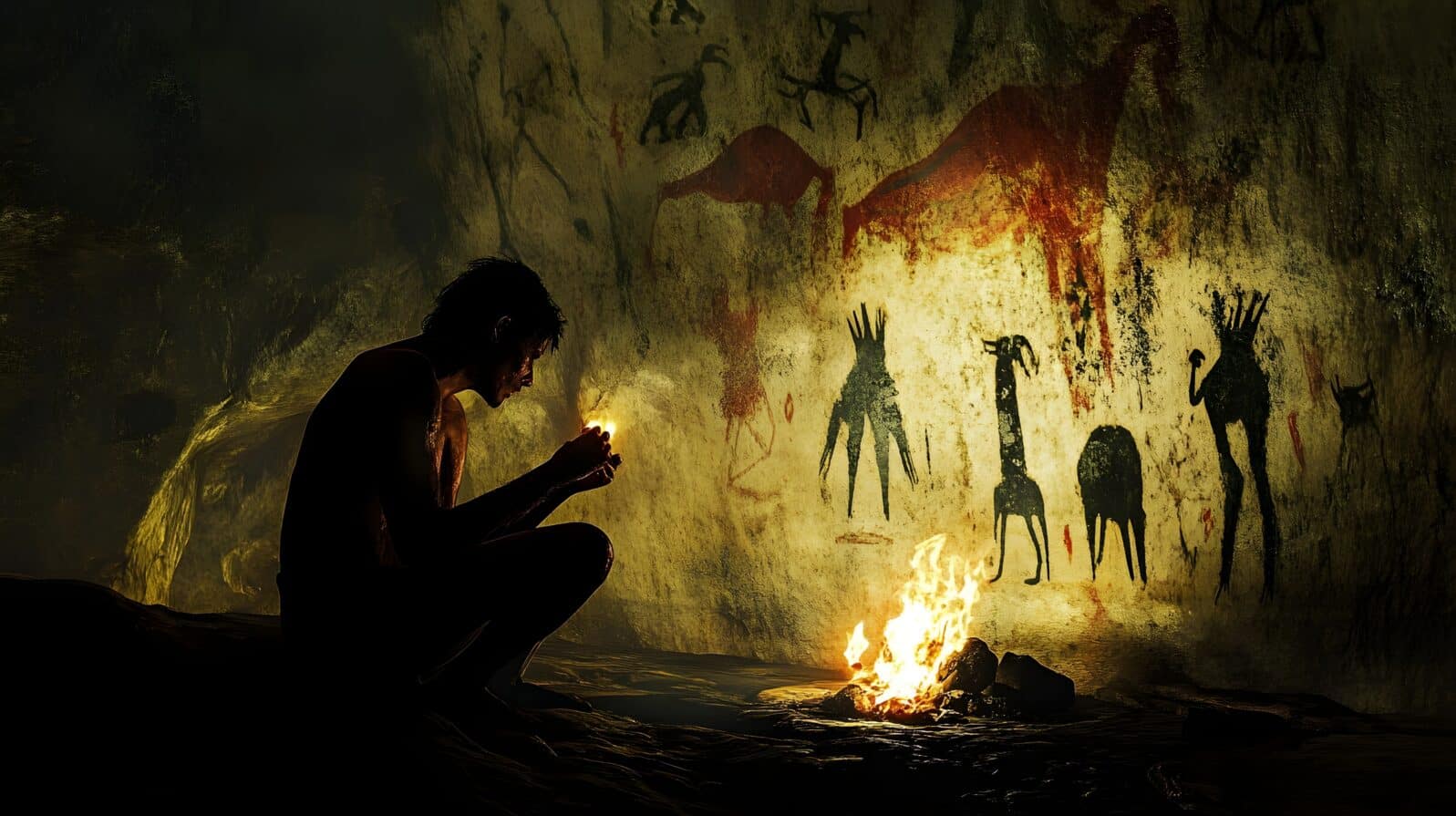
Did Art Really Invent Humanity — as Opposed to the Other Way Around?
It’s an intriguing concept, and a welcome departure from more pedestrian claimsContemplating cave art, Ottawa essayist J. F. Martel offers an interesting thesis at Aeon, as to the origin of humanity — Humans did not invent art. Art invented us:
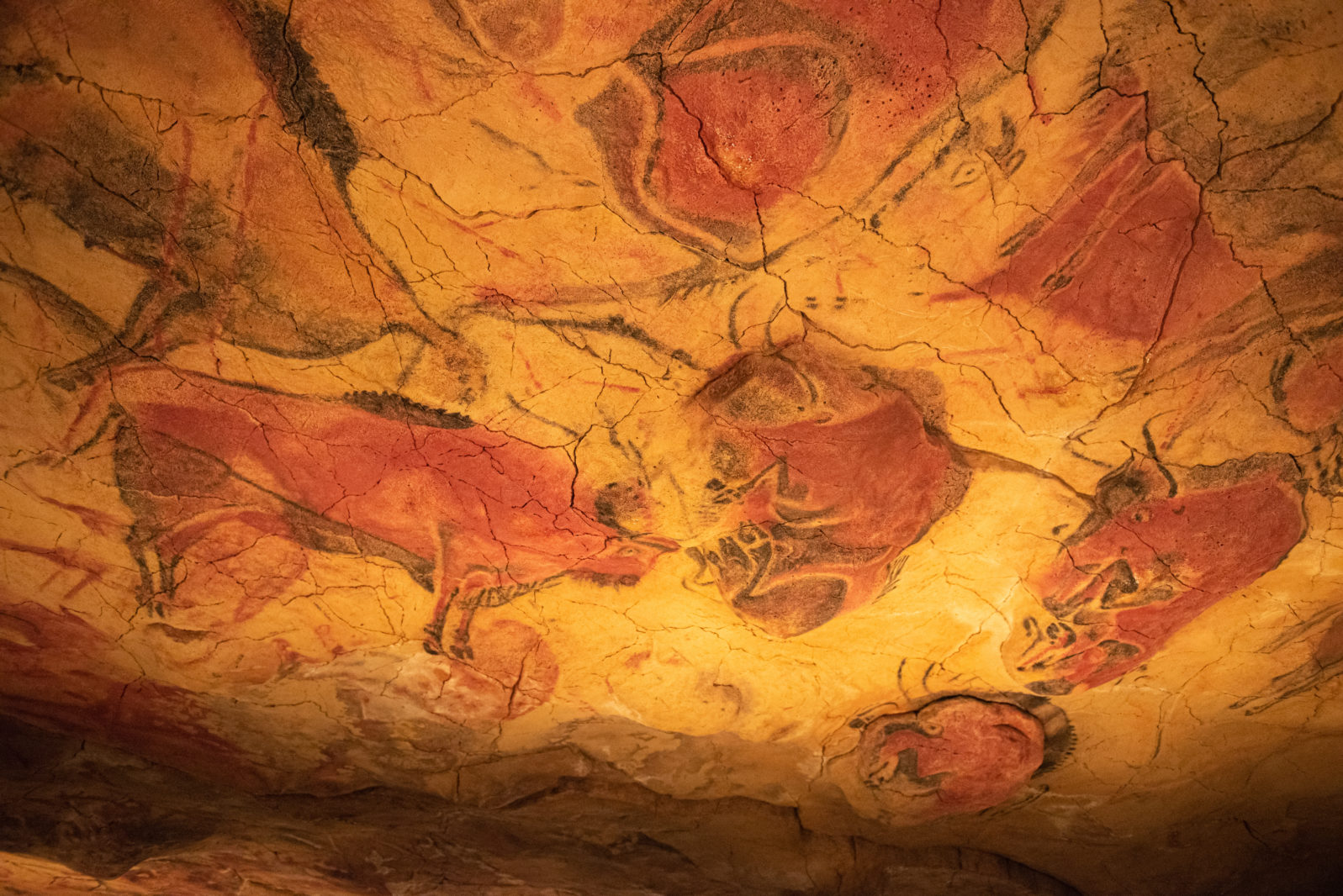 Image Credit: acongar -
 Think about empirical science. In order to have it, we must believe that the Universe is intelligible in principle. Somehow, we humans have the cognitive equipment to think about the world as it is. We must be able to trust our senses enough to believe that the conceptual and mathematical ideas we derive from sensory experience can tell us something about what the world is like beyond sensory experience. The basic realism of science, then, rests upon the following claim: the Universe is such that facts can be plainly stated within it, even though the facts themselves need not be plain.
“How art invented humanity,” July 30, 2026
It’s a longish essay (nearly 5000 words) so I can only touch on a couple of the points he makes:
In beauty, we encounter a gap between what we expect to find in a material universe governed by physical laws – and what we actually find there, however rarely. To say that beauty is bizarre is to say that it is a kind of excess – but an excess of reality, not fantasy. More astounding than the fact that a world exists at all is the fact that the existing world should be so full of wonder and strangeness, because each instance of wonder or strangeness prevents the calculating intellect from clamping down on things and persuading us that we have figured them out. “Invented humanity”
The role of art that really matters is not merely to represent but to create:
Earlier I said that the existence of an intelligible universe isn’t one problem among many but a radical mystery. Ecstatic art (or what James Joyce called ‘proper’ art) puts us in touch with truth and beauty of the second order insofar as that mystery is affirmed therein. It cannot do this by merely representing nature, because to represent is simply to reproduce, changing nothing. Rather, proper art participates in the mystery of creation itself, the process through which the world emerges anew from the womb of nature at each moment. “Invented humanity”
Martel notices something that most of us have missed
Accurate human forms did not appear very often in prehistoric artwork, not until starting about 10,000 years ago. The earlier paintings are mostly of animals.
Is that because few of us dared to depict the human form in earlier days? If cave paintings of animals were thought to exert some influence or power, there may have been a reluctance to risk representations of humans. Once we got over that concern, of course, the human form became the norm in artwork. Animals and plants mostly ended up as part of the supporting cast.
Martel picks up on the magical sense the early animal paintings convey:
The things on the cave walls are not quite those that a scientific mind, intent on measurement and quantification, would recognise. For they appear there as things-in-the-making. And if it is true that nature is creative before it becomes causal, magical before it becomes mechanical, then we are within our rights to say that it is always-already art, and was so from the beginning. Everything is a process of change, a becoming whose course we halt – mentally and thus artificially – when we tag it with a fixed identity, a concept. “Invented humanity”
Thus, he considers the idea that humans invented art as true only after the fact. He sees art as having given us the capacity to become more human: “it was the practice of making images, repeated over hundreds of generations, that occasioned the emergence of those minds we take for granted.”
So what to make of his thesis?
stylized depiction of a human being,
First, it is a refreshing change from the usual reductive efforts of evolutionary psychologists; he understands the cave paintings as a spiritual experience for the artists and their audience. What his thesis does not — and cannot — address is the question of how such a process got started. Art cannot have helped make us more human if we did not start out that way. And that in turn could not have happened without some impetus that was simply not granted to any other life form.
But what he gets right is the sense of ancient people trying out creative and intellectual powers that, in the grind of daily life, they may not have ever realized that they had.
Interestingly, a recent article in Nature picks up on this, in part. At Nature, Ewen Callaway draws attention to bird carvings found in a cave, dating from 40,000 years ago in Ice Age Europe. A very heavily stylized female human figure was also found from that period, the tiny Venus of Hohen Fels, and a flute carved from a vulture bone.
Callaway picks up on the sense Martel is trying to convey:
“There’s something magical about these pieces,” says Nicholas Conard, an archaeologist at the University of Tübingen in Germany, who has led the excavation of Hohle Fels since the late 1990s. Conard argues that the artistic capabilities on display at Hohle Fels and nearby caves mark a shift in cognitive and cultural sophistication that might have helped these humans to flourish in ice-age Europe, when other groups vanished. He now hopes to test this theory by collecting ancient DNA from Hohle Fels cave sediments.
“This is the ultimate laboratory,” says Conard, “Why did it happen here? What’s the driving force? And where does that take us?”
“40,000-year-old bird carvings provide clues to how ice age humans flourished,” July 29, 2026
Conard’s research sounds useful but it’s a lot to ask of DNA.
For one thing, the assumption that the qualities that resulted in cave carvings and paintings necessarily helped groups of people survive is just that — an assumption. Stonehenge, from a much later period, was a magnificent work of monument building. But the Stone Age culture that painstakingly built it was destroyed by a Bronze Age culture. Depressingly perhaps, military superiority was what mattered.
But one of the keystone values of art is that it can survive the civilizations that created it and speak to us tens of thousands of years later.
