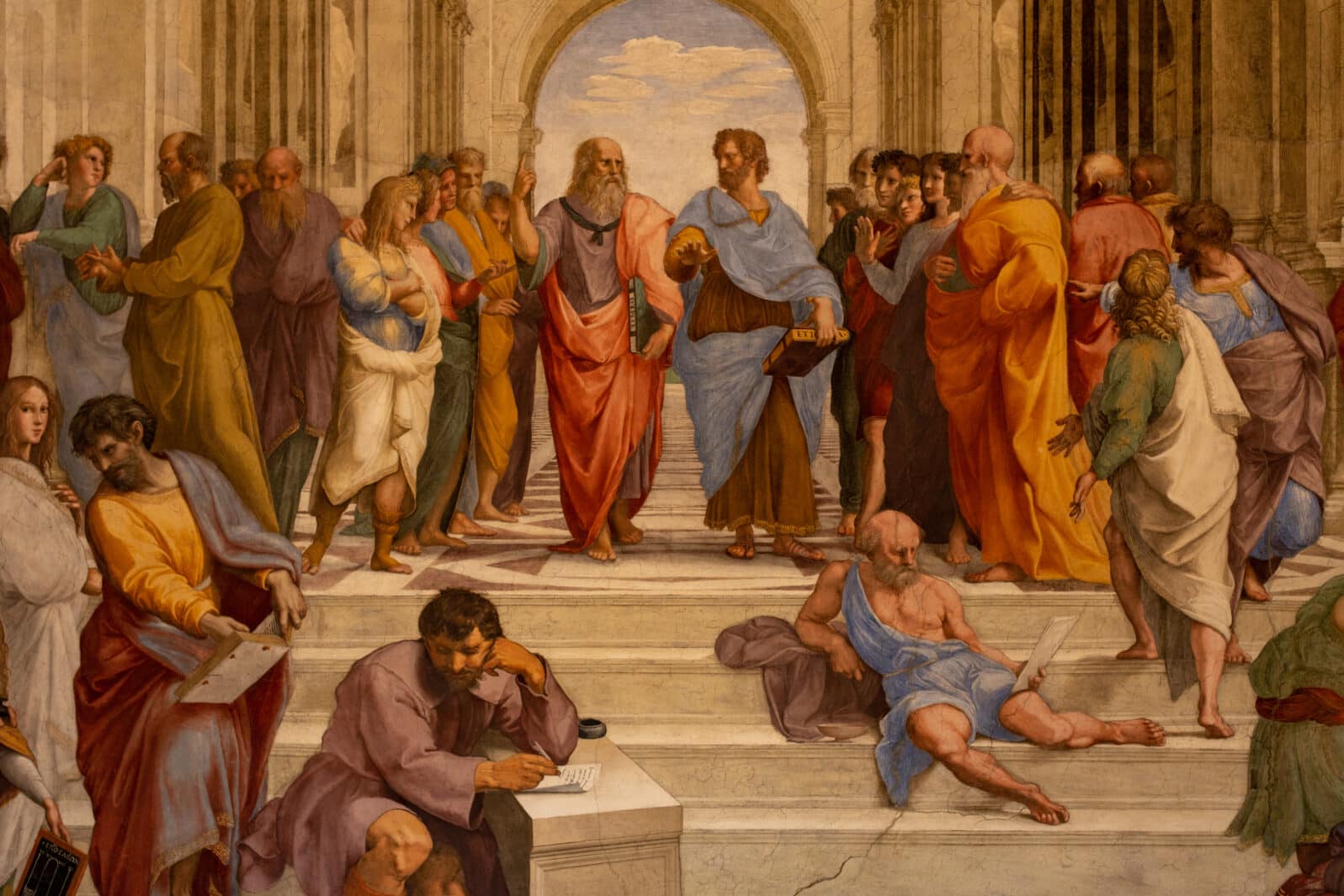
AI Companies are Hiring Philosophers
In 2010, Stephen Hawking said "philosophy is dead"In 2010, Stephen Hawking opened his co-written book, The Grand Design , Hawking, Stephen, Mlodinow, Leonard – Amazon.com, with a sentence that is self-refuting: “Philosophy is dead.”
Hawking argued that the biggest questions about the universe were for physicists to answer or theorize on. He said modern cosmology had become the best tool for exploring questions that philosophy had wrestled with for centuries. He said these things, unaware that they were philosophical statements.
When The Grand Design was published, I attended a weekend conference at a university in Belfast on science, Darwinian evolution, and philosophy. One of the talks focused on Hawking, amid great praise for his co-written book. During a Q&A, I raised my hand and criticised comments Hawking made in The Grand Design.
My question was, “Why did Hawking write such a nonsensical idea that the universe created itself because of gravity?” (In order for the universe to create itself it would have to have existed before it exists; it would have to be before it was! and gravity is part of the universe). I also asked why did Hawking write “philosophy is dead” at the beginning of his book, while constantly philosophising throughout the entire book?
There was an awkward silence in the lecture hall and the host speaker looked at me in what seemed like a confused expression. He said, “Did he really say that?” (He hadn’t read the entire book). I told him the page numbers where he could find the quotes. I wasn’t criticising Hawking the man (a person enduring a severe neurone disease that had paralysed him for decades), but Hawking the scientist.
But, as the speaker looked at me with what seemed like an expression of disbelief, to my rescue came a distinguished astrophysicist on the panel, the then course Director of the Faraday Institute, who stood up and said, “Kenneth is right; Hawking did write those things”. The subject was quickly changed in a ‘move-along-nothing-to-see-here’ kind of way.
Because Hawking was an atheist and didn’t believe the universe was created by God, his views on the origin of the cosmos generally went unchallenged by secular academics and the mainstream media who are generally hostile to Christianity.
Fast-forward 16 years: Who would ever imagine that a higher degree in philosophy would become advantageous in gaining employment in the world of AI?
But it was bound to happen, as a growing number of AI labs have been hiring from a surprising pool of candidates: “Philosophers,” according to NPR Network. NPR’s Scott Detrow talked with Benjamin Sutherland, who recently wrote about this for The Economist: Why AI companies are hiring philosophers to help develop their models : NPR
Host Scott Detrow said:
For years, the conventional wisdom has been that if you want to work in tech, you should learn to code, and if you want a job anywhere, you should avoid liberal arts majors like philosophy. But that is all changing as AI has endangered coding and a growing number of AI labs have been looking for new hires from a surprising pool of candidates. That is right – philosophers. That is, people who have thought deeply about ethics, reasoning and human decision-making.
Over the past few years, I have also written about the need for understanding the Mind/Brain problem and how science, AI, philosophy and theology are compatible: Novelists’ Fear of AI Takeover – New English Review; The Virtues and Limitations of AI – New English Review; The Mind is Not the Brain – New English Review.
I also highlighted the complexity for AI regarding semantics, metaphors, symbolism, and, as an example, humorous punchlines. Imagine a robot, a drunk and a comedian walking into a bar and having a drink together over a few jokes.
The chances of the comedian and drunk laughing at the punchlines to the jokes are quite good. But could the AI robot get such punchlines or even understand the jokes in the way they’re intended to make someone laugh? Or is this understanding unique to the human mind?
High-Tech zealots would think, “Surely AI is more intellectually sophisticated than a drunk.” However, while the drunk and comedian intuitively get the punchlines, AI has to mine the available data in its system and form it into intelligible concepts and the selected language spoken by the humans.
It works like this: ChatGPT mimics human speech by absorbing trillions of such words and conversations that it reads online. It absorbs how to associate sentences and phrases then turn them into concepts, arguments, poems and jokes.
So, it seems reasonable that syntactically, AI might ‘understand’ the joke as a basic narrative, but could it understand it semantically or even laugh at it, puns and all? And can it comprehend the method of allegorical interpretation?
As a humorous example, consider the following joke: An old man hobbles up to the ice-cream parlor and orders a chocolate sundae. As he slouches at the counter rubbing his aching upper thigh, the lady asks him what dressings he’d like. She suggests to him: “Crushed nuts?” to which the old man replies: “No. Arthritis,” as he continues to rub his thigh.
In order for AI to get the punchline of this joke, it would have to select from over many options: The rude slang term ‘nuts’ (male testicles, the intended punchline); nuts (a fruit); ‘nuts’ (slang term for someone who is crazy); ‘nut’ (person’s head); or a nut from a toolkit: a pre-formed metal block with a ‘female’ internal screw thread.
So, it is worth considering if philosophy is crucial to AI in its understanding of intelligence, ethics, consciousness, and some properly basic form of grasping some semantic concepts. It will never fully understand these things that are unique to humans, but it will build on the limited knowledge that AI now possesses.
We now await an army of predominantly middle-aged, bearded male philosophy graduates, out of work for the past 20 years, raising their wrists, thus pointing their fingers to the sky as they make their journey for an interview in Silicon Valley.
