
For C.S. Lewis fans: AI is not N.I.C.E.
C.S. Lewis’s novel That Hideous Strength got drafted into the AI wars — on the wrong side“C.S. Lewis predicted AI in That Hideous Strength. N.I.C.E., that’s AI.” So said Jeremy Wayne Tate, founder of the Classic Learning Test, on X this past February. Tate has plenty of company.
Is AI demonic?
Paul Kingsnorth, whose Against the Machine has made him the most widely read Christian critic of what he calls the Machine, has written that the novel “points at our current spiritual dilemma with perspicacity.” He has also argued, in the pages of Touchstone, that AI is demonic. Kingsnorth never quite connected those two dots in print, but his readers did it for him. Robin Phillips took him to be hinting that AI is less like the Wizard of Oz (pulleys and levers behind a curtain) and more like Belbury’s severed head (machinery as a front for demons).
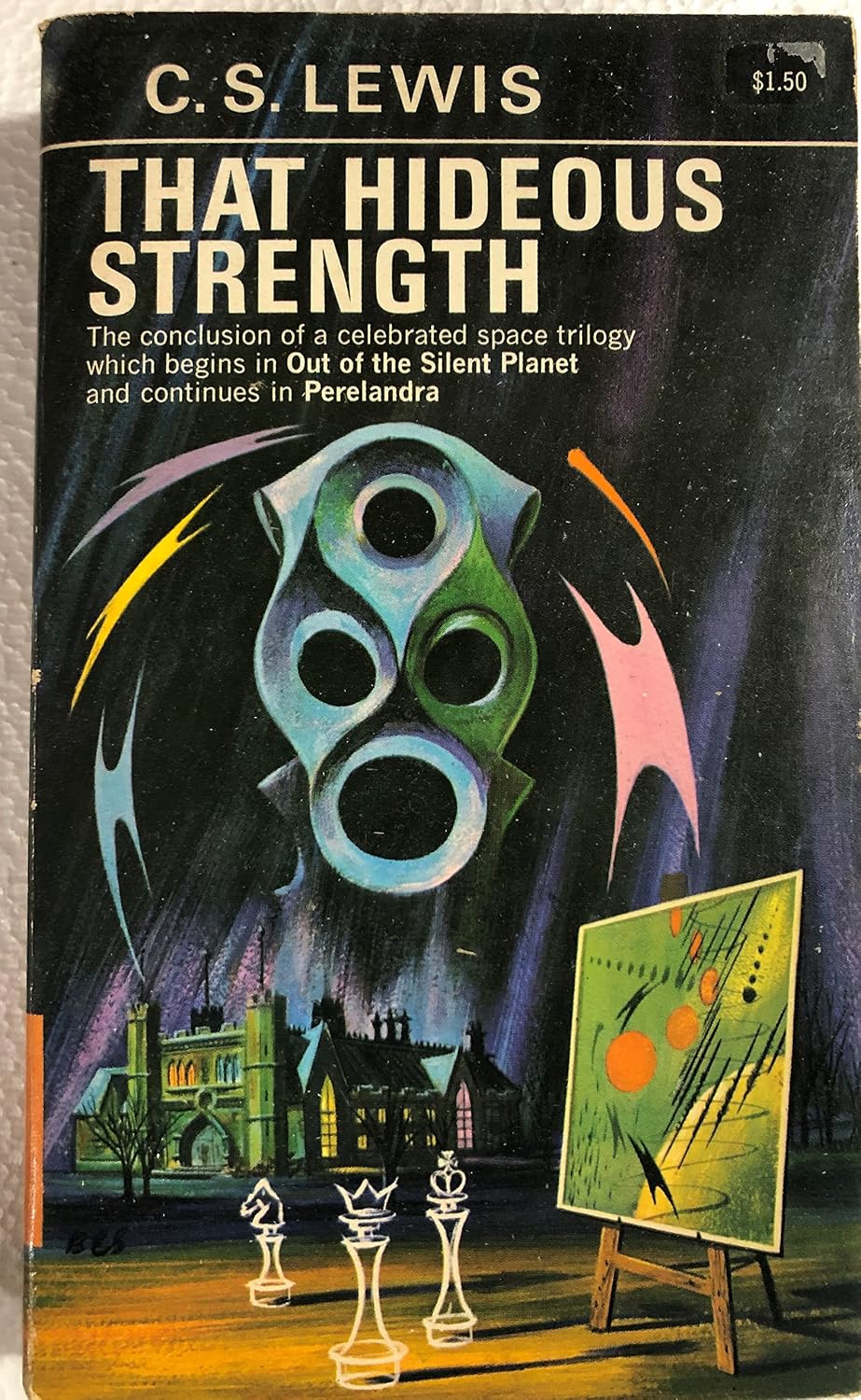
Rod Dreher skipped the hints. He subtitled a 2025 essay “Or, Why We Are Living In C.S. Lewis’s ‘That Hideous Strength,’” and argued that Professor Alcasan’s head, the oracle the scientists at Belbury consult, is really a doorway for demons, and that AI might be too, at least in part. At the Gospel Coalition, Derek Rishmawy surveyed Silicon Valley’s techno-spirituality and concluded, “C. S. Lewis’s That Hideous Strength wasn’t fiction; it was prophecy.”
This September, Mere Orthodoxy ran Annie Crawford’s long essay pairing Lewis with Kingsnorth’s Machine, which diagnoses our moment this way: “Concerned about the existential dangers of AI, we rush to create more AI.” And in August, Shane Morris asked in WORLD Opinions whether Ross Douthat had interviewed every Lewis villain, starting with my friend Peter Thiel. I answered that one in WORLD and won’t relitigate it here.
The novel, in other words, has been drafted. It’s been conscripted into the AI wars and marched out against the builders. I have some skin in this game.
That Hideous Strength (1945) is my favorite novel. The first paper I wrote in college was about Lewis’s A Preface to Paradise Lost (1942), and our youngest son is named after Lewis. My family is even considering a family tattoo theme, with a lampstand as the current front-runner. Lewis is important enough to me that I don’t want to see his novel used in non-Lewisian ways.
The most remarkable fact about N.I.C.E. is hidden in plain sight
The critics do get a great deal right. Lewis did see something coming, and the novel really is about technology, power and the demonic. Where they go wrong is on the question of who the villains are. Read it again, slowly, the way Lewis meant it to be read (there are no throwaway details in this book), and you’ll notice something odd about the most sinister institute in English fiction: for all its laboratories, it produces almost nothing. Belbury is a taker, not a maker.
Crawford herself calls the N.I.C.E. a quasi-governmental organization, and she describes the Machine as running on bureaucratic state power. She’s closer to the truth than she may realize.
Start with this: for an institute, N.I.C.E. does remarkably little science. The lab work is almost incidental — what the name actually describes is the National Institute of Co-ordinated Experiments.
The C in the title is doing all the real work; the I and the E are just cover.
What N.I.C.E. actually does is coordinate: capturing institutions, extending bureaucratic control, running propaganda, policing dissent, managing populations psychologically, and manufacturing emergencies that justify still more power. Lewis, once again, anticipated something real, something like Effective Altruism and the modern NGO. It is precisely the kind of body that safetyists would want running things and that some religious leaders would want overseeing AI development.
The pattern is older than AI. In 1946, the propaganda film One World or None argued that America should hand its atomic monopoly to the United Nations or risk the world’s destruction. Ever since, “Do you want humanity to survive?” has come packaged with the same rider: surviving nuclear weapons, climate change, biotechnology, pandemics, or artificial intelligence requires handing authority to a sufficiently powerful global body — a point Oxford philosopher Nick Bostrom has pressed repeatedly. Paul’s warning in 1 Thessalonians 5:3 turns on exactly that slogan: “peace and safety.” Fear of disaster produces the authority that promises to prevent it. I read that passage as commentary on first-century politics rather than a forecast of the twenty-first, but the logic travels well. A system demanding enough power to guarantee peace and safety, to eliminate risk, is the biggest risk of all.
Organizations like OpenAI, Google DeepMind, Anthropic, and other AI research organizations build models, test capabilities, and make technical discoveries. But N.I.C.E. borrows the prestige of science while devoting itself to propaganda and political control.
Lewis establishes that distinction within the novel through William Hingest, known as “Bill the Blizzard,” a distinguished chemist and a Fellow of Bracton College. He accepts recruitment by the N.I.C.E. because he expects serious scientific work but promptly resigns after discovering a political project instead. By then he has seen too much and is murdered. But he goes down fighting.
The choice of a chemist looks particularly apt for illustrating my point. The 2024 Nobel Prize in Chemistry recognized two Google DeepMind researchers for developing AlphaFold2, an AI model that solved the decades-old problem of predicting complex protein structures. Would a real-life contemporary Bill the Blizzard be writing position papers advocating that this sort of research be coordinated by N.I.C.E., or would he, right now, be using the latest tools to model the extremely complex problem of protein folding?
Reading That Hideous Strength in the light of Lewis’s Abolition of Man (1943)
Lewis said as much in his preface: “This is a ‘tall story’ about devilry, though it has behind it a serious ‘point’ which I have tried to make in my Abolition of Man.” That’s the license for reading Filostrato philosophically rather than merely as a villain.
Start with his body. Abolition of Man’s charge against the debunkers is that they strip the heart of its trained loves — the Tao — and still expect virtue from what’s left: “In a sort of ghastly simplicity we remove the organ and demand the function… We castrate and bid the geldings be fruitful.” Filostrato is that sentence made flesh: obese and an actual eunuch, unfruitful in himself, whose program is to unmake the rest of creation the same way and call it progress — metal trees for real ones, a switch for real birdsong, a brain kept alive on chemicals instead of “dead brutes and weeds.” He is the gelding of Lewis’s metaphor, turned missionary — his own inverted gloss on Christ’s eunuchs “for the kingdom of heaven’s sake”: he made himself one for the kingdom of the N.I.C.E.
Reading more deeply into Filostrato
And this is where shallow readings of literature for the purpose of polemics leave the reader shortchanged. Dig around in a text looking for a weapon, and you stop the moment you find one. Dig around in it looking for truth, and you keep digging. The facile, polemical reading never gets as far as the name Filostrato.
His name makes the same argument twice, and deliberately. Read through its Greek roots — philos, love, plus stratos, army or host — Filostrato means something like lover of conquest. Boccaccio, who coined the name for his own poem Il Filostrato (c.1335), glossed it in the opposite direction: laid low by love. Neither reading was idle wordplay for Lewis. His Greek was not a schoolboy’s; his autobiography records how completely the language had become second nature to him even as a young man under Kirkpatrick’s tutelage: “I very soon became able to understand a great deal without (even mentally) translating it; I was beginning to think in Greek.” And Boccaccio’s Italian poem was no book Lewis knew at second hand — in The Allegory of Love (1936), he works through Il Filostrato directly, weighing it clause by clause against Chaucer’s Troilus and Criseyde.
A scholar who had read both the Greek root and Boccaccio’s own poem that closely did not reach for this name as an empty label. Both of its meanings are Abolition of Man’s central claim in miniature: “Man’s conquest of Nature turns out, in the moment of its consummation, to be Nature’s conquest of Man.” Filostrato, the Lover of the Conquest of Nature, ends exactly as Boccaccio’s gloss says the name means — laid low, by the N.I.C.E.’s own libido dominandi, the lust for domination left standing once the moral code is gone. He designed the guillotine that kills him.
Filostrato is also a deliberate, inverted John the Baptist. Both are forerunners, and Lewis gives both of them the identical, literal fate: beheading. John goes before the true King and dies bearing witness to a kingdom that was real, whether he lived to see it or not. Filostrato goes before a different king — the coming reign of the disembodied “next stage,” dominion belonging finally, he tells Mark, to “one man” freed from decaying flesh — and his beheading is a liquidation: the machine he designed, in hands loyal only to power, discards him once he’s spent, with none of the vindication history grants a martyr.
True to his gospel to the last second, what escapes him at the end is a technician’s complaint about sloppy workmanship — wrong temperature, no sterilized blade. That is the eunuch argument closing on itself: the chest is exactly the organ that would produce indignation at one’s own murder, and Filostrato’s was excised long before the guillotine ever reached his neck.
The institution is similar to the man
The same logic operates one level up, on the institution rather than the man. Bracton was named for Henry de Bracton, source of the common-law principle that even the king stands “under God and the law” — justice bounded by desert, a sentence that fits a crime and ends. By the novel’s time the college has “forty Fellows, of whom only six study Law and of whom none, perhaps, prays for the soul of Bracton”: the tradition on the letterhead, hollowed out underneath.
What replaces it is what Lewis names two years later in “The Humanitarian Theory of Punishment”: a system that discards desert for cure, which has no natural stopping point. A man can be held under “an indefinite sentence terminable only by the word of those experts,” handed to “technical experts whose special sciences do not even employ such categories as rights or justice.” Lewis’s verdict: “a tyranny sincerely exercised for the good of its victims may be the most oppressive… It would be better to live under robber barons than under omnipotent moral busybodies.” That is N.I.C.E. in one sentence.
The guillotine carries that same history into the scene itself. It was conceived as a mercy — a swift, equal method of execution bound to the idea of a sentence that fit a crime — and became the Terror’s icon the moment it was unmoored from desert, put to work purifying the nation of counter-revolutionary contamination instead. Wither and Straik turning it on Filostrato has the same late-Revolutionary logic as Robespierre’s own end on the same machine: a movement that has abolished the old restraints in the name of purification does not stop with outsiders. It moves on to its own, and the instrument built to execute enemies of the new order ends up executing the men who built it.
The role of the severed head
The guillotine’s first victim, in the story’s own timeline, is Alcasan — guillotined before the novel opens, for poisoning his wife. The N.I.C.E. preserves his severed head and makes it the household god of Belbury: “the Head,” consulted and obeyed by everyone including Filostrato. The relic is a fraud even by the novel’s own account: what speaks through it is not Alcasan’s mind at all. Note what Lewis tells us on the novel’s first page: Alcasan was a radiologist, and an Arab by descent.
Sanford Schwartz has pointed out that the name itself hints at alchemy, a word that comes to us from Arabic, and Lewis the philologist would have known it. Alchemy is the right word for what goes on at Belbury: transmutation and the quest for undying life, dressed up as science. One more reason to doubt that the N.I.C.E. is about science at all. A severed head worshipped as an oracle inside a guarded stronghold reads like a picture of the gates of hell, and Christ’s promise about those gates was that they would not prevail.
Lewis does not leave that promise merely implied. When the N.I.C.E. falls, its own caged animals turn on their keepers first — a bear kills Wither, the Deputy Director who has quietly run the place all along — and then the ground itself gives way, swallowing Belbury and Edgestow into a single chasm. The fortress is not stormed from outside. It is crushed from underneath, the oldest promise in the book: Genesis 3:15’s “it shall bruise thy head, and thou shalt bruise his heel.”
Transhumanism vs. Christianity
Filostrato wants the function without the organ — a mind preserved by machine once the body is ruled to be an inefficiency. Christianity runs the other direction. The transhumanist dream offers, at most, a longer lifespan, edited genetic material, or a simulation of someone’s mental patterns. Christianity promises something categorically greater: the resurrection of the body, the whole person, body and soul, made new. Lewis spent the final chapters of Miracles (1947/1960) insisting on exactly this: the Christian hope is not a ghost slipping free of nature but nature itself, raised and remade. Filostrato would keep the head and discard the rest. The resurrection keeps everything.
Filostrato’s own prophecy — organic life abolished, dominion finally reduced to “one man” — describes, in Lewis’s fictional terms, what Christians have historically called the Antichrist: the ruler who completes the modern project of consolidated, unaccountable power. That Hideous Strength is, at bottom, a story about human beings working in concert to prevent exactly that consolidation of power. Ransom’s company at St. Anne’s wrestles not against flesh and blood; the descent that empowers Merlin is what secures their Pentecost-like victory.
What’s in the name, St. Anne’s?
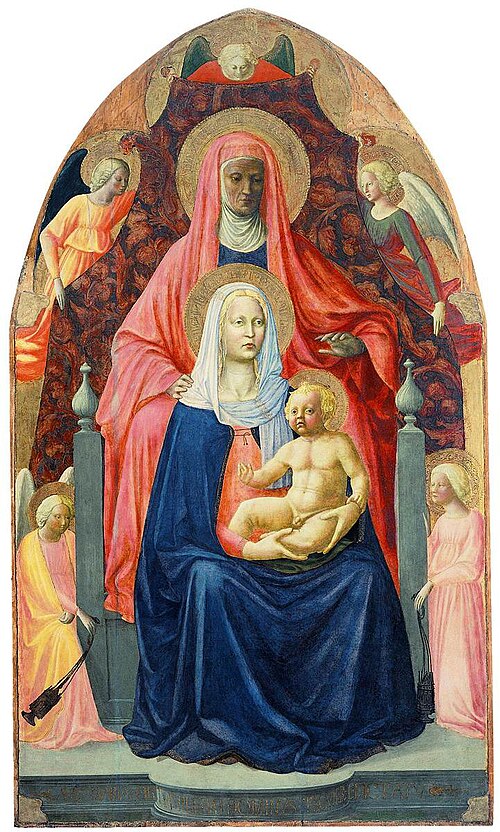
Panicale, Public Domain
St. Anne’s own name carries the message in microcosm. Tradition holds Anne as the mother of Mary, granted a child late and only after years of barrenness — patron of grandmothers and of couples who cannot conceive. Lewis’s household takes her name, and its final chapter, “Venus at St. Anne’s,” delivers exactly that inheritance: animals pairing off around the grounds, marriages reuniting, and Mother Dimble — childless herself — dressed as a “mother of mothers” at the center of it.
The same pattern is illustrated by the Studdocks’ own marriage. Jane and Mark begin the novel having settled, on Jane’s terms, that they “were to have no children, at any rate for a long time yet” — her reasoning: “One had one’s own life to live.” It is the same life-denying refusal running through the book at three scales at once: Filostrato’s is biological, cut out of his own body; N.I.C.E.’s is civilizational, engineered onto the whole planet; Jane’s is domestic, chosen in the name of an autonomy she believes a child would invade.
All three are answered at St. Anne’s, in the same chapter, by the same restored fruitfulness. Filostrato’s life denial comes to its logical conclusion, moving from castration to beheading. N.I.C.E. is destroyed, and its plans to eradicate all life on earth are defeated (for the moment). And Jane’s last steps in the book carry her back toward exactly what she had refused: “she thought of children, and of pain and death.”
St. Anne’s is the pro-natal counter-civilization built against N.I.C.E.’s sterility on every scale it appears: a household named for a birth that reversed barrenness, set against an institute run in the end by a man who can no longer produce one, and a marriage that completes itself only once it stops holding children at bay. All this contrasts nicely with Alcasan, who poisoned the wife he had and left behind a severed head that became N.I.C.E.’s oracle of demons which would poison all marriage and indeed all life.
A question for AI companies, investors, and critics
By that measure, the question to ask about any AI company, investor, or critic is not whether he builds powerful tools, but whether he wants those tools coordinated from Belbury. Those who resist that consolidation belong with the band gathered at St. Anne’s-on-the-Hill. If they fail, they and the rest of us will be like Bill the Blizzard: we will go down fighting.
And what of the politics of that hideous strength? It probably wasn’t until my fifth reading that I noticed the significance of the fictional college in which the drama plays out: Bracton College, founded in 1300 “for the support of ten learned men whose duties were to pray for the soul of Henry de Bracton and study the laws of England.”
The choice before our institutions in the age of AI is between Bracton and Bostrom: law that binds the powerful, or power that promises to keep us safe.
I think that the ten learned men may be a quiet biblical nod to Genesis 18. Abraham negotiates with God over Sodom until God agrees that the city will be spared if ten righteous people can be found. Others may differ.
A warning for writers and thought leaders
Two Lewisian warnings apply directly to writers and thought leaders. The nearer one is Mark Studdock in That Hideous Strength. Capable, ambitious, and desperate to be let inside the Inner Ring, he is undone less by malice than by vanity. Chasing the approval of people he thinks matter, he lets his patrons’ expectations quietly reshape what he is willing to call true. Any journalist, essayist, or commentator who shapes copy to please an audience, an editor, cliques, or clicks is walking Studdock’s road. Charles Williams, Lewis’s friend and one of the models for the novel, tells a kindred cautionary tale through the central figure of Descent into Hell (1937). I read the Studdock passages with real unease every time, and anyone entering a public controversy should do the same.
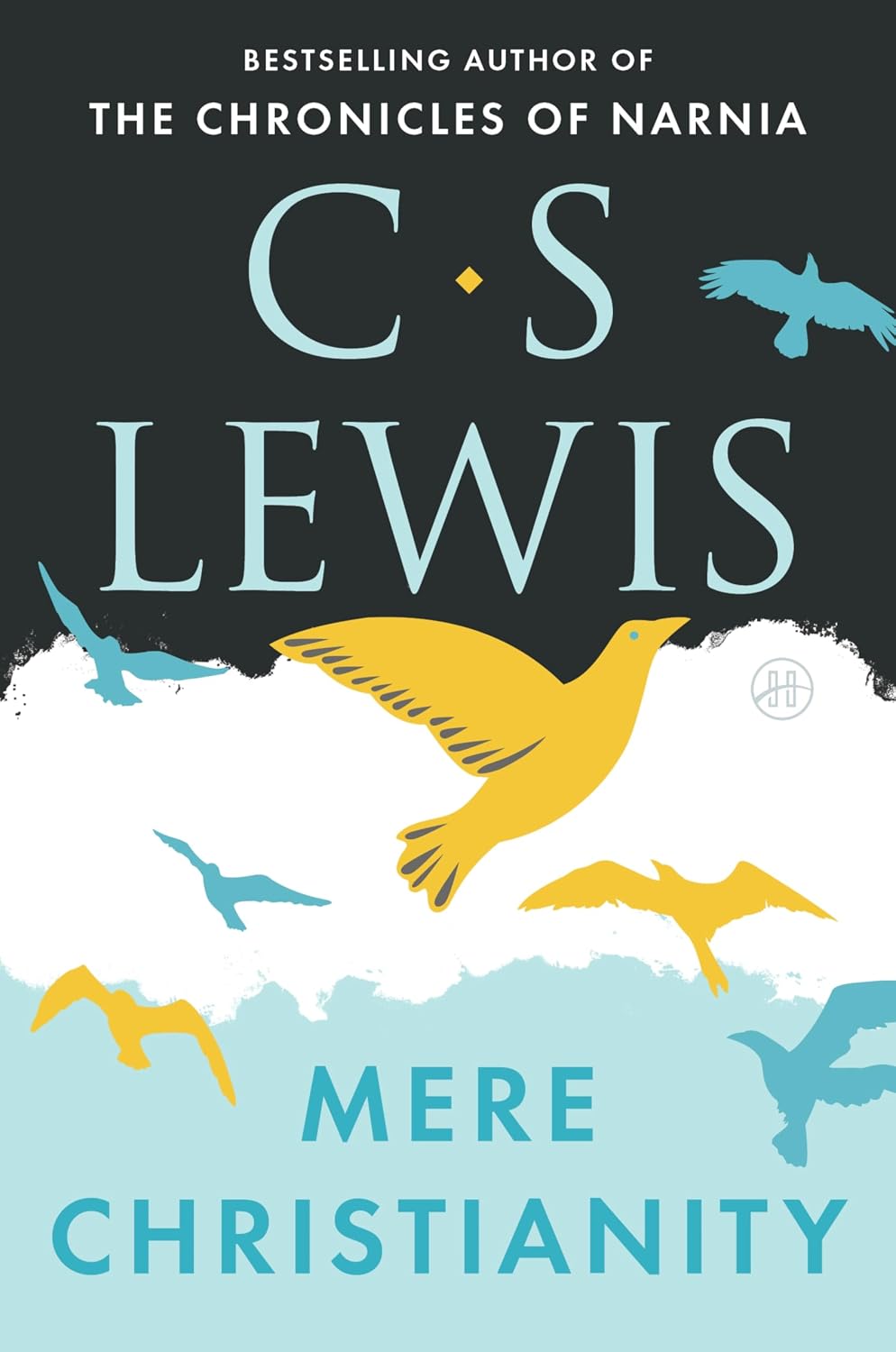
The other Lewisian warning comes from Mere Christianity (1952) and is directed toward anyone in search of villains. Suppose the press reports terrible conduct by one’s enemies, Lewis asks:
Suppose one reads a story of filthy atrocities in the paper. Then suppose that something turns up suggesting that the story might not be quite true, or not quite so bad as it was made out. Is one’s first feeling, ‘Thank God, even they aren’t quite so bad as that,’ or is it a feeling of disappointment, and even a determination to cling to the first story for the sheer pleasure of thinking your enemies are as bad as possible? If it is the second then it is, I am afraid, the first step in a process which, if followed to the end, will make us into devils. You see, one is beginning to wish that black was a little blacker. If we give that wish its head, later on we shall wish to see grey as black, and then to see white itself as black. Finally we shall insist on seeing everything — God and our friends and ourselves included — as bad, and not be able to stop doing it: we shall be fixed for ever in a universe of pure hatred. (p. 118)
Let’s use the test Lewis himself suggests. Once readers learn that Lewis’s villain is the coordinator, not the chemist, do they respond, “Thank God, they are not quite as bad as that”? Or does the lurid picture of AI as Alcasan’s Head feel too satisfying to give up? We’re about to see which.
So by all means, let’s keep reading That Hideous Strength in the age of AI. But let’s read it the way Lewis wrote it. The novel’s one honest scientist is among the first to see through Belbury, and he pays for it with his life. Christians who have drafted the book into a campaign against the builders have put it in the wrong uniform.
