Orwell: Totalitarianism Starts As an Internal Mental State
While the scene has certainly changed in the last eighty years, the effort to control information is still vigorousOn Saturday, I looked at Matt Johnson’s thoughts on George Orwell’s vital but comparatively unknown 1946 essay, “The Prevention of Literature.” Orwell, famous for Animal Farm (1945) and Nineteen Eighty-Four (1949), wanted to “make political writing into an art.”
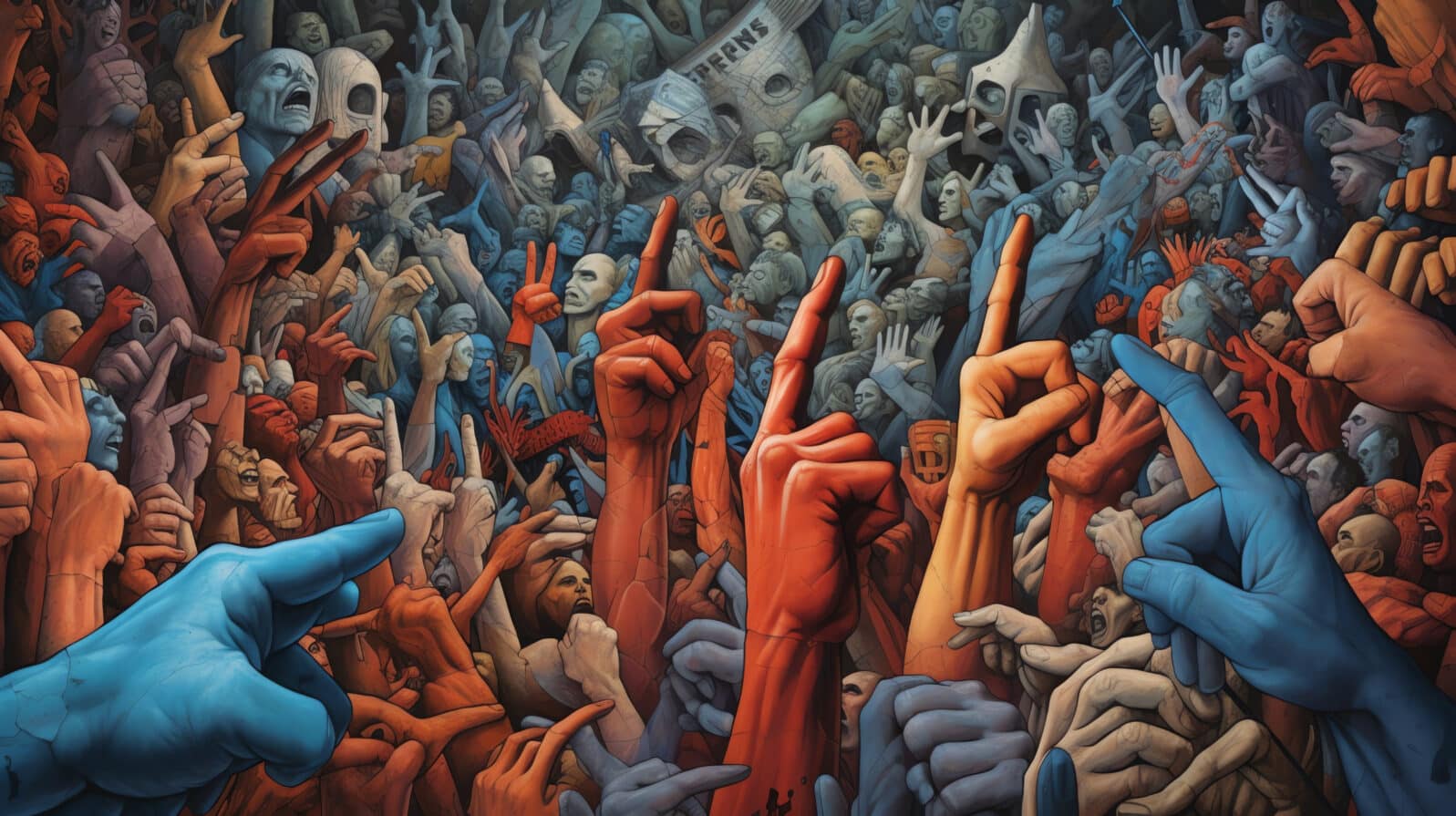
 Image Credit: Igor Nikushin -
 He was well aware that most competitors for public attention simply wanted to make political writing a reliable form of mass brainwashing. He hoped to find a public that sought an alternative.
He published “Prevention” (longish, at 5500 words) in Polemic, a short-lived British intellectual magazine (1945–47), which featured work by such notables as Henry Miller, Bertrand Russell, A. J. Ayer, and Dylan Thomas.
Intellectual freedom as “violence”
Intellectual freedom, as we have always been told, is only ever one generation away from extinction. While the scene has certainly changed over the last eighty years, the effort to control information is still vigorous. I’ve excerpted a few parts of the essay and offer some update comments:
Freedom of thought and of the press are usually attacked by arguments which are not worth bothering about. Anyone who has experience of lecturing and debating knows them off backwards. Here I am not trying to deal with the familiar claim that freedom is an illusion, or with the claim that there is more freedom in totalitarian countries than in democratic ones, but with the much more tenable and dangerous proposition that freedom is undesirable and that intellectual honesty is a form of anti-social selfishness. “Prevention”
Most of us today will be unfamiliar with the specifics of the issues in Britain just after the end of World War II. But we are all familiar with the assault on intellectual freedom Orwell describes. The term of art today is “Your speech is violence.”
As Jonathan Turley put it, in The Hill,
The redefinition of opposing views as “violence” is a favorite excuse for violent groups like antifa, which continue to physically assault speakers with pro-life and other disfavored views. As explained by Rutgers Professor Mark Bray’s in his “Antifa: The Anti-Fascist Handbook,” the group believes that “‘free speech’ as such is merely a bourgeois fantasy unworthy of consideration.”
“‘Your speech is violence’: the left’s new mantra to justify campus violence,” June 3. 2023
Or, as Orwell said in his essay, opposing views are “a form of “anti-social selfishness” … He goes on:
Although other aspects of the question are usually in the foreground, the controversy over freedom of speech and of the press is at bottom a controversy of the desirability, or otherwise, of telling lies. What is really at issue is the right to report contemporary events truthfully, or as truthfully as is consistent with the ignorance, bias and self-deception from which every observer necessarily suffers.
Truth may be too hot to handle
Media coverage today takes some lies for granted because the alternative may be too hot to handle. For example, the widespread claim that there is a dispute about when human life begins is false. Human life, like all animal life, begins at conception and continues until natural death, sooner or later. The controversy is really over when it is acceptable to treat a human entity as medical waste or disposable material for an experiment. But that can’t readily be admitted.
Similarly, despite media claims, there is no true controversy over whether some humans can be transgender. Humans are primate mammals and no primate mammals can change their sex. We humans can and do believe all sorts of things about ourselves and we act on these beliefs — but our beliefs remain beliefs. However, again, can this really be admitted without controversy?
The pretense of a controversy is driven in both cases by political needs, to which media routinely defer, especially if, as in Canada, most of the media are funded by the government.
Another of Orwell’s sobering observations is worth mentioning here:
Literature has sometimes flourished under despotic regimes, but, as has often been pointed out, the despotisms of the past were not totalitarian. Their repressive apparatus was always inefficient, their ruling classes were usually either corrupt or apathetic or half-liberal in outlook, and the prevailing religious doctrines usually worked against perfectionism and the notion of human infallibility. “Prevention”
Indeed. Those regimes, whatever their aspirations, also never had the panopticon of total surveillance that is potentially available today. That panopticon may itself advance creeping totalitarianism.
No fixed beliefs
One other thing that Orwell stresses is that, unlike a traditional religion, modern totalitarianism does not have fixed beliefs:
What is new in totalitarianism is that its doctrines are not only unchallengeable but also unstable. They have to be accepted on pain of damnation, but on the other hand, they are always liable to be altered on a moment’s notice. “Prevention”
We’re closer than we might think. Remember when the promotion of women’s sports alongside men’s sports was a big political issue? But in a few short years, it was completely wasted by the trans lobby — demanding inclusion of biological males in women’s sports, who promptly made off with a large share of the prizes. And the same pundits were expected to simply switch gears and applaud. Which they mostly did.
In short, as Orwell knew, you don’t need armies in jackboots to enforce a totalitarian mindset. Many people in modern Western societies are already there and adopt it willingly. That’s the real threat to intellectual freedom, then and now.
Note: Orwell had trouble getting Animal Farm published in Britain because it showed Stalinist Russia in a bad light.
