AI and the Spectrum Crisis: What You Need to Know
The spectrum crisis is NOT a metaphor. The frequencies everyone wants are finite, the physics will not budge, and the tools to fix the problem are availableThe air around you is full of information-bearing radiation—cell signals, Wi-Fi, broadcast television, AM and FM radio, GPS, and radar They all travel as electromagnetic waves.
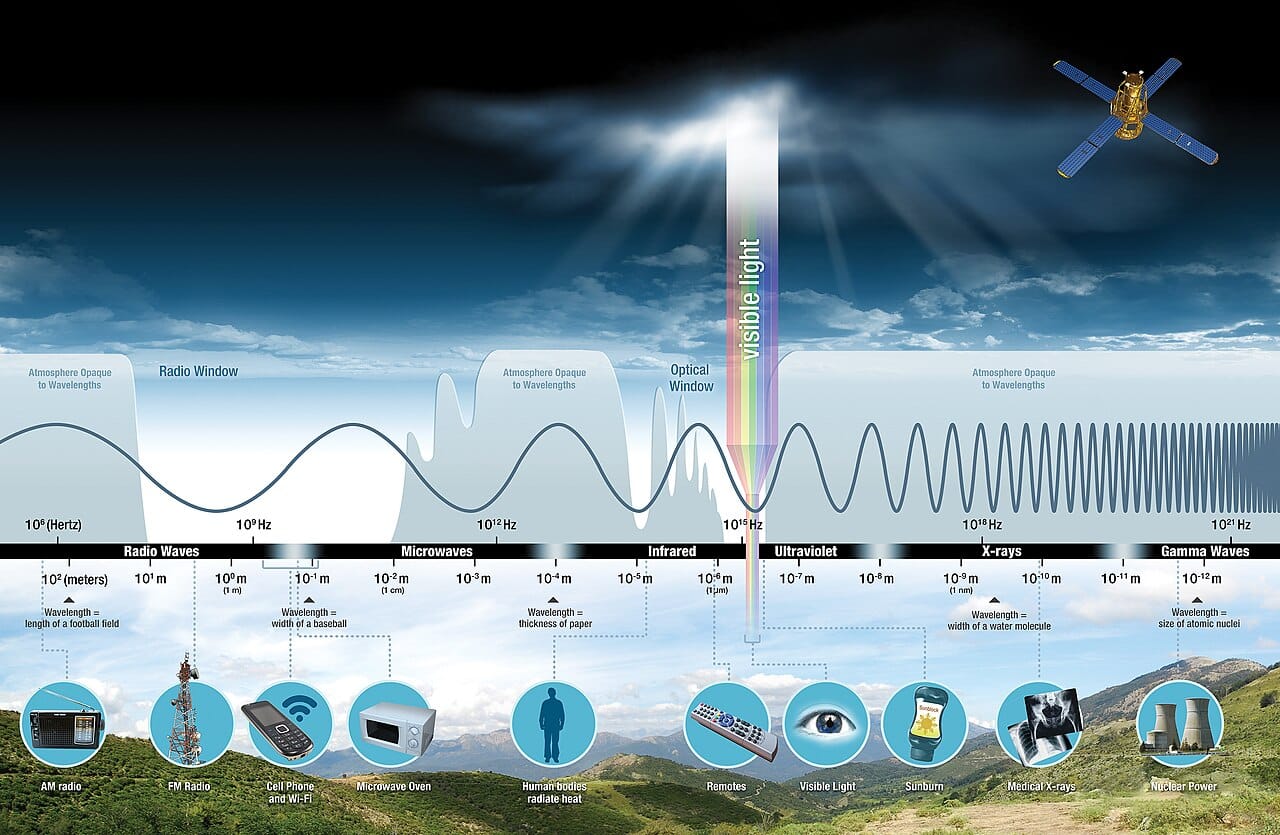
The only thing that separates one type of wave from another is its frequency—how many times the wave wiggles each second. Visible light is the same kind of wave. It oscillates trillions of times a second.
Managing that range of frequencies, the electromagnetic spectrum, was the subject of a recent Mind Matters News conversation hosted by Robert J. Marks.
Marks is joined by three colleagues from Baylor University’s SMART Hub, a 15-university research center devoted to enabling a more effective use of the wireless spectrum: Charles Baylis, a professor and the center’s director, who has testified before Congress on the topic; Austin Egbert, also a professor at Baylor; and Jonathan Swindell, a PhD candidate. Their shared warning is simple. The world is running out of usable frequencies, and regulation alone will not fix it.
Why are we running out of usable frequencies?

Baylis traces the crunch to a change most listeners have lived through. When he was born in 1979, almost no one carried a personal wireless device. Students in his classes now walk in with four or five. Every cell phone, radar, and passive scientific instrument needs a slice of spectrum.
Weather forecasting is one of the less obvious claimants. Radiometers listen for the faint radiation that atmospheric water vapor emits between 23.6 and 23.8 gigahertz, and for an oxygen emission near 50 gigahertz. Those signatures sit at fixed frequencies. Nature will not retune them. When 5G was allocated near 24 gigahertz, engineers worried that out-of-band emissions from phones could wash out the water-vapor signal and degrade forecasts of hurricanes and other water-driven storms.
Not all frequencies are created equal
That raises the obvious question: why not just move one service up or down the dial, the way a listener changes an AM station? Baylis’s answer is that not all frequencies are equal. The stretch from just below one gigahertz to about four, five, or six gigahertz is what spectrum people call beachfront property. Radar likes it because the wavelength is short enough for a reasonably small antenna and sharp enough to image an aircraft or a ship.
Drop too low in frequency and the wavelength grows; the target spans fewer wavelengths and the image gets worse. Climb too high and atmospheric attenuation and ordinary propagation loss take over. Loss grows with frequency, and signals have a harder time crossing distance or punching through walls and windows. Even above six gigahertz, those problems become serious. Early 5G plans that simply “went higher” ran into that wall and came back down into mid-band. A recent fight over 3.1 to 3.45 gigahertz—wanted both by Department of War radar and by commercial wireless—was a fight over that same scarce middle.
SMART Hub’s proposed AI solution to the crisis
SMART Hub’s proposed way out is sharing, not another exclusive carve-up. A radar operating near 3.1 gigahertz could sense a nearby wireless network, shift to 3.4 gigahertz, and keep its range. The hard part is that conventional electronics are built for one frequency. Move the operating point and efficiency, power, and range all sag unless the circuitry reconfigures itself in milliseconds or less, at high power. Baylis said that the needed combination—speed plus power handling—was missing until recent device breakthroughs.
Much of that reconfiguration happens in the power amplifier, the last stage before a signal leaves the antenna. It boosts the waveform enough to reach a receiver, and it consumes more power than any other part of the transmitter. More output power means more radar or communications range, but an amplifier pushed for efficiency also tends to splatter energy into neighboring bands. Designers have to trade range, battery efficiency, and interference in real time.

Egbert explained how engineers find the right setting; they use a measurement called load pull. He compared it to a window at night: some light reflects but some passes through, because glass and air have different impedances. Electronics do the same thing at circuit boundaries. Certain impedances give an amplifier its best efficiency and output power; others do not. A load-pull setup presents many impedances and records the result. Traditional mechanical tuners can take seconds per point. Faster electronic tuners exist, but they are expensive. The search is iterative—nudge, measure, nudge again.
The group has a patent in process that cuts the number of those experiments by borrowing a trick from artificial intelligence. Given an image with a missing patch, an AI model can fill in a plausible completion. Applied to load-pull data, the same idea lets the system infer much of the performance map from fewer measurements.
But the hardware timeline is the other half of the story
Baylis and Marks began the work around 2010, after a military colleague warned that radar coexistence would become a major problem. Early tests on commercial laboratory tuners took minutes and were only meant to prove the algorithms. Navy and National Science Foundation funding followed.
Power handling was the next roadblock. With colleagues at Purdue, the team moved to a mechanically actuated evanescent-mode cavity tuner—levers over resonant cavities—that handled roughly 90 to 100 watts near 3 gigahertz and tuned in about two seconds. Physical motion still could not reach milliseconds.
That changed, however, with silicon plasma switches, conductive when illuminated and insulating when the light is removed. A tuner built on those switches can finish a tuning algorithm in hundreds of microseconds, handle about 20 to 65 watts from 2 to 4 gigahertz, and is small enough to imagine inside a real system. Over roughly 15 years, optimization went from minutes to under a millisecond. Baylis called that the difference between “we must regulate” and “real-time coexistence is technically feasible.”
The political jockeying could affect your cell phone use
Marks talked about that. Spectrum auctions have moved bands from military assignment to commercial use. A strong defense and a thriving wireless industry both matter. Sharing, if the electronics can actually do it, is a way to be good neighbors instead of forcing a winner-take-all split.

The conversation then turned to agentic AI—the software harnesses wrapped around large language models so they can read files, write code, and carry out tasks, not just answer a chat prompt. Swindell compared the moment to Wikipedia: easy to misuse, genuinely useful if judgment is employed.
Baylis argued that AI and spectrum policy have not yet been joined at the federal level, and that they should be. Models can observe past spectrum use, estimate which bands will be free, and speed up the multi-dimensional circuit optimizations that Swindell and Egbert have been building. That way, a system can change bands and recover performance faster. Design software is also beginning to let engineers drop their own AI code onto circuit-design platforms, capturing some of the judgment of a 40-year amplifier designer for younger engineers.
Will this new approach replace the designers?
Baylis said no. Calculators did not end engineering when slide rules faded from use, and computer-aided design did not end it when technicians stopped tuning amplifiers with copper tape in the garage. In one of the group’s own tests, an AI “biased” a transistor by shorting the bias network to ground with two inductors. It had seen pictures of circuits but it did not “know” circuit theory. Someone who knows the fundamentals still has to catch that sort of thing and steer the tool. Baylis’s classroom aim is unchanged: fundamentals first, then fluent use of modern tools.
So where to next?
Looking ahead, Egbert expects more real-time shared management, building on experiments already in the field. These include the Citizens Broadband Radio Service, where cloud systems coordinate unlicensed users with military systems, and 6 gigahertz Wi-Fi sharing with fixed links. Sharing is more complex than exclusive licenses, but it uses the same beachfront more efficiently as device counts rise.
Baylis added the missing piece: money. Auctions raise large sums, and major carriers pay for exclusive rights because a dropped call is costly. A workable market still has to be built.
The spectrum crisis is not a metaphor. The frequencies everyone wants are finite, the physics will not move, and the tools to share them—fast reconfigurable circuits, smarter search, and carefully stewarded AI—are finally starting to exist.
