Slime Molds and the Growing Controversy Around “Intelligence”
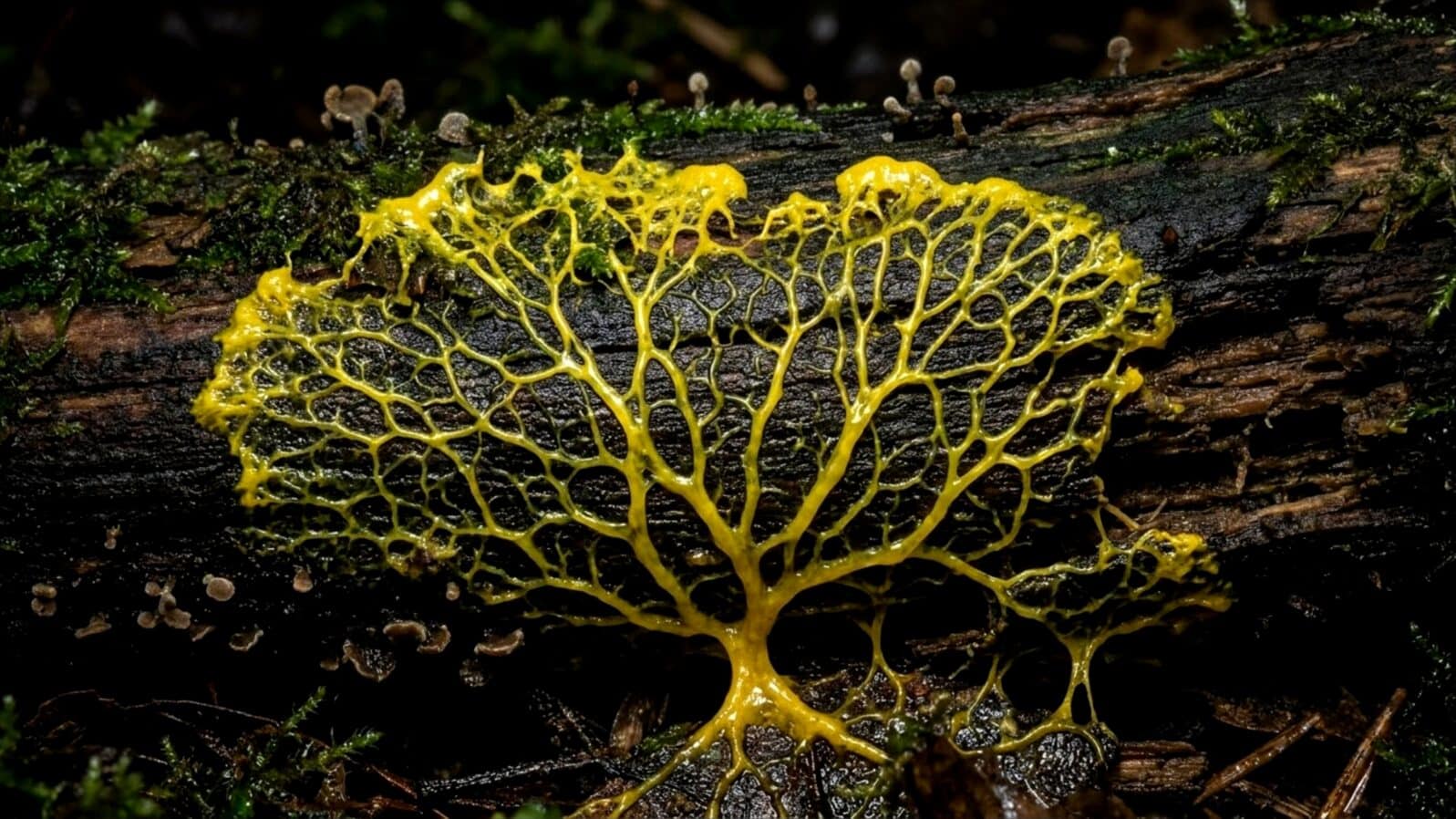
How they solve problems with no brain, no nervous system, no conventional sense organs is creating challenges in defining intelligenceIn a long and informative article at the Guardian, Samanth Subramanian reported earlier this month on conundrums around the intelligence of the slime mold amoeba, Physarum polycephalum.
You read that right. Intelligence. Despite the limitations of being a blob with maybe thousands of nuclei, no brain, mouth, limbs or eyes. How does it learn or remember? Well, that’s what scientists would like to know.
Hokkaido University researcher Toshiyuki Nakagaki has spent his life studying this type of amoeba. He uncovered their amazing ability to find the shortest path to food. As Subramanian writes,
In 2010, the New York Times wrote about Nakagaki’s most famous experiment – the canonical study that scientists offhandedly call “the Tokyo railway one”. Nakagaki placed oat flakes to resemble the map of Tokyo and 35 of its satellite towns. Then he let the Physarum loose from the centre of “Tokyo”. From that one metropolitan oat, the mould spread outwards seeking the others, stretching towards them with its tubules. Then, putting out more branches, it linked up with itself, from one suburban oat flake to the next.
In doing all this, the mould displayed such a verve for efficiency – no wasted motion, an optimal pursuit of its food – that it ended up nearly retracing the route map of the greater Tokyo area’s railway system. Nearly, Nakagaki said – because, in fact, free of human bias or politicking, Physarum may have improved the design of the network.
“‘This is dangerous’: slime moulds and the bitter debate over the nature of intelligence,” September 8, 2026”
Media have covered Physarum’s feats regularly over the years. No surprise; it can solve the Traveling Salesman problem that has baffled computers.
So does that mean that the mold is intelligent?
That’s become a loaded question. The traditional (materialist) assumption was that a brain and nervous system are essential for intelligence. So, in principle, the mold fails the test. But then what do we do with the evidence that it can solve problems?
Meanwhile, other scientists point to evidence of apparently intelligent behavior in plants and fungi. Subramanian notes, “since the 1980s, more and more scientists have argued that traits such as cognition are intrinsic not just to animals but to all life ”
A quarrel erupted, he says, in 2007 between the brain-only “neuropurists” and the “biogenic” advocates. At Trends in Plant Science the neuropurists proclaimed, “We maintain that plant neurobiology does not add to our understanding of plant physiology, plant cell biology or signaling.” More candidly, one of them described their letter of rebuke, published in the journal, as “the last serious confrontation between the scientific community and the nuthouse on these issues”.
Yes, it’s gotten pretty fiery. Michael Levin, who argues that all living cells are cognitive, says he gets regular hate mail.
Trying to avoid the problem by reframing it
Some want to claim that slime smarts are a blow to the idea that humans are exceptional. University of Adelaide philosopher Pamela Lyon, who gave the biogenic faction its name, told to Subramanian,
Human beings have regarded themselves for too long as “the crown of creation” because of our intelligence, she said. “The locus of intelligence and cognition is now finally shifting from the human paradigm. We’re on the cusp of a Copernican revolution, and it’s barreling towards us.” “Nature of intelligence,”
But that’s completely off the mark. Humans do have brains but, in any event, our intelligence is of a different order than that of any other life form (much as some try to talk around it). The question we want to answer here is, how do life forms with no brain learn and remember?
Another mold mystery
Not only does the mold have no brain but how it forms individuality is unclear. Subramanian also talked to Audrey Dussutour, who studies mold cognition at CNRS in Toulouse:
“If you cut one slime mould into four pieces, those pieces are all the same – they’re clones of each other, so you’d expect them to behave the same way,” Dussutour said. “But they act differently. In an experiment, one piece will pick option A, and another will pick option B. “Nature of intelligence,”
And some answers
Researchers know that Physarum consists of thousands of “tiny oscillators” that sense the environment and cause the protoplasm to flow more thickly in one direction than another. If a direction seems like a dead end, the mold lets it dry up. So that’s the basic mechanism. But many questions remain.
First, what are we asking the word intelligent to do? Subramanian assesses what he has learned: “We live in a time when scientists claim degrees of intelligence and cognition for trees, cuttlefish and ant swarms, for things with neurons and things without neurons, things that move and things that stay still, things made of carbon and things made of silicon.”
Indeed. It’s beginning to sound as if panpsychism (everything is conscious) is slowly replacing eliminative materialism (nothing is conscious) as an underlying assumption in science.
Tellingly, one researcher told Subramanian, “If I apply the word ‘emotion’ to a jellyfish, then I sell my paper better. Scientists are human beings!” Yes, but what sells the paper is not the fact that the peer reviewer is a human being. It’s the fact that he wants to hear that message.
This is not a “one-way trip to the nuthouse”; it’s a paradigm shift. But it is not a shift away from materialism. A panpsychist scientist could be just as hostile to the idea that the human mind has immaterial elements as the eliminativist is. The difference is, instead of claiming that neither humans nor slime molds are really cognitive, the panpsychist will claim that they both are — and then minimize the difference between them.
