
Is Talking to Animals Really AI’s “Next Ethical Minefield”?
Curiously, the Bloomberg article focuses not on the potential for new understanding of animals but the risks that that understanding is thought to poseAt the center of the concern is University of Leon (Spain) investigator Vittorio Baglione, who studies European carrion crows, considered to be among the smartest birds:
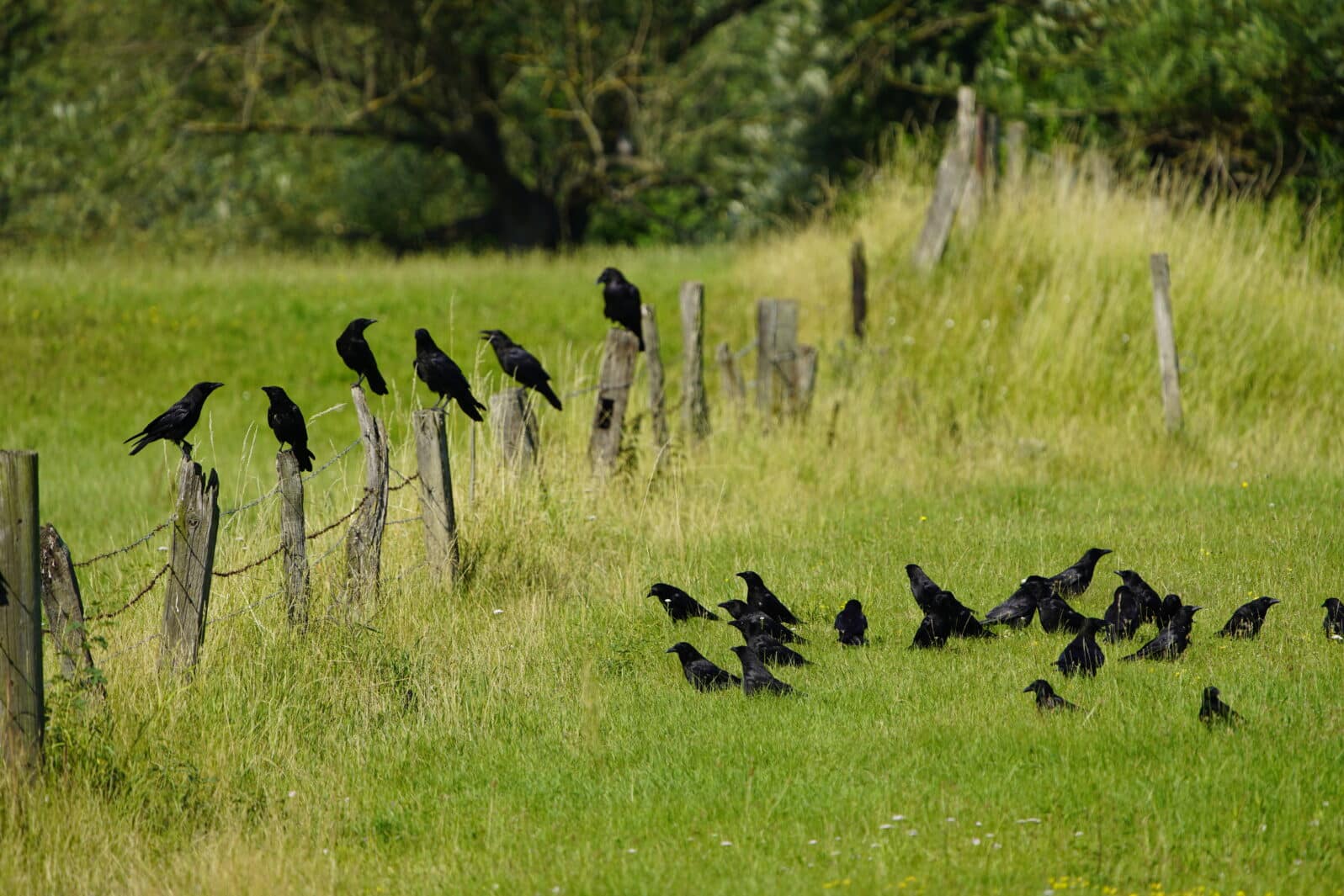 Image Credit: guentermanaus -
 He attached tiny microphones to the tail feathers of 43 birds. Years later, he and his wife/research partner Daniela Canestrari ended up with about 150 000 hours of taped bird calls. For the massive job of sorting and interpreting the calls, they turned to a machine learning model from Earth Species Project that could distinguish individual bird calls and other sources of noise. The results were illuminating:
Baglione’s favorite call was the soft burst of sound the crows would make when their nest was under attack by a buzzard. It was always followed by the arrival of others to defend the nest, so he interpreted it as something like, “Hey! Come help!”
Morgan Meaker, “Talking to Animals Is AI’s Next Ethical Minefield,” Bloomberg, September 4, 2026
But, far from seeing this as a science advance, many, including Balione, are sounding the alarm:
The promise of AI-enabled animal translation is already creating a rush for data, alarming animal-rights activists. Researchers are dropping hydrophones into water to listen to whales, attaching biologgers to wolves and designing backpack microphones for birds. It’s enough for some to call for a version of privacy rights for animals. “Next Ethical Minefield,”
At New York Post, Ronny Reyes warns
In his 2025 report on the development of AI models striving for animal communication, [César] Rodríguez-Garavito said the technology has the capacity to expose animals to mobs of people wanting to chat or to even weaponize them.
“AI may soon allow humans to talk with animals — but some say it could violate their right to privacy,” September 6, 2026
A driving force in the sudden rush is probably the Coller Dolittle Challenge, which offers substantial cash awards for scientific research on interspecies communication algorithms.
The trouble with all these expressions of concern is that privacy is a human concept. Even if we are really earnest about preserving privacy while trying to communicate with animals, we are still imposing our concepts on them. This is not a game rational creatures can win.
And it turns out, of course, that there is more to the story…
What is translating animal languages really supposed to reveal?
A recent article at Springer-Nature’s Topoi by Marriah Alcantara and Kristin Andrews unpacks an underlying implication: Animals reason like people; we just haven’t been able to see it yet:
Looking ahead, we argue that successful two-way communication with animals would both reveal an existing moral landscape and create a new one. Any successful two-way communication system would require radical translation of animal signals, which in turn entails that animals are rational beings who live in normative communities. Furthermore, the creation of these communicative systems also gives rise to new responsibilities and new demands. As researchers work to transform our social relationships with animals, they must also take on the responsibility to prepare humanity for the challenges that will arise in this novel multi-species landscape.
Alcantara, M., Andrews, K. Can we talk to the animals? The ethics of using machine learning to decode animal communication. Topoi (2026). https://doi.org/10.1007/s11245-026-10409-2 “,” Open access
In short, this is a return of the mid-twentieth century research animus to show that chimpanzees really talk the way humans do. The authors discuss that movement in some detail and they seem to expect a breakthrough via AI.
Elsewhere, Andrews, a CUNY philosopher, has called for consciousness science to “move past a focus on complex mammalian brains to study the behaviour of ‘simpler’ animals”:
The perspective reflected in the survey of philosophers that infant humans are probably conscious, that fish may be, and that plants probably are not, is a cultural perspective that reflects the demographics of today’s professional philosophers. What might the starting assumptions about consciousness look like if professional philosophers were not overwhelmingly white, male and WEIRD? …
Maybe in another few years we will need to push back on another assumption, and at that time find it profitable to study consciousness in biological systems beyond animals, such as plants and fungi. If we recognise that our starting assumptions are open to revision and allow them to change with new scientific discoveries, we may find new puzzle pieces, making the hard problem a whole lot easier.
“What is it like to be a crab?,” Aeon, November 20, 2023
Hey, wait a minute…
Here at Mind Matters News, we have offered many articles on animal (and even plant or fungus) mind. The communicative sounds and behavior of animals can be highly informative. But without abstract reason, human-like language is not possible. And there is no evidence for abstract reason as a fundamental component of animal behavior.
If we came across chimpanzee cave paintings, we would, of course, reconsider. But the thing is, we don’t.
Perhaps the AI “ethical minefield” around interpreting animal sounds — what a rich vein for grad bioethics seminars! — is a way to avoid confronting this problem: AI can probably crack the crows’ warnings about buzzards or advertisements of food. But it won’t ever catch them asking “Why?”
There is a great gulf fixed and AI can’t cross it.
Note: “WEIRD” means “ Western, Educated, Industrialised, Rich and Democratic.”
