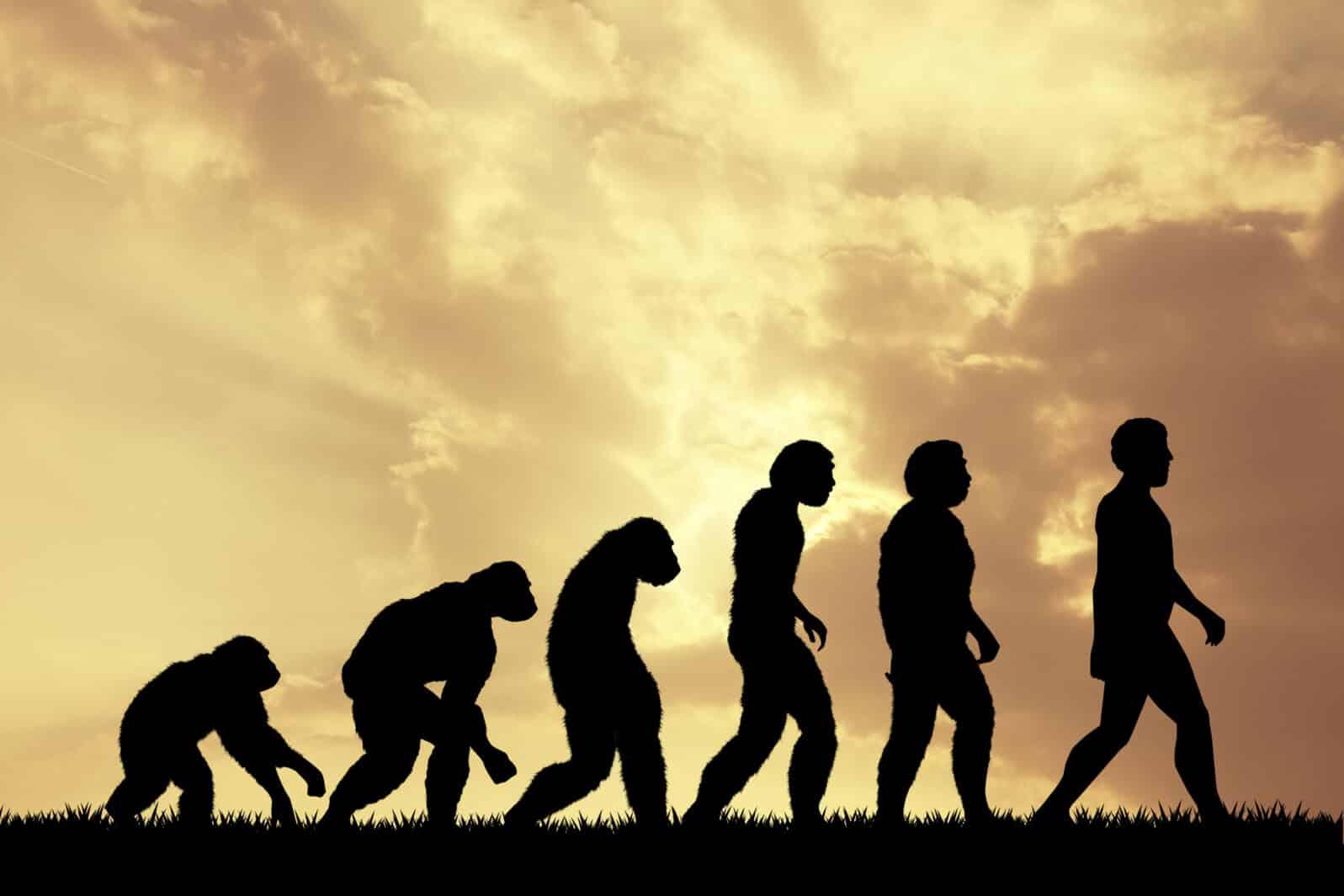
Who, Exactly, Is the Subject of Evolutionary Psychology?
Neurosurgeon Michael Egnor and science writer Denyse O’Leary offer some thoughts about why the discipline does not make senseA best-selling book by Concordia University marketing prof Gad Saad is called Suicidal Empathy (2026).
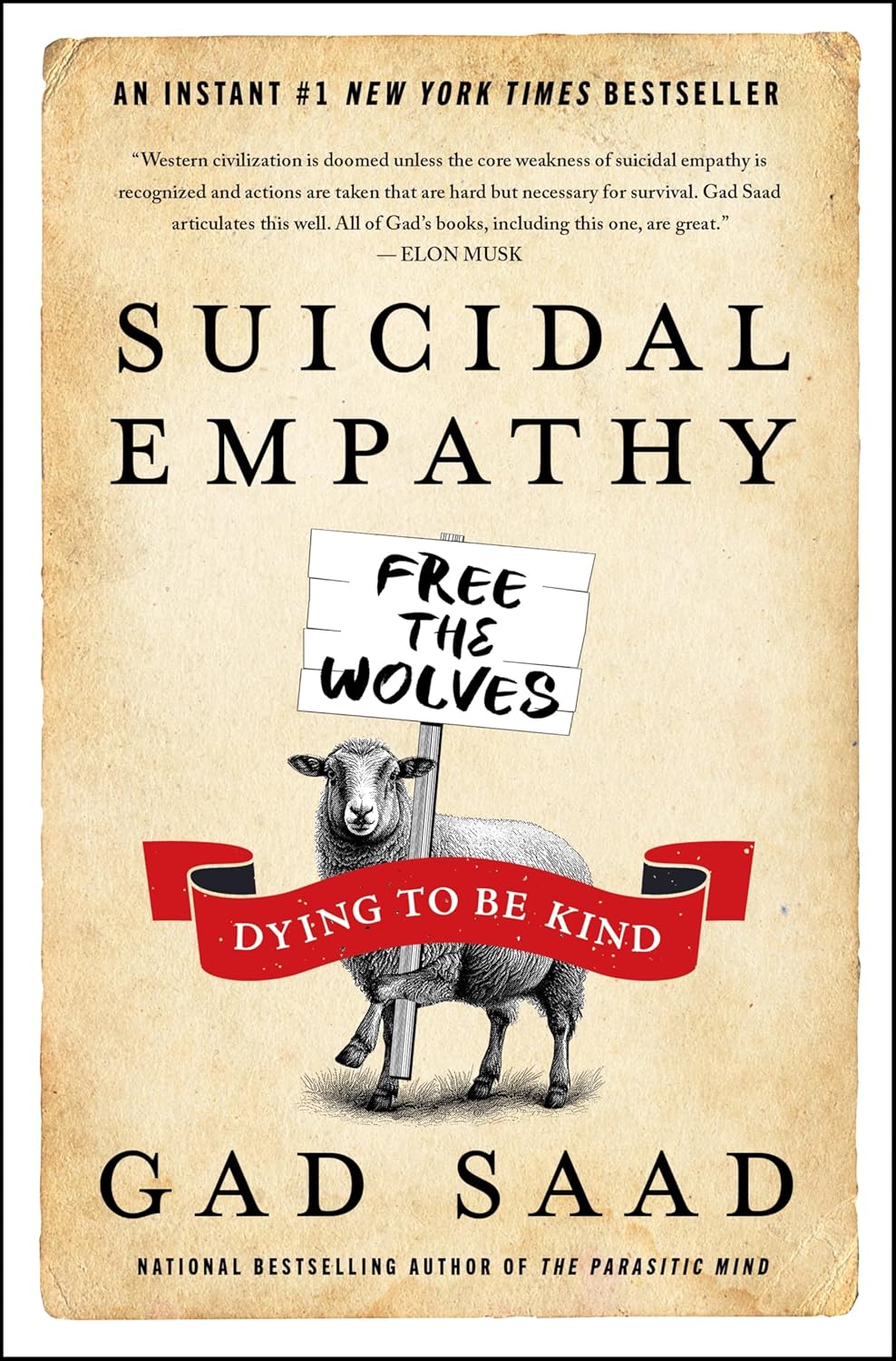 Published by Broadside Books in 2026
The Montreal professor’s book is centered on evolutionary psychology, the idea that evolution can explain human psychology.
It’s been a bestseller; one thing that probably helped elevate its status was that the basic thesis has been panned by just the people you’d expect.
Suicidal empathy is a purported phenomenon in which excessive, misdirected and pathological forms of empathy are claimed to be destructive for the party that exhibits it. This is often claimed to happen through prioritizing compassion, understanding and empathy over logic and long-term consequences. – Wikipedia, July 19, 2026
You can hear the elite sneering, right?
As it happens, many people understand the gist of what Saad is talking about. A counselor friend once told me, “I have women in my practice who are harboring and protecting men who will probably kill them one day.” That’s pretty much a definition of the phenomenon.
[Denyse O’Leary:] So Mike, what do you think?
[Michael Egnor:] I like Gad Saad. I think he’s a very interesting guy, but…
[O’Leary:] Oh good! You’re gonna own him too! He’s moving to the States! So you may as well like him.
From the Montreal Gazette: Montreal academic Gad Saad tells Joe Rogan he’s moving to the U.S.
In a recent episode of Rogan’s podcast, Saad spoke of the online threats he received while teaching at Concordia.
Saad didn’t cite the specific reasons for his decision to move to the U.S., but he did touch on his experience at Concordia. In his book — and during the podcast with Rogan — Saad recounted a “tsunami of online death threats” in 2017 linked to his public opposition to Bill C-16, which amended the Canadian Human Rights Act to include gender identity and expression as protected grounds. May 18, 2026
That crackdown is ramping up. But now back to evo psych in general:
[Egnor:] My take on evolutionary psychology is that it is obviously ridiculous. The reason that Darwinism has any cachet whatsoever with the public is that most of the explanations that Darwinists offer involve issues of cladistics, speciation, and molecular biology, that the public doesn’t really know anything about. So they just take them at their word.
But when you tell people that the reason that men have more propensity to promiscuity than women, is because male apes were able to spread their seed, but they didn’t have to or carry the babies for 9 months or take care of them after they were born, everybody knows it’s kind of BS.
Evolutionary psychology just lays bare the fairy tale nature of Darwinian theory. So I support it. I think it’s a wonderful thing. I think the more Darwinists talk about evolutionary psychology, the better.
[O’Leary] Well, the thing that struck me about it is a question: “Who is the subject of evolutionary psychology?”
It can’t be human beings as we exist right now. We could have been suddenly created intact last Thursday and everything would probably be much the same, with no evolution at all. Or at least I couldn’t prove it wasn’t.
Well then, it has to be some prehuman or subhuman? Can we identify that person or group? Who exactly is the topic of evolutionary psychology? If not, why isn’t it just… psychology?
[Egnor:] Evolutionary psychology is almost unfalsifiable in a sense. It’s just fairy tales. Ever read Darwinian Fairytales?
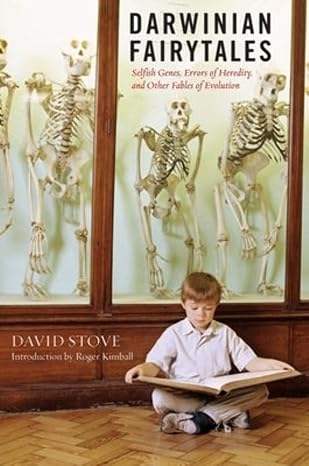 Published by Encounter Books in 2007
[O’Leary:] Yes. The author David Stove died too young (1927– 1994). I mean, he could have written more books.
[Egnor:] And my recollection of the gist of his book was that you might be able to explain animal behavior based on evolutionary reasoning. But human beings, you simply can’t. It’s just a fairy tale.
If Darwin’s theory of evolution were true, there would be in every species a constant and ruthless competition to survive: a competition in which only a few in any generation can be winners. But it is perfectly obvious that human life is not like that, however it may be with other species.
This inconsistency, between Darwin’s theory and the facts of human life, is what I mean by ‘Darwinism’s Dilemma’. The inconsistency is so very obvious that no Darwinian has ever been altogether unconscious of it. There have been, accordingly, very many attempts by Darwinians to wriggle out of the dilemma. But the inconsistency is just too simple and direct to be wriggled out of, and all these attempts are conspicuously unsuccessful. They are not uninstructive, though, or unamusing.
From Essay 1 in Darwinian Fairytales.
[O’Leary] Would it be fair to say that one of the problems with any such explanation is that we human beings are each reasoning on our own?
If I want to explain feline behavior, just for example, I’m making an assumption: The animal doesn’t know what I know. I have access to intellectual tools that he does not. For example, if you neuter a tomcat when he is mature, he may behave exactly the way any other tomcat will behave. Nothing happens, but he doesn’t know it. He doesn’t understand what happened to him. So I can account for why his behavior did not change.
But I can’t account for human behavior that same way, because I don’t know that another person isn’t smarter than me. He may see intellectual things I don’t.
[Egnor:] In a sense, you can carry the argument even further. And the hallmarks of the human mind are the capacity for reason and free will, none of which can evolve. They’re not material powers of the human body.
Whatever Darwinian evolution is worth, it can’t account for things that are not physical. It’s conceivable that you could account for such things as emotional tone, instincts and capacity for memory and things like that.
You know, it may be that we’ve inherited a propensity to aggression from our primate ancestors, or some such silliness. But intellect and will, which really are the hallmarks of the human mind, are not and cannot be evolved.
The whole Darwinian paradigm of natural selection falls apart when you’re dealing with the human mind. It’s a very different thing.
