Shermer’s Truth: When “Myside Bias” Becomes the Method
First pass finds easy readability, subpar scholarship, and a polemical agendaTruth. That’s the title of Dr. Michael Shermer’s recent book, and the subject of my recent TEDx talk. It’s a hot button issue and has been for millennia.
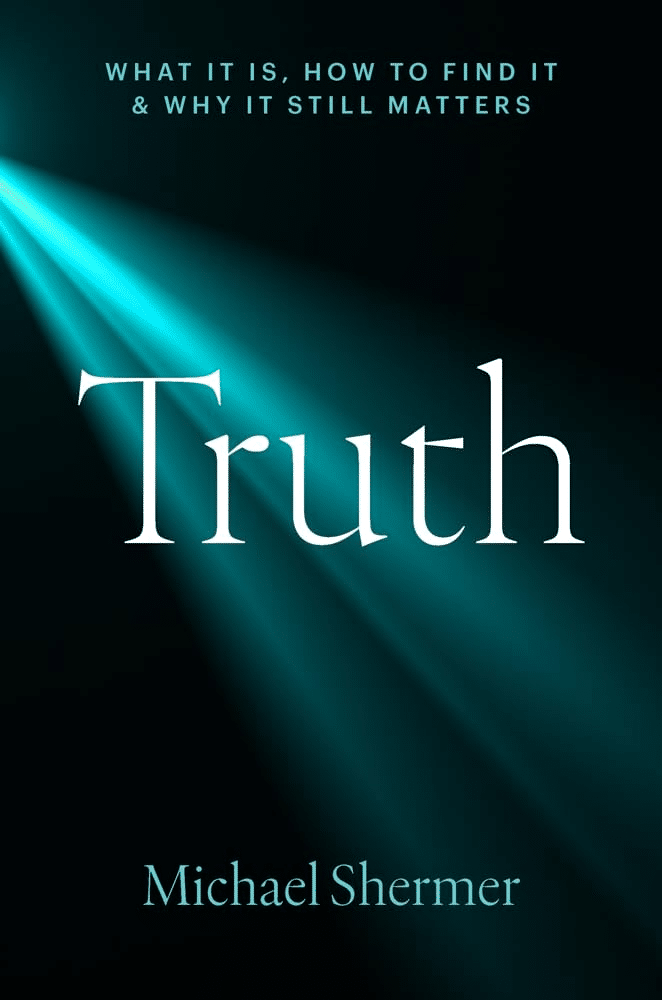
As a 35-year lawyer who taught legal research, writing and advocacy at a top-20 law school, I look at a writing project’s stated goals, types of factual and reference support, and ways it treats opposing views. A book entitled Truth, by a renowned author, would seem to promise persuasive presentations and strong arguments that provide ways to find truth.
The “Objectivity” Test
The book presents itself to be “about the search for objectivity and what we should believe.” (p.4) Okay, let’s consider the “objectivity” part.
For starters, the book parades a list of “deniers” who categorically deserve derision. We realize “denier” is the fashionable insult to declare people as second-class and unworthy of consideration. In the book, people who question climate prophecies, the risks and benefits of nuclear power, “evolution,” or the safety of genetically modified foods, some vaccines, and untested drugs, are all lumped together with Holocaust deniers. (p.14) The absence of any precision or distinctions in wholesale condemnation tells me: This author has an agenda to prove.
Referring to these absolute categories of “deniers,” the author says people who question his views aren’t thinking straight. “In many cases, it isn’t the truth about the facts that is under dispute; rather, the contention comes from an underlying motive properly identified … as the myside bias.” (p. 14) Motives, not reasons, drive everyone who disagrees with him, he says.
Drawing from Keith Stanovich’s The Bias That Divides Us (2026), Shermer asserts you might be captive to myside bias if, for example, you (1) select and favor facts that support your group, (2) apply “logical rules” when they support your conclusions, and (3) question the scientific status of any evidence that challenges your existing conclusions. In other words, myside bias does not merely make us opinionated. It makes us selective so that we treat friendly facts as obvious, friendly logic as airtight, and unfriendly evidence as suspicious.
Unsupported Opinions Declared as Truth
Let’s see how those three criteria work in Shermer’s book. In chapter 2 of Truth (p.38), it contends:
For us to have confidence in the truth value of any claim, there must be a source of external validation so that it can be treated as an objective truth. Otherwise, it’s just personal taste, opinion, or feeling.
In books, external validation comes with cited references and endnotes for readers to consult. Moreover, to objectively analyze something, we consider both or all sides of facts and opinions. This book itself advises people to “steel-man” the opposing arguments, that is, to evaluate the strongest opposition in its best light. (p.13)
On first review with these criteria, Truth doesn’t fare well. Consider these items I found in just minutes of perusing.
- Page 14: The book’s categorical smear of “deniers” amounts to Shermer’s personal opinions and feelings, presented to readers as some form of “truth.” Many of the “denials,” i.e., actual opposing arguments, nowhere appear developed in that chapter or related endnotes.
- Page 188: Asserts “states with more guns and fewer gun control laws have higher homicide and suicide rates.” The supporting endnote 35 cites only Shermer’s 2013 article in his magazine, Skeptic. No citation is given to voluminous scholarship controverting the absolute claim, such as posted at Crime Prevention Research Center. (To be fair, Shermer’s 23-year-old Skeptic article does cite some opposing views.)
- Page 142: Dismisses the belief in the physical resurrection of Jesus after crucifixion, in 1.5 pages that cite only one modern skeptic. No mention whatsoever of Dr. Gary Habermas’ four-volume encyclopedic treatment of the subject, nor to Dr. Micheal Licona’s detailed exploration.
- Page 103: “Highly improbable and statistically unusual events cannot be miracles because they are still in the realm of natural possibilities that brook no need for divine intervention.” Following 18 pages of a variety of points and observations, Shermer draws this conclusion as an absolute. That chapter on miracles nowhere mentions Dr. Craig Keener’s comprehensive coverage in Miracles(2 vols., 2013) and Miracles Today (2021), nor Dr. J. P. Moreland’s work. Avoiding the leading authorities in the field, Shermer’s absolute conclusion exposes an agenda, not truth-seeking.
- Pages 291-292: Shermer declares “macro evolution” an undisputable fact at every level. He summarizes in just one paragraph the entire opposing view challenging undirected mindless macro evolution, yet doesn’t cite the sources making those science-based arguments. Shermer’s short “counter argument” dismisses the controversy as though thoroughly solved, when it is not. Readers unfamiliar with the scientific arguments are invited to just take Shermer’s word for it, since no real opposing view is cited or “straw manned.”
These five immediately discoverable instances show Shermer’s myside bias and avoidance of opposing views and sources, undercutting any claim to “objective” truth.
Disposing of God in Just 25 Pages
Shermer, an avowedly committed atheist, delivers Chapter 11, entitled “The Truth About God” with evident glee. Space limits prevent going point by point here, but people should read Chapter 11’s supposed rebuttals to arguments for God’s existence.
Repeatedly, Shermer declares facts as undisputed truth without showing why they should be believed. His coverage of issues like the design inference and irreducible complexity is embarrassingly shallow. Recall Shermer urged people to “steel man” the strongest opposing arguments by explaining them in their best terms before rebutting them. No steel-manning here. Failing to even mention the comprehensive book, I Don’t Have Enough Faith to be an Atheist, suggests Shermer doesn’t know the field (yet he knows well one author of that book).
The utter lack of even grudging citations to solid books by scholars Antony Flew, Stephen Meyer, William Dembski and so many others, does two things. First, it betrays the neutral reader by implying that no opposing views exist worth citing. Second, it reveals the very myside bias Shermer decried early in his book.
Returning to Shermer’s claim that Truth is about “objectivity” and “what to believe”: It appears to be mostly about telling readers “what to believe,” without objectivity at all.
FOOTNOTE: As a lawyer I must observe: Shermer (p.2) relies upon Terminiello v. Chicago without any citation. In fact, the simplest research finds that 1949 decision was effectively superseded in 1969 by the holdings in Brandenburg v. Ohio. Such careless imprecision on such an easy point raises questions about other cites and claims in the book.
