
Hush! A Forest Organizes Itself in a Non-Darwinian Way
Plants co-operate as well as compete — though that doesn’t mean they are consciousBack in the 1990s, University of British Columbia Forest Ecology prof, Suzanne Simard, drew colleagues’ attention to the way trees communicate with each other:
Foresters were in the habit of getting rid of paper birch trees in order to promote the more valuable Douglas fir trees. But that strategy wasn’t working well. Simard and colleagues found through study and experiment that the two species of trees co-operate.
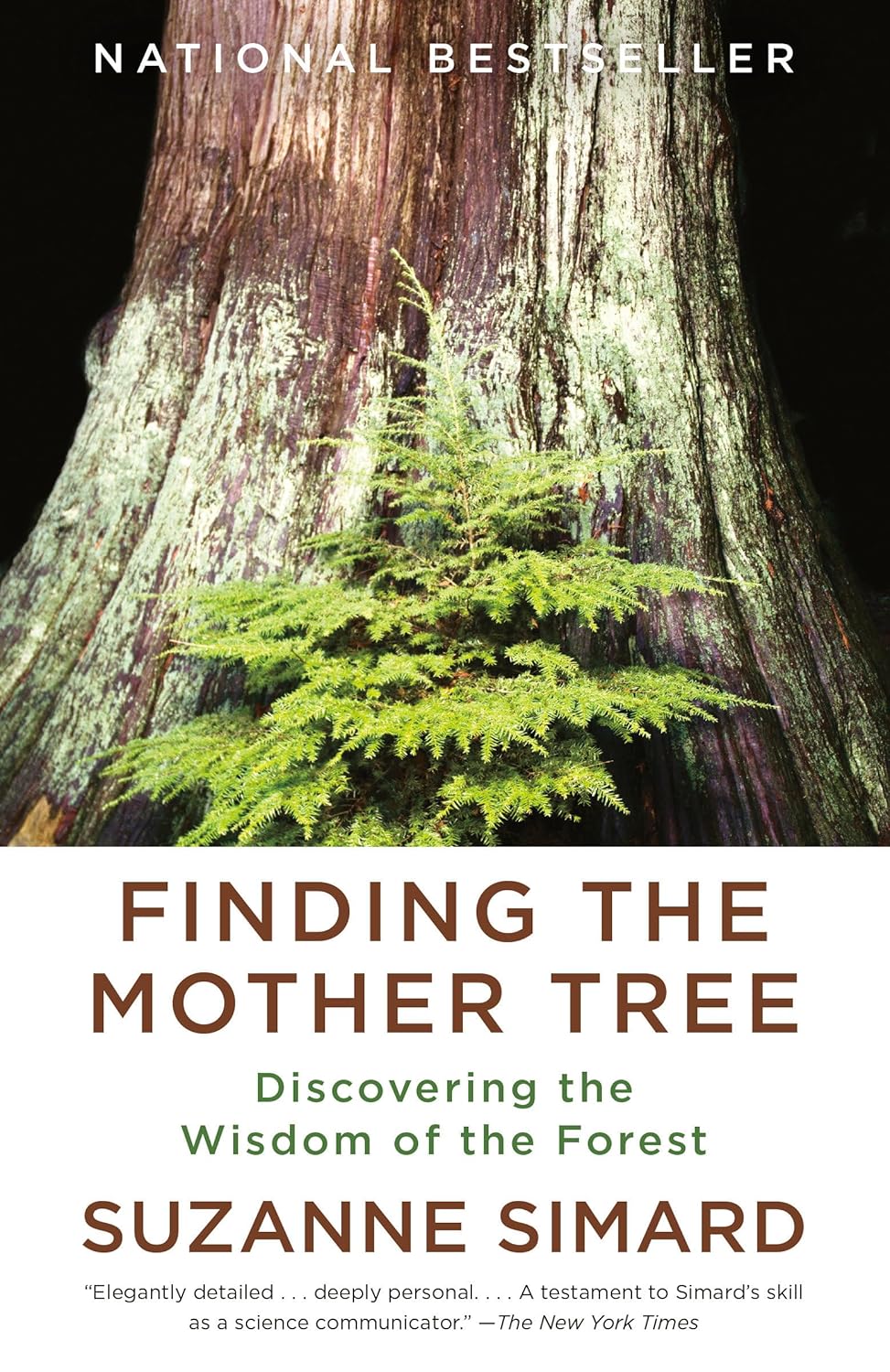
According to the Arbor Day Foundation:
Trees in a forest are usually thought of as fierce competitors, each struggling for control of available light and soil moisture, usually at the expense of neighboring trees. But Canadian research Suzanne W. Simard and her colleagues found that paper birch can actually aid neighboring Douglasfirs.
Through carefully-controlled research, Dr. Simard has documented the transfer of carbon (sugar) from paper birch to nearby Douglasfirs. The transfer takes place through tiny underground strands of beneficial fungi called ectomycorrhizae…
Dr. Simard discovered that the mycorrhizae on birch trees and Douglasfirs in her research plots interconnected. Sugars flowed between the tree roots, with a net gain for the Douglasfirs. She also found that the more the Douglasfirs were stressed by shade, the more of a sugar fix they received from the paper birches.
“Paper Birch & Douglasfir: An Odd Relationship,” February 15, 2018
How did the researchers find this out?
Each tree may look like an independent organism, but trees occupy another world underground. When two root systems overlap, and with the help of some beneficial fungi, a trade route can open up between trees.
Simard’s first experiment involved 80 saplings each of three species: birch, firs and cedars planted together. The birches were covered in plastic bags filled with a radioactive form of carbon dioxide gas. After leaving them for an hour, Simard checked the trees with a Geiger counter. As expected, the cedars didn’t elicit any sound. The birches set it off, showing they had absorbed the radioactive gas. But the firs set off the Geiger counter, too. They had radioactive carbon, and the only possible source was through the roots of the birch trees.
Theresa Machemer, “Trees are talking to each other. Here’s what they’re saying” The Hill, Nov. 4, 2019.
At X, popular image curator Massimo (4.3 million followers) writes,
Simard’s research overturned the traditional Darwinian view of forests as battlegrounds of ruthless competition. Instead, she revealed a far more sophisticated reality: forests operate as highly cooperative systems where trees communicate, support one another, and even warn neighboring trees about threats like drought, disease, or insect attacks.
Communicating about danger
Many plants use communication systems to halt the advance of predators:
It’s now well established that when bugs chew leaves, plants respond by releasing volatile organic compounds into the air. By Karban’s last count, 40 out of 48 studies of plant communication confirm that other plants detect these airborne signals and ramp up their production of chemical weapons or other defense mechanisms in response. “The evidence that plants release volatiles when damaged by herbivores is as sure as something in science can be,” said Martin Heil, an ecologist at the Mexican research institute Cinvestav Irapuato. “The evidence that plants can somehow perceive these volatiles and respond with a defense response is also very good.”
Kat McGowan, “How Plants Secretly Talk to Each Other,” Wired, December 20, 2013
Unfortunately, a 1978 film, “The Secret Life of Plants” helped create a misunderstanding: that plant communications are based on consciousness. Indeed, several recent books have made that claim.
All this has left serious researchers scrambling to make clear that they were not claiming any such thing. “Plants are not conscious!” some of them exclaimed in a journal article, fearing (with good reason) the loss of grants.
The insistence among neuroscientists that human consciousness is a wholly material process and that the mind is an illusion had the unexpected effect, perhaps, of making it easier for many people to assume that maybe trees feel and think too.
Plants don’t need to be individually conscious or intelligent in order to communicate
There may be a misunderstanding underlying the debate. Communication can just mean sending and receiving a message. There may be no conscious intelligence at either end. Consider the case of a deserted office building overnight. A fire starts in the electrical system, immediately triggering an alarm. The sprinkler system starts automatically. Meanwhile, the alarm’s signal is received at the fire station and (if Elon Musk has his way), an autonomous fire truck is dispatched. We hope that the truck has human firefighters in it as well. But so far, a great deal of communication has been sent and received with no intelligence displayed whatsoever.
Ah, the skeptic replies: But did all that communication get started autonomously? No indeed. It took a considerable amount of conscious human intelligence to produce a system that functions autonomously to that extent. But that intelligence is frontloaded. It is not — and need not be — a feature of the systems downstream.
Now let’s go back to Massimo’s non-Darwinian trees for a moment: A designing intelligence can produce a system of tree relations that Darwinian competition does not. In specific situations, all the trees work together in their mutual interests — for growth and against predators. They are not conscious so they could not have designed the complex non-competitive systems they benefit from.
If we accept the idea of an underlying design in nature, we do not need to suppose that trees are conscious in order to understand their complex relationships.
