
Paleoartists — Artists for Dinosaurs — Confront Generative AI
Generative AI cannot yet combine science-level accuracy and sensitivity to artistic issues but it is starting to have an impact anyway.As generative AI steamrolls through the art world, science-related art faces some unique conundrums. One of them concerns paleoart, the accurate-as-possible depiction of extinct life forms, based on as much information as we have — often not a lot. Essentially, it’s art because it requires a good deal of judgment and interpretation. But it is also science because, when representing science findings to the public, maximum possible accuracy is a duty. A pterosaur sprouting a third foot from its wing hardly meets the standard.
But that’s an obvious type of generative AI goof. How would lay people who follow paleontology know about less obvious departures from accuracy? That’s a problem, as Isaac Schultz notes an article in Gizmodo earlier this week:
Depending on the prompts they are given, AI image generators are not currently capable of intaking this complex and varied information and producing an image from it with the same fidelity and attention to detail as a human artist.
Isaac Schultz, “Paleontologists Are Fuming Over AI Depictions of Prehistoric Animals,” Gizmodo, June 10, 2024
As the work of paleoartist and scientific illustrator Gabriel Ugueto illustrates in the video above, when the artist must decide how best to portray the subject, it’s a delicate balance between all-important accuracy and the human touch.
Generative AI as copyright theft
Another issue, of course, is copyright. Generative AI mops up everything available, including copyrighted works.
“Image generative AI is an algorithm for copyright theft,” said Per Ahlberg, a paleontologist at Uppsala University in Sweden, in a video call with Gizmodo. “What’s even worse is that you can then use this to start driving the people whose work you have stolen and incorporated into your learning algorithm out of business, and this is a major problem because we need to paleoartists—real ones.”
Schultz, “AI Depictions of Prehistoric Animals”
The paleoartists’ dilemma is one element of the larger, general problem of how to compensate original creators, whether artists or writers, when their work is melded and repurposed in AI-generated output. While new tools that poison an attempted AI image might work for artists, some see the problem as better addressed by new instruments for compensation for creators.
Some paleoartists have taken to X to discuss the problem at #paleoagainstai:
I wasn’t expecting that from this decomposing T. rex model. Pure ridiculousness.
[In the link below, the decomposed T. rex remains morph into a domestic cat:]
https://x.com/i/status/1759601542028505597
Many of my friends & colleagues are artists who dedicate their lives to bringing ancient creatures back to life. It takes skill, passion, & creativity to create something special. #PaleoAgainstAI pic.twitter.com/OdQXyx7HDx— Dr Dean Lomax (@Dean_R_Lomax) February 19, 2024
It’s a challenge the art world must address
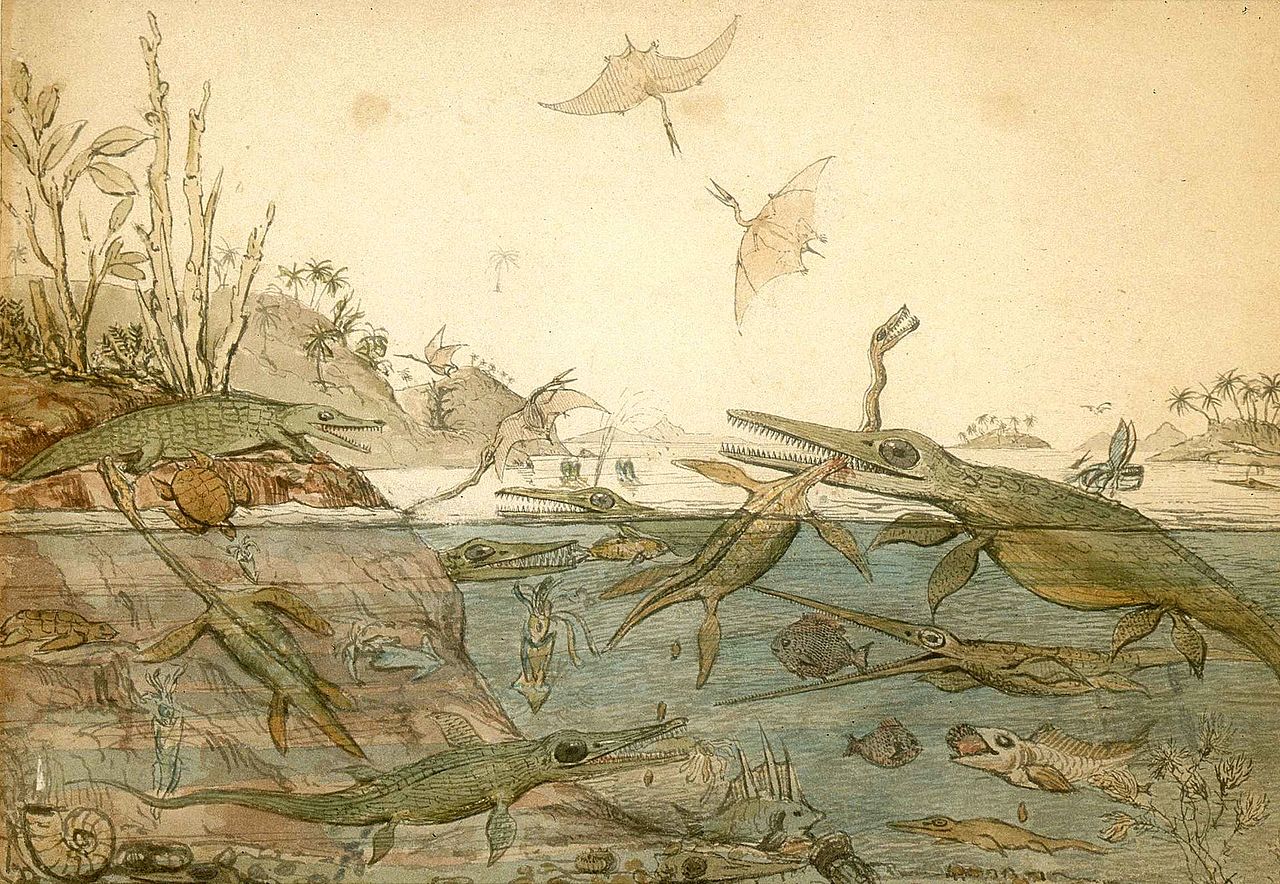
Antiquior – A more Ancient Dorset, based on fossils found by
Mary Anning/Public Domain
It’s no surprise that paleoart became a fixture of science reporting back in the nineteenth century. It would be difficult for most laypeople to take much interest in prehistoric life without visual depiction. Would the tyrannosaur have become a cultural icon, instantly recognizable, if we had to rely only on written descriptions for accuracy? Hardly.
Moving with the times includes finding new ways to compensate the creativity that computational systems such as generative AI depend on.
You may also wish to read: Artists strike back!: New tool “poisons” images pirated by AI. Nightshade, developed by University of Chicago computer science prof Ben Zhao, makes the AI generator keep giving you a cat when you ask for a dog. Overall, Nightshade may prove more useful than lawsuits to artists. It is embedded in pixels, visible only to AI, not to humans.
and
Generative AI is creating a copyright crisis for artists. How does an artist assert copyright when her image was only one of many used to create a new image? How does she make a living if she can’t? AI companies could be required to record images’ origin and compensate copyright holders. But as Robert J. Marks notes, end users might then have to pay.
