
New Research Assistant Puts Mind Matters Info at Your Fingertips
Disco provides a readable summary of what we’ve covered on a topic that may interest youYesterday, Nathan Jacobson introduced “Disco” It can get you info fast on a topic we cover here, as well as info from other Discovery Institute projects:
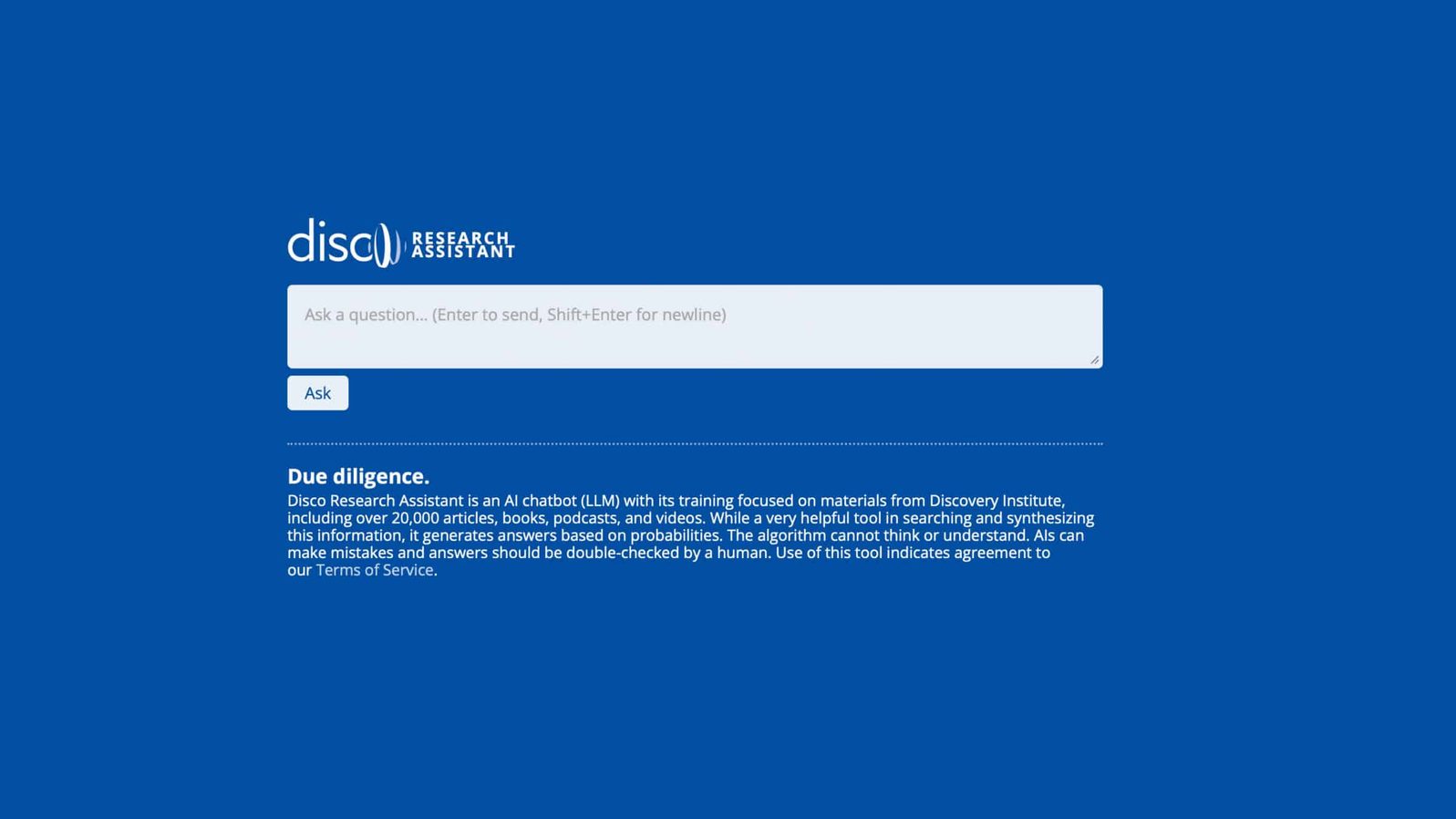
This new tool is an AI-powered research assistant built to help readers and researchers sift and synthesize a vast well of over 20,000 Discovery Institute books, articles, and other materials. In contrast to general purpose large language models like ChatGPT and Gemini, it uses retrieval-augmented generation (RAG). This means that Disco Research Assistant searches and synthesizes a curated collection of Discovery Institute materials and predominantly uses those sources to prepare a response. Responses include links directly to the materials that inform each answer. (Science & Culture Today)
Why is this useful?
Disco provides a readable summary of what we’ve covered on a topic that may interest you. Here’s an example: Paradoxical lucidity is the remarkable fact that people deep in dementia may suddenly recover mental awareness — sadly, only for a short period. The phenomenon is not well enough understood yet for researchers to develop methods to prolong it. But at least it is becoming better documented.
Now, suppose you want to know more. Go to Disco and type: paradoxical lucidity
As of today, this is what you will get:
– – –
Paradoxical Lucidity
Paradoxical lucidity refers to the surprising phenomenon in which people suffering from advanced dementia suddenly regain clear, coherent mental function and communication, despite severe and often well-documented brain degeneration. Intelligent design proponents, particularly those associated with Discovery Institute’s work on the mind-brain relationship, treat this phenomenon as significant evidence against the purely materialist claim that the mind is nothing more than what the brain does. Neurosurgeon Michael Egnor, a professor of neurosurgery and ID theorist, has explored this topic extensively, including in his co-authored book with Denyse O’Leary.
What the Phenomenon Involves
According to Dementia Hints That the Brain Is Not All There Is to the Mind, paradoxical lucidity describes moments when a person with dementia, previously thought to be entirely unreachable, suddenly becomes clear and present again, sometimes spontaneously and sometimes triggered by personalized music or familiar symbols. Dr. Stephen Post, Director of the Center for Medical Humanities, Compassionate Care and Bioethics at Stony Brook University, reports that roughly 80 percent of caregivers self-report witnessing such surprising moments of lucidity in loved ones they had assumed were permanently lost to the condition.
A related but distinct phenomenon is terminal lucidity, where individuals with severe cognitive impairment near death unexpectedly regain clear communication shortly before dying. Clues About Consciousness from Dementia Research notes that these episodes are formally studied in the peer-reviewed literature (citing Peterson et al. in Alzheimer’s & Dementia, 2022) and remain mysterious, with researchers at the Penn Memory Center wondering what underlying mechanism allows a person with advanced dementia to abruptly communicate clearly again.
The ID Interpretation
Intelligent design proponents argue that these episodes are difficult to reconcile with strict physicalism, the view that the mind is simply identical to brain activity. As discussed in Can We Define the Soul Out of Existence?, if the brain fully generated the mind, there would be little reason to expect such abrupt and complete returns of personality and memory in a brain that has undergone substantial neurodegeneration. The argument draws on a broader pattern of evidence, including split-brain cases, patients missing large portions of brain tissue who retain normal cognitive function, and near-death experiences, all cited as reasons to question whether the mind is wholly reducible to brain states.
What if the Brain Is a Filter? presents an alternative model, sometimes called the “filter” or “transmission” model, drawing on psychologist William James’s suggestion that the brain may filter or transmit consciousness rather than generate it outright. On this view, paradoxical and terminal lucidity occur because consciousness can, in certain circumstances, operate somewhat independently of normal brain function, particularly as the brain fails or nears death.
A Public Debate Over the Evidence
The topic has also surfaced in public discourse. As Evidence of a Soul, Charles Murray and Steven Pinker Debate Terminal Lucidity describes an exchange in which Murray cited the clinical literature and Alexander Batthyany’s book “Threshold” as evidence for terminal lucidity, while Pinker characterized the reports as mere anecdotes. Materialist responses to the phenomenon, such as those proposing that lucidity results from oxygen-starved neurons or shifting cranial pressure, are discussed in COSM Debate: “Are Human Beings Machines?”, where such explanations are described as struggling to account for why people with substantial, well-documented neurological degeneration would regain complex memory and reasoning at all.
Discovery Institute’s Terminal Lucidity: When the Mind Outlasts the Brain podcast features Egnor in conversation with researcher Alexander Batthyany, who views the phenomenon as pointing toward an “indestructible” core of personhood that persists even when the brain’s ability to express that personhood is severely disrupted. Evolutionists and materialist researchers are not regarded by ID proponents as ignorant or dishonest for holding a different view; rather, intelligent design advocates simply contend that the evidence from paradoxical and terminal lucidity is better explained by a model in which the mind is not entirely reducible to brain function.
– – –
Could you find all this yourself by searching on Terminal Lucidity + Mind Matters? Yes, probably. But it would take longer. And you will find links to further information available in the summary above anyway.
Jacobson offers a caution though
Of necessity, all large language models come with disclaimers. Because they generate answers based on probabilities and have no understanding of their own, these tools are prone to fabricate or misrepresent views where there is ambiguity or a scarcity of information. Discovery Institute staff have extensively tested Disco Research Assistant to validate and improve the quality of its automatically generated answers. As reliable as it is in the majority of cases, it is imperative that serious researchers do their due diligence, checking the sources provided to ensure that answers accurately represent the source material.
He also pauses to thank the people who made it possible:
Led by Casey Luskin, a number of Discovery Institute staff have been instrumental in bringing Disco Research Assistant into service. Winston Ewert has been the principal developer, gathering and loading assets, fine-tuning the system prompt, and preparing the code for implementation on Discovery Institute’s websites. Katherine West has modified Discovery Institute sites to serve up the right data in the right way. I have styled and designed the interface. As always, John West has provided essential oversight. We hope this tool assists your own research, whether for an off-hand question or a deep-dive on a topic of investigation.
Put Disco on the desktop or phone if you come here a lot.
