
Does Consciousness Philosopher Thomas Nagel Think AI Meets the Threshold?
On winning the Berggruen Prize, he explains why he finds the idea “ridiculous”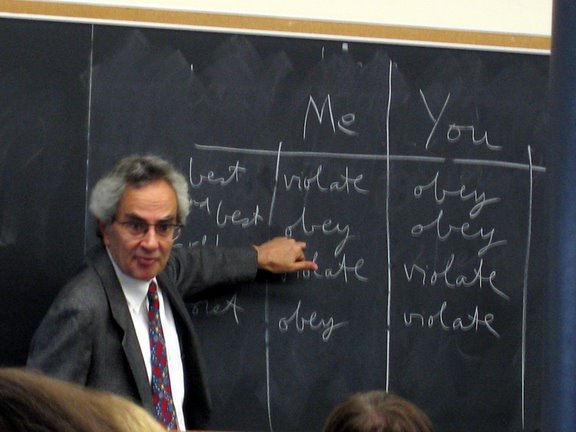
New York University philosopher Thomas Nagel is best known for clarifying our thinking on animal consciousness — with a simple question. It was the title of his famous essay, “What is it like to be a bat?”
His point was that if it is “like” anything to be a bat, then the bat is conscious in some sense.
One can turn that around. If there is nothing that it is like to be a turnip, then the turnip is not conscious. There are, of course, many complexities and fine points but it is a place to begin.
The California-based Berggruen Prize of US$1 million, first awarded in 2016, honors innovative thinkers. It has honored Martha Nussbaum (public policy, 2018), Ruth Bader Ginsburg (gender equality, 2019), and Peter Singer effective altruism, 2021).
Wired asks Nagel, Is AI conscious then?
Tech writer Steven Levy seized the occasion to interview him at Wired on whether AI is conscious. A couple of snippets:
THOMAS NAGEL: Like everyone, I’m tremendously impressed by the lifelikeness of these systems compared to the history of earlier AI. But the disposition of some philosophers to take seriously the question whether these things are conscious or might soon become conscious is just ridiculous. They are assuming that the physical substrate is irrelevant. They all think that the material conditions for consciousness can be given in functionalist terms.
For those of us who have forgotten our philosophy classes, tell us about functionalism.
Functionalism is substrate-independent. It’s more than likely that the truth is one which links physical processes and systems of certain kinds to mental phenomena. Complicated data centers have absolutely nothing in common with the physical character of a nervous system. We have strong reasons to believe that while there may be consciousness elsewhere in the universe, it would require the appearance of some kind of organism with something analogous to a nervous system.
“‘Just Ridiculous’: A Famed Philosopher Takes on AI Consciousness,” Nov 18, 2026
So, from Nagel’s perspective, AI isn’t conscious because it isn’t alive. A turnip actually stands a better chance of consciousness at this point.
The conversation turned to the question of treating chatbots as if they were conscious:
I’ve actually met the person at Anthropic whose job it is to model welfare, to look after Claude’s interests. I should say you’re rolling your eyes now.
There’s nothing that’s good or bad for it in the sense that something can be good or bad for a cockroach—there’s no mental life there in the ordinary sense. It’s not a mind. It’s not somebody that we have to care about. It’s a machine. Here are some of the smartest people on the planet being completely idiotic. Well, intelligence is not completely transferable, I guess. “Takes on”
Asked if chatbots like Anthropic’s Claude are part of our moral universe, Nagel replied, “They can simulate morality just as they can simulate beliefs about anything. But since I don’t think they have any real beliefs, I don’t think they have moral beliefs either.”
So the question comes down to whether a machine simulation of human thought, relying on vast databanks, can be thought to assume a “life” of its own.
Many people treat the chatbots as if they were human (anthropomorphism) but that doesn’t establish anything. Some people do that with cars; some believe the clouds are talking to them. Such people aren’t insane, usually; they are just inclined to project the assumption of consciousness onto their environment. And, unlike the chatbots, neither the car nor the clouds have vast databanks from which to formulate any automated response, so as to convince them further.
Nagel acknowledges that he won’t live long enough to see how all this turns out.
Meanwhile, at COSM 2026…
At COSM yesterday, philosopher Jay Richards, computer scientist Robert J. Marks, digital artist Nathan Jacobson, and attorney Casey Luskin participated in a panel addressing a related question: Non-Computable You: Is Human Creativity Irreplaceable? We’ll be bringing you highlights from this panel over the next few days.

