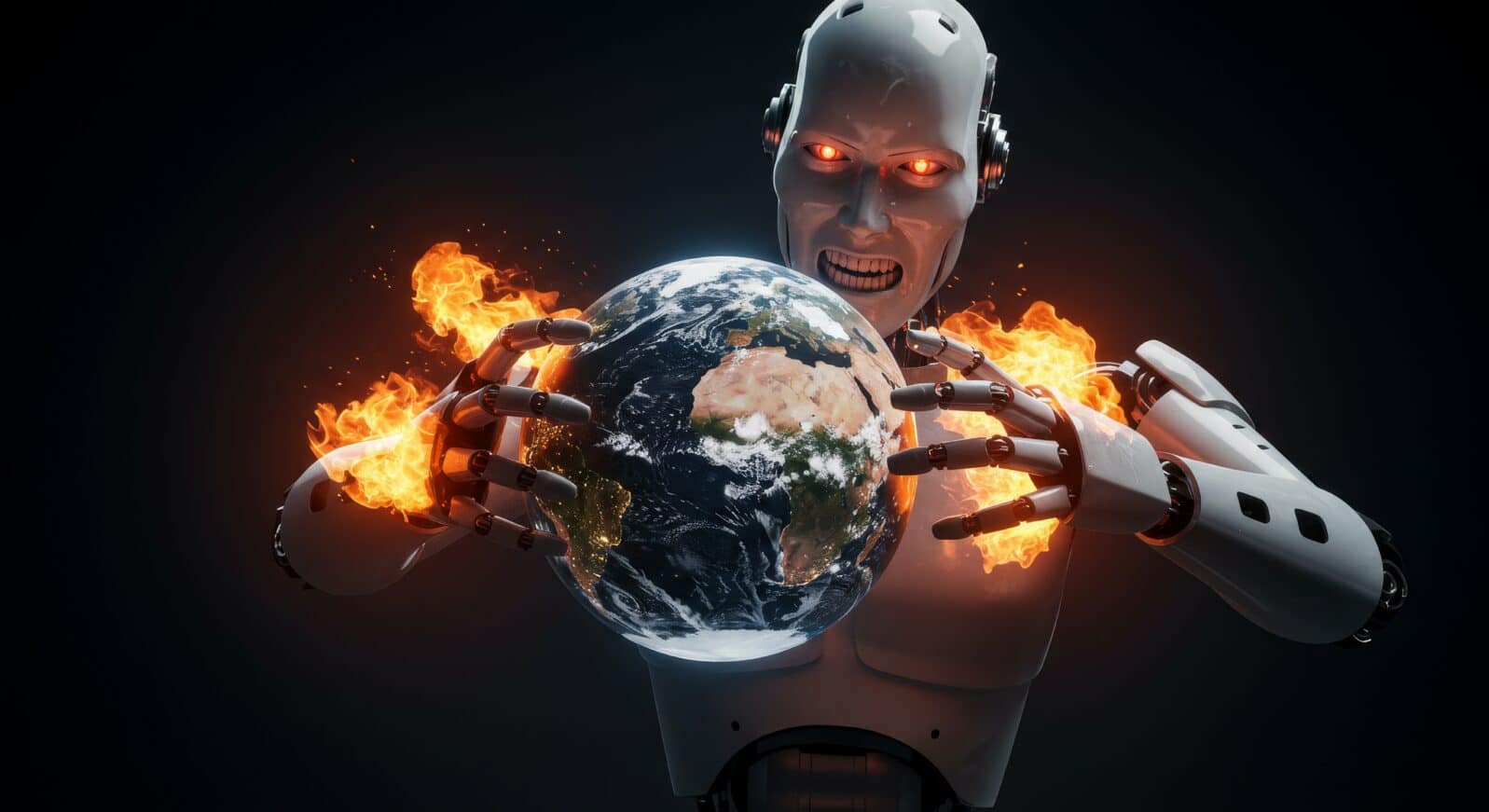
Isn’t the AI March of Dooms Getting a Bit Ridiculous Now?
The recent military incident of concern stemmed from an analyst relying on a hallucinating chatbot — surely an avoidable errorIn an interesting cultural development, thinkers on both the left and right are highly skeptical of the Silicon Valley Doomers’ warnings.
Keep an eye on that sharp young cookie…
At her blog, User Mag, Taylor Lorenz, formerly of the Washington Post, warns against the “Dark Money Behind AI Doomer Panic”:
We break down the math behind the so-called “10% extinction risk,” expose how dark money and ideological fellowships shaped mainstream AI coverage, and discuss why big tech labs actively benefit when lawmakers regulate frontier models out of fear rather than tackling immediate, real-world harms like wage discrimination, data privacy violations, and corporate consolidation. September 18, 2026
Meanwhile, at The Spectator, business writer Geoffrey Cain likewise warns us to beware of billionaires touting the apocalypse:
The reasoning inside the laboratories runs like this: AI may kill everyone, so it must be built by people who understand that it may kill everyone, so it must be built by us.
In practice, the reasoning is becoming a standard AI business model. It works like so: a researcher concludes that his employer is building the technology too dangerously. He leaves and then explains, at length, why AI may destroy us. Then he raises several billion dollars to build “safer” machines.
Investors don’t as a rule withhold cash on the grounds that a product is too powerful. Amodei knows this, and he knew it at the end of 2020 when, as then-vice president of research at OpenAI, he let it be known that he felt his employer was not taking the danger seriously enough. He left with a group of colleagues and founded Anthropic early the next year. September 19, 2026
Indeed? Then those who freak out watching these nerds play Doomball without a net are the cheering section for some sharp cookie’s next $billion or two.
The rewards — and risks — of courting both the left and the right
At Jewish World Review, Ian Duncan and Nitasha Tiku offer some thoughts about how old-fashioned socialist Bernie Sanders came to board the Panictown Express: “The meeting between Sanders and advocates of the idea that powerful AI will threaten humanity’s future occurred amid a years-long drive by activists to forge connections in Congress and elevate their concerns. In recent days, that work appeared to have paid off.”
Not an accident of history, that.
Duncan and Tiku go on to assess the Doomers’ strategy in marketing fear to both the left and the right. In theory, no matter who wins in November, Doom will have friends in high places.
Better still, nothing appeals to most figures in government like something Big to regulate. And many AI midwits who were never headed for stardom in the Valley anyway could end up with high-level government jobs.
That’s the reward part; now here’s the risk: What if neither side believes them? Donald Trump clearly doesn’t (“a hoax”) and he’s in for another two years no matter what.
Ridicule follows disbelief naturally. Roger Kimball quipped at The Spectator,
Right on cue, Bernie Sanders threatened legislation to bankrupt companies and cast anyone pursuing “superintelligence” into prison for 20 years. Some innocent bystanders wondered whether by “superintelligence” the Senator meant anyone more intelligent than he.
It’s always possible that the Doomers are onto something. But they’ve been predicting an AI apocalypse for decades. What’s missing is any scale by which we can assess the risks or decide policy. Readers who live in a forest fire or earthquake zone will understand: Assessment of scale must precede rational planning of any sort.
It’s not like there’s nothing to worry about…
At Gizmodo, Matt Novak reports,
The U.S. military planned to board a Chinese vessel in the Middle East based on bad intelligence from an artificial intelligence tool but backed out at the last minute, according to a new report from CNN. The determination to even consider a boarding action against the China-flagged ship relied on an AI-hallucinated claim it was shipping nuclear weapon components and “almost started a war,” according to an anonymous source who spoke with CNN.
Details about the incident in the Middle East remain scarce, but what we do know is that the faulty intel originated with a special operations command analyst who used a chatbot in their duties. That chatbot “inaccurately identified the material the ship was carrying,” according to CNN, apparently believing that it had something that could be used to make nuclear weapons. September 18, 2026
Maybe the real lesson here is that reliance on chatbots is even dumber than we thought. But we can’t expect the chatbot industry to unite in a chorus to warn us about that.
What we can do is pay attention to non-Doomers as well. Quillette, for example, which never bought into the panic, offers a series of articles tracing its history and assessing our actual prospects.
For example,
Revisiting Nick Bostrom’s Superintelligence a decade after publication, our reviewer, Sean Welsh, argued that a great deal has to go consistently and infallibly wrong for the doom theory to hold—and that many of Bostrom’s arguments rest on deeply anthropomorphic premises. Human-level machine consciousness remains a distant prospect.
and
Most recently, in the wake of the OpenClaw panic, Peter L. Levin makes the case that today’s systems are better described as artificial autocomplete than artificial mind—vast pattern-recognisers reproducing statistical regularities in text. The real dangers lie in human incentives, bad regulation and corporate hype.
Meanwhile, invest in popcorn futures and keep a good personal supply on hand.
