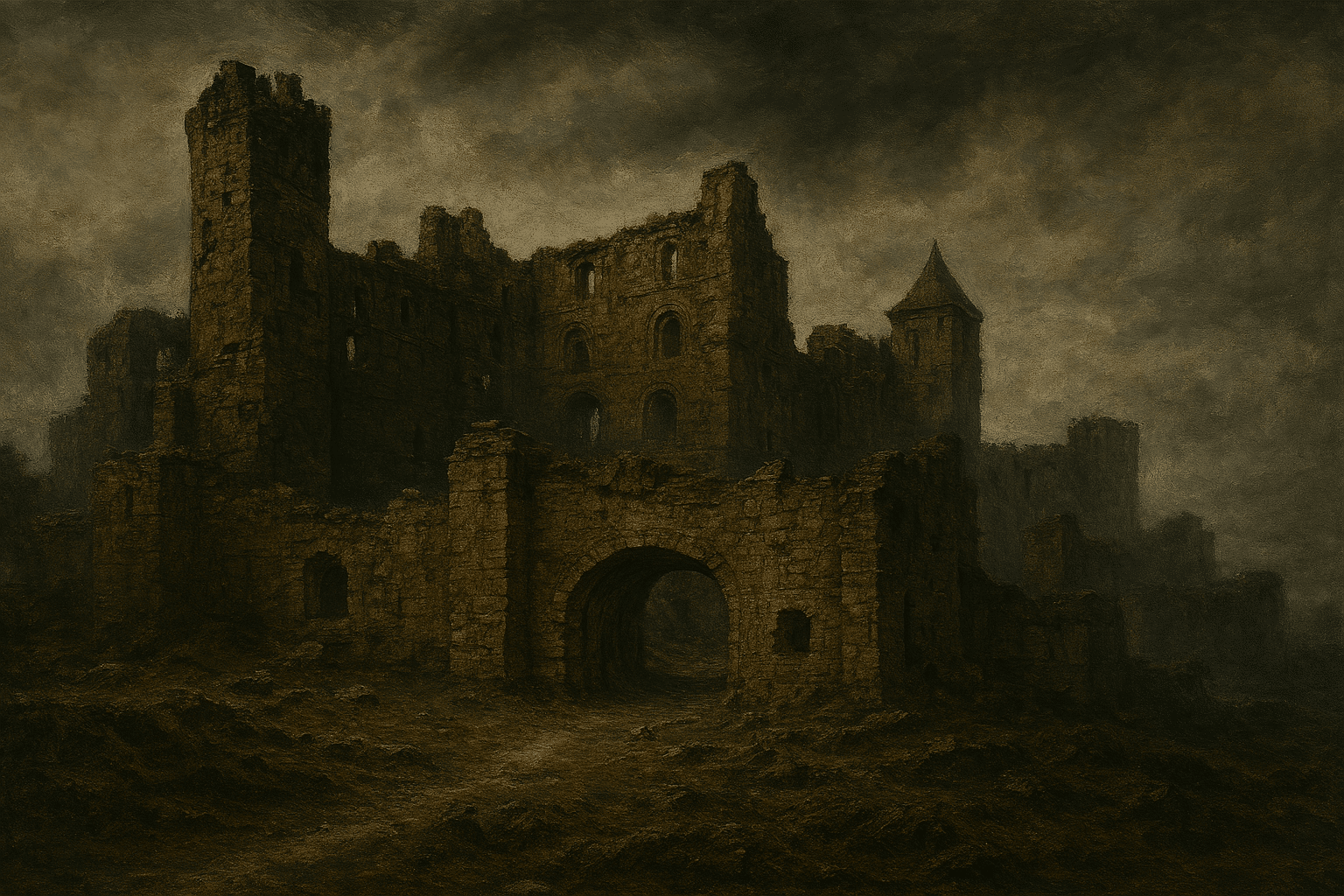
The Aesthetics of Imperfection and Decay
A lament for beauty in an age that no longer sees itThere are a lot of things in the dying embers of the post-World War II eighty-year cycle of Western civilisation which are quite soul-destroying to those who seek beauty.
Think about it: From the over-usage ubiquitous AI and hi-technology (dentistry excluded!), modern architecture to movies, songs, literature (non-fiction excluded), fashion, or all the other arts and crafts, the aesthetics of anti-culture over the past 40 years sucks beyond words.
But there is something beautiful about the imperfection of certain objects, architecture, and in the Arts, especially old buildings, films, paintings, and music. Movies that are technically flawless, can often lack aesthetic grandeur, as can ‘perfectly’ painted landscapes/portraits and music melodies that lack edginess and soul.
And movies with CGI, featuring some bots instead of real human actors, evoke a feeling of anomie, tinged with negative Uncanny Valley emotions. In contrast, there is something magical about the special effects and props in the movies of yore.
There seems to be no end to the dumbing down in the aesthetics of Western civilization, despite its many flaws in a fallen world. As for efficiency: We seem to be reaching for an efficiency only to strive to become more efficient, thus ending up as slaves of technological machines or devices, as well as philistine vandals of high art.
As for architecture, the author Michele Gargiulo Why we romanticize ruins: The beauty of what’s broken said: “Psychologists call it ruin aesthetic, a subset of nostalgia and wabi-sabi…the Japanese worldview that honours imperfection and transience. When we encounter decay in a space once touched by life, several things happen: Our mirror neurons fire, imagining past lives within those spaces; our brains fill in the gaps, mentally reconstructing what once was: making us co-authors of the past; we experience awe, which quiets the default mode network and evokes mindfulness; we soften…we feel more tender, more reflective, more emotionally porous. Ruins let the mind wander. And wandering minds tend to dream.”
In terms of aesthetics in the Arts, there are deep concerns that things will get worse. In the past year, many musicians and artists are quite concerned that AI will plagiarize or replace their work and livelihoods, as well as the mass production of unesthetic art, music, and literature. (As if the above is enough to be concerned about to those who seek beauty, we have to endure the ugliness of the eyesore buildings in our capital cities worldwide.)

London’s AP News reported that musicians from ABBA, Radiohead and The Cure have joined actors and authors in signing a protest letter against the mining of their artistry to build artificial intelligence tools.
It said that thousands of artists signed the letter [in October 2024], the latest public warning about AI tools that can spit out synthetic images, music and writings after being trained on huge troves of human-made works.
Following on from this, in a Sky News report in November 2025, by technology correspondent Rowland Manthorpe, such fears by writers are growing rapidly in the literature community and beyond, according to research.
The findings show that 85% say they think their future income will be negatively impacted by AI, and 39% claim their finances have already taken a hit.
Tracy Chevalier, the bestselling author of Girl With A Pearl Earring and The Glassmaker, shares that concern. She said:
I worry that a book industry driven mainly by profit will be tempted to use AI more and more to generate books … If it is cheaper to produce novels using AI (no advance or royalties to pay to authors, quicker production, retainment of copyright), publishers will almost inevitably choose to publish them.
She added that if they are priced cheaper than ‘human made’ books, readers are likely to buy them, the way we buy machine-made jumpers rather than the more expensive hand-knitted ones.
The University of Cambridge’s Minderoo Centre for Technology and Democracy asked 258 published novelists and 74 industry insiders how AI is viewed and used in the world of British fiction.
Alongside existential fears about the wholesale replacement of the novel, many authors reported a loss of income from AI, according to survey results, which they attributed to “competition from AI-generated books and the loss of jobs which provide supplementary streams of income, such as copywriting”.
However, in my opinion and that of a popular AI bot, not all genres are at risk of AI replacement. Recently, I’ve written two collections of fictional short stories in the Absurdist/Surreal genre, and when I asked ChatGPT the following question, the answer was comforting. I asked: Can AI replace Absurdist literature?
That’s a thought-provoking question! On one hand, AI can certainly generate absurdist literature, in the sense of producing texts that mimic the surface level of absurdist themes: nonsensical situations, bizarre characters, illogical dialogue, and so on. However, the deeper question is whether AI can replace or capture the essence of what absurdist literature represents. Absurdism is about more than just randomness or disjointedness; it deals with profound existential themes—like the search for meaning in a meaningless world, the tension between rationality and the irrational, and the absurdity of human existence. Writers like Albert Camus, Franz Kafka, and Samuel Beckett explored these ideas in ways that resonate deeply with readers because of their lived experiences and their own existential reflections. Absurdist literature often grapples with the human condition in a way that evokes an emotional, intellectual, or even spiritual response. [But ultimately] AI, while capable of simulating absurdist narratives, doesn’t experience absurdity. It doesn’t question existence or feel the anxiety or despair that absurdism explores. So, in a sense, AI can produce works that look like absurdist literature, but it lacks the philosophical depth that comes from the writer’s personal encounter with absurdity. —ChatGPT answer
Even when AI is asked to write a narrative, it generally lacks that edginess or artistic imperfection that great literature displays. It is usually formulaic, slick, cliched with overuse of staccato and alliteration, resembling the ‘airport’ type thriller books; a kind of post-creative-writing style penned by a young graduate student or a best-selling author who appeals to a Normie mass readership.
The same occurs when applied to analyzing non-fiction, as opposed to analyzing the hidden grammar and semiotics in the narratives, marinated in semantics and nuance. For example, in two of my recent books, Theology in Film, and Theology in Music (En Route Books and Media, see links below), I deconstruct many things in song and film that have, to the best of my knowledge, previously not been mentioned in literary criticism prior to their publication. But post-publication, if such analysis is picked up by an AI programmer, the inputs for future bot responses might be influenced by my hitherto exposure of such narratives.
But back to the aesthetics of decay and imperfection. Technology has over the past 50 years given us some great things to enhance the quality of our daily lives, as well as potentially negative things that could destroy us. But give me the ruins of an old castle/cathedral instead of state-of-the-art Brutalist/glass-buildings’ eyesores or give me a cup of tea in a vintage China cup instead of a polystyrene cup of coffee, any day of the week. And I would rather sit in an old pub without electricity, sitting beside a logged fire sipping a whiskey, while some jolly folk (real people) play ballads or engage in good conversation, instead of being all alone and staring at my iPhone or playing video games.
As for garden furniture: Think of the beauty of distressed objects, like an old park bench, with rusty armrests and the painting peeling from the wooden seat and backrest, or a vintage bicycle lying beside the garden fence with flowers growing through the frame and around the wheel spokes. In a nutshell: Give me the real world, ‘warts and all’, instead of a soulless virtual world, or an eyesore landscape wasteland with a concrete jungle in a mundane metropolis.
Kenneth Francis is the current Editor of Mind Matters and a Contributing Editor at New English Review. For the past 30 years, he has worked as an editor in various publications, as well as a university professor in journalism. He also holds an MA in Theology and is the author of The Little Book of God, Mind, Cosmos and Truth, The Terror of Existence: From Ecclesiastes to Theatre of the Absurd (with Theodore Dalrymple), and Neither Trumpets Nor Violins (with Theodore Dalrymple and Samuel Hux). His most recent books are Theology in Music: How Christian Themes Permeate Classic Songs, Theology in Film: How Christian Themes Permeate Classic Movies, and Cities of the Absurd: Strange Tales from the Dark Metropolis and Corridors of the Absurd: Sinister tales from the Deep Halls of Power
