
Free Will vs. the Totalitarian Temptation
If our thoughts and choices really are wholly determined, what follows?This article is republished from Salvo.
After forty years’ study of humans and primate apes, Stanford professor of neurology Robert Sapolsky, author of Determined: A Science of Life Without Free Will (2023), announced that “We are nothing more or less than the sum of that which we could not control—our biology, our environments, their interactions.” Sam Harris, a well-known atheist and neuroscientist, agrees: “Free will is an illusion.”
 Published by Worthy Books
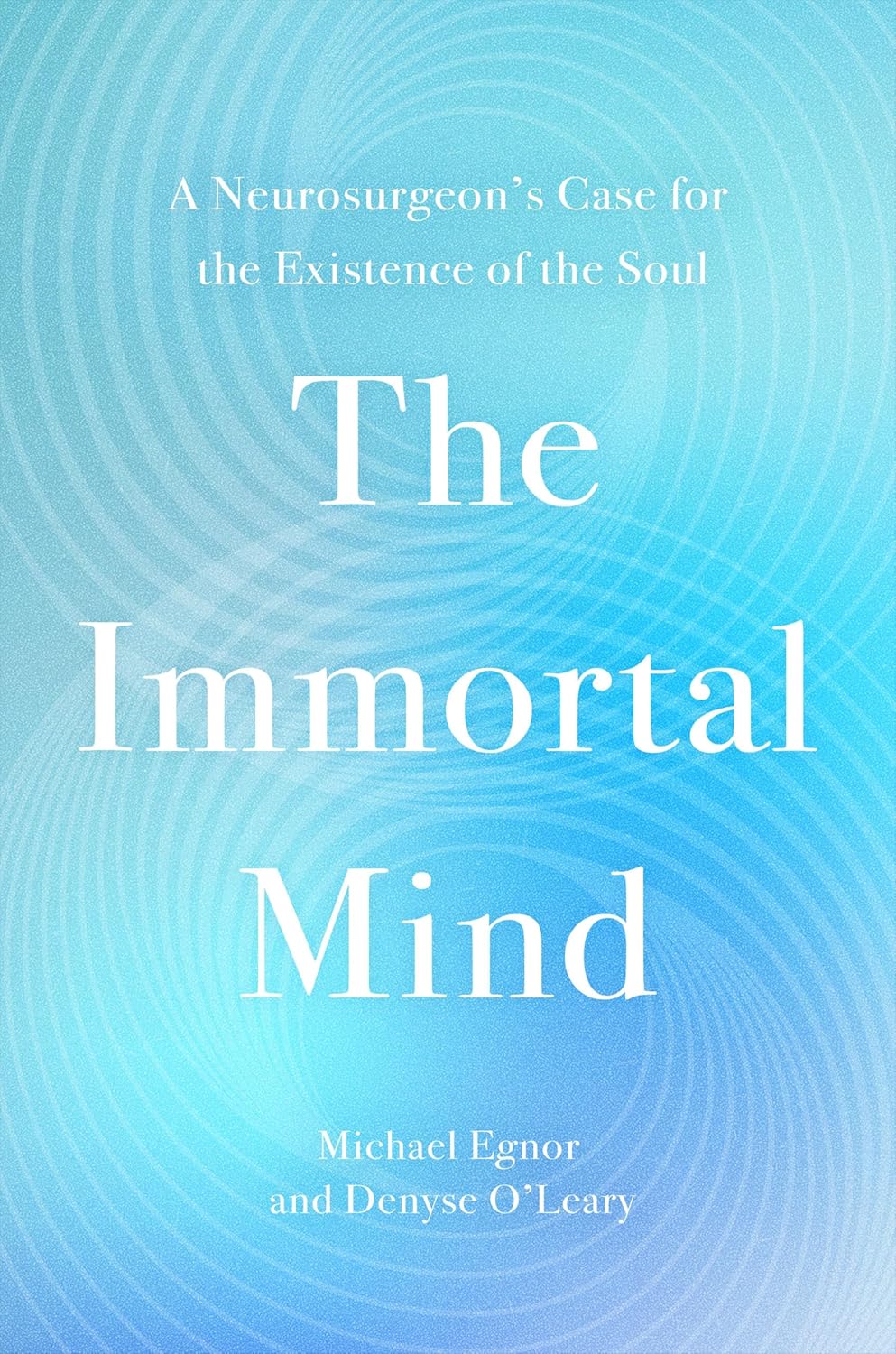
Denial of free will is popular among scientists generally and is probably the majority view among neuroscientists. As a result, many will assume that free will has somehow been refuted by science. Actually no. As neurosurgeon Michael Egnor and I note in The Immortal Mind: A Neurosurgeon’s Case for the Existence of the Soul (2025), denial is an ideological fashion. It is not a rationally consistent belief.
Problems with Denial
Here are some of the reasons we give:
The logic problem. If our thoughts and choices really are wholly determined, what follows? Even the statement that “Free will doesn’t exist” cannot coherently be argued as true or false, any more than a moaning wind might be true or false. If we lack free will and our thoughts are determined wholly by the laws of physics and chemistry, then we cannot make any valid argument. Free will denial is part of a logically self-refuting suicide of the intellect.
The physics problem. Over a century of modern physics has established that our universe is not, at bottom, wholly determined. In 2022, physicists Alain Aspect, John F. Clauser, and Anton Zeilinger received the Nobel Prize in Physics for experiments establishing that at the most fundamental level, nature is governed by probabilities and not certainties. This, it follows that human choices are not rigidly bound up in strict laws of physics.
The neuroscience failure to rule it out. Wilder Penfield (1891–1976), a pioneer neurosurgeon, noticed something significant when he was stimulating patients’ brains during awake surgery (generally to treat epilepsy). An awake patient could always tell whether Penfield had caused her limb to move by stimulating a part of her brain or whether she had freely chosen to move it herself. After more than eleven hundred surgeries, Penfield was not able to find a center in the brain where the “will” could be located. Originally a materialist, he later inferred that the will does not arise in the brain but is a power of an immaterial mind.
 Image Credit: Mihail -
 The neuroscientist we hear about most often in connection with free will studies is Benjamin Libet (1916–2007). Introductory psychology students may very well be taught that he disproved free will. He himself disagreed; what he found was a detectable “readiness potential” that appeared in the brain just before an experimental subject decided to push a button. But his later research showed that no such potential arose if the subject decided not to push the button. So he famously quipped that he couldn’t say for sure that he had proved the reality of free will, but he had proved the reality of “free won’t!”
Later research in this area took a different tack, focusing on the relative importance of a decision. Pushing a button in Libet’s lab incurred no real-life consequences, but what about decisions with true consequences? Researchers found something very interesting: meaningless choices were preceded by a readiness potential, but meaningful choices were not. When we care about a decision and its outcome, our brain appears to behave differently.
Given that free will matters most to us when we are making important decisions, it is surely significant that the important decisions did not seem to have a material correlate. If anything, such research findings support free will.
Critical to Freedom
Much of the Western world today, even Britain, is flirting with a totalitarian temptation: if we are nothing but meat puppets molded by time and chance, why shouldn’t the government mold us instead of us molding our government? That includes managing our ideas. For example, many in the United States, including Vice President J. D. Vance, are looking on with dismay as Britain has begun arresting thousands for social media posts—while crimes against real persons spiral out of control. This only makes sense in a totalitarian context. Governments groping toward totalitarianism are much more concerned with the spread of wrongthink than they are with their citizens’ safety.
In The Immortal Mind, we argue that the totalitarian temptation stems from a rejection of the reality and importance of free will. Prominent historian Yuval Noah Harari goes so far as to claim that the very idea of free will is dangerous: “If governments and corporations succeed in hacking the human animal, the easiest people to manipulate will be those who believe in free will.”
Some may comfort themselves with the notion that the government only shuts down obnoxious people. But they probably haven’t reckoned with the next steps. The 2002 film Minority Report assumes that incarcerating people before they have committed crimes is strange. But it makes perfect sense in a totalitarian light: The inevitable protest— “But I’m innocent!”— is meaningless. Without free will, we are never either guilty or innocent. Nonetheless, authorities may seek to forestall a future risk, perhaps by incarcerating whole classes of people, as in the Soviet gulags.
Similarly, if free will doesn’t exist, disagreement with the government can be redefined as irrational—the output of a badly functioning brain. The Soviet Union, for example, “medicalized” dissent by forcibly hospitalizing political and religious dissenters as psychiatric patients, unable to reason correctly.
The trend is slower in the United States, but real. And these changes need not happen by violence. Societies whose inhabitants don’t believe in free will may just drift toward totalitarianism. Pundits and politicians alike are tempted by the idea that, if there are no higher powers or greater realities to answer to, they can force people to fulfil their visions with impunity. And there is more than government coercion that is at issue here. Overcoming addictions and sorting out conflicts and troubled relationships are a much greater challenge if the underlying assumption is that we do not have the inner power to change.
Yuval Noah Harari is wrong, and not just in his belief about free will. It is elitists’ denial of free will that presents the greatest danger to humanity. It is those who deny free will that tend to become the most abusive manipulators of the masses.
Free will is real. It is a natural aspect of our immaterial minds. We can use or abuse it, but it cannot just cease to exist.
