
Should Christians Harness AI Chatbots As a Force For Good? Part 2
The claims being made for what these bots can do for ministry would lead us into dangerous territoryThis article is reprinted in two parts from Doug Smith’s blog, That Doug Smith (October 12, 2025). This is the second part. The first part is here.
Last Sunday, I was looking at the claims made for the use of gen AI chatbots in Christian ministry by Pat Gelsinger. He is the former CEO of Intel and head of technology at faith-forward AI startup Gloo. It seems to me that everything Gelsinger says serves the agenda of his company, Gloo. They’re the sponsor, and they want to sell their GenAI chatbots to ministries around the world. He must inspire his customers to believe the tool trope (AI is just another tool) so they’ll buy what he’s selling.
Gelsinger sounds like software pioneer Marc Andreessen and other Big Tech luminaries as he describes educating every child on the planet, presumably by giving them all internet access so they can use (his) AI. He forgets that Big Tech elites send their kids to tech-free schools, and that we’re already seeing how harmful GenAI is to education because of epidemic levels of cheating and stunting the brain’s ability to learn.
 Image Credit: top images -
 He also believes he can eliminate poverty with AI:
Almost everybody living in extreme poverty lives in the other 6,000 languages. AI will enable us to conquer the other 6,000. So literally since Babel, we will have conquered language through AI for the first time.
I wonder if he can hear himself? Since Babel? He’s using AI to roll back God’s judgment at the Tower? Has he forgotten that God specifically didn’t want us to “make a name for ourselves” through our technology? God is our Savior, not AI.
But this still sounds inspiring, as Gelsinger links techno-utopia with pleasing Christ:
I believe that’s the single most powerful thing that we can do to eliminate poverty. I believe that’s possible in our lifetime.
Do you think the heart of our Lord Jesus Christ would be honored if His Church did that? I do. And those are the kind of things that we will be able to do when we take AI on mission with us.
He’s going to eliminate poverty in our lifetime! Using the same techniques and talking points that Big Tech titans prescribe.
But is God going to save the world through AI?
Sticky Contradictions
Gelsinger’s company, Gloo, certainly seems to think so. So they’re selling GenAI chatbots with a Christian veneer. They claim to make an “AI you can trust for life’s biggest questions.”
Trust is the big deal at Gloo. Their goal: “Progress moves at the speed of trust. At Gloo, we convene ideas and experts to raise the bar on trust in AI.” Trust in AI — as savior? Maybe, but don’t worry, they’re “dedicated to ensuring that artificial intelligence is ethical, transparent, and aligned with biblical values.”
What biblical values, exactly, are aligned with technology that is designed to form dehumanizing, deceptive relationships?
Because GenAI uses LLMs to confabulate every word, their chatbot rightly has this disclaimer: “Gloo AI Chat can make mistakes. Confirm important info with other trusted sources.” Yet they want us to trust it with “life’s biggest questions?”
And though they claim to use ethical models, how can they be ethically sourced when their tech is built on nothing less than Meta’s LLAMA AI and China’s DeepSeek? Meta, maker of Facebook and Instagram, who has built their world-dominating influence by knowingly destroying the mental health of a generation and lying to everyone while they’re doing it? And DeepSeek, seemingly directly trained on ChatGPT?
I’m not seeing any good models for ethics here.
Gloo wants their AI to disciple the world, promising utopia while ignoring the destruction that will be left in its wake. Just like Big Tech is doing, but with a fish sticker on the back.
Because it’s so easy to just go along with what’s popular. I wish I could sometimes! I’m “that guy” everywhere — the one who is cautious, points out risks, asks hard questions. How much easier to just embrace the idea that AI is ushering in a utopian future. Or that God Himself might use AI to end poverty in our lifetimes.
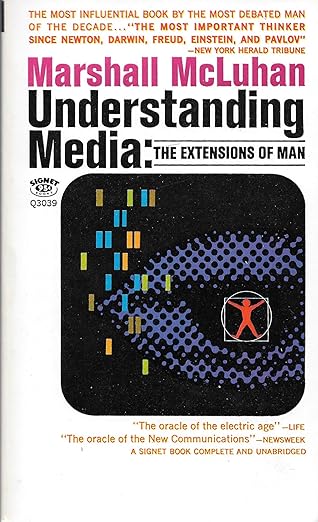
chapter is “The medium is the
message” (free .pdf)
Beware of Anti-Christian Utopias
Marshall McLuhan (1911–1980), the Catholic scholar famous for the aphorism “the medium is the message,” shared insights we should consider before thinking we can use AI as a tool for good. Rod Dreher quotes McLuhan here:
Electric information environments being utterly ethereal fosters the illusion of the world as spiritual substance. It is now a reasonable facsimile of the mystical body [i.e., the church], a blatant manifestation of the Antichrist.
He wrote this before GenAI chatbots. Before the internet. The illusory, deceptive, fake spiritual world created by our electronic technology tricks us into thinking it is going to save us, but this is anti-Christ. McLuhan urges us not to fall for a false savior:
When electricity allows for the simultaneity of all information for every human being, it is Lucifer’s moment… Just think: each person can instantly be tuned to a “new Christ” and mistake him for the real Christ.
Could generative AI, even in the hands of a “Christian” company like Gloo, be more Luciferian than Christian?
In another important article, McLuhan reminds us:
There is no harm in reminding ourselves from time to time that the “Prince of this World” is a great P.R. man, a great salesman of the new hardware and software, a great electrical engineer, and a great master of the media.
Isn’t that the truth? When I see the same “tool trope” talking points across such varied industries, ministries, and churches, I see the hand of the “prince of the power of the air” dictating the propaganda himself.
C.S. Lewis and the Religious Techno-Savior

In That Hideous Strength (1945), C.S. Lewis (1898‒1965) wrote a prophetic parable that aligns a little too closely with where society is today as we are perched the precipice of GenAI’s worldwide domination. In the book, the elites of the world are devoting themselves to a disembodied Head, a fount of all knowledge. Their science and technology have led them to something that is going to usher in a utopian society in its disembodied image. As we read, we learn that the Head is animated by the devil himself.
But there’s a cleric among the leaders of the N.I.C.E., the institution tasked with bringing about the Head’s promised techno-utopia. Reverend Straik sounds strangely like Christians who think they can “bend the arc of technology for good.” Consider:
For, mark my words, this thing is going to happen. The Kingdom is going to arrive: in this world: in this country. The powers of science are an instrument. An irresistible instrument, as all of us in the NICE know. And why are they an irresistible instrument?
They are an irresistible instrument because they are an instrument in His hand.
C.S. Lewis, Space Trilogy, HarperCollins, Kindle Edition, p. 546.
The questions I raised last Sunday are critical. And the stakes feel apocalyptic. Why? Because the promises are world-saving, but the Big Tech leaders behind them are world-dominating deceivers. And their chatbots reflects their creators.
So no, we should not try to shape AI chatbots as a force for good. We cannot — and our attempt may be idolatrous (Psalm 115). Instead, recognize that we are shaped by technology, especially by AI chatbots, in ways that are against all of our goals as Christian disciples.
Christian friend, I urge you: please don’t fall for the tool trope. Please look deeper into what AI chatbots really are, and all that we lose by using them: critical thinking, discernment, creativity, humanity, and spiritual life.
Because we’re all being discipled. Obviously, Big Tech is discipling many Christian leaders to nod along with their tool trope. But Jesus calls us to watch for Him. To wait for Him. To trust and follow Him. Salvation is in Christ alone, not in chatbots.
A Haunting Final Question
In Matthew 24:24, Jesus warned that “false christs and false prophets will arise and perform great signs and wonders, so as to lead astray, if possible, even the elect.” What signs-and-wonders-performing, elect-deceiving power might arrive in the future that would be more captivating that GenAI chatbots?
If GenAI chatbots don’t fulfill this prophecy, whatever does will rhyme, or be in the same key. And some leaders inside and outside the church will be likely to promote it with at least as much tool-trope-driven enthusiasm as they use on GenAI today.
Moody Radio’s wise and insightful Janet Parshall interviewed me about this article. You can hear the interview here.
