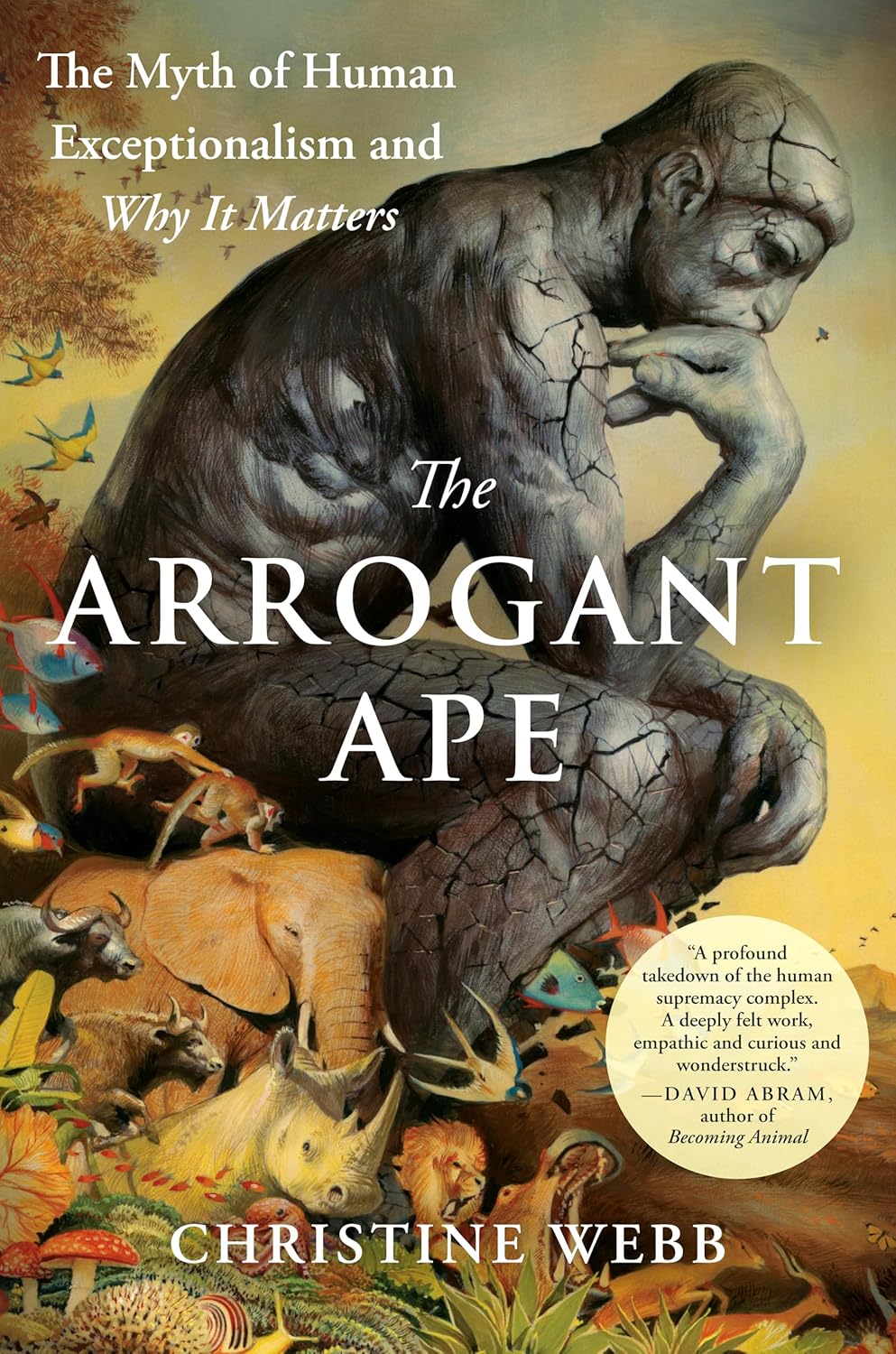
Christine Webb, an environmental studies prof at New York University, published a book in September, The Arrogant Ape: The Myth of Human Exceptionalism and Why It Matters:
Darwin considered humans one part of the web of life, not the apex of a natural hierarchy. Yet today many maintain that we are the most intelligent, virtuous, successful species that ever lived. This flawed thinking enables us to exploit the earth towards our own exclusive ends, throwing us into a perilous planetary imbalance. But is this view and way of life inevitable? The Arrogant Ape shows that human exceptionalism is an ideology that relies more on human culture than our biology, more on delusion and faith than on evidence. (Publisher)
In her landmark book, The Arrogant Ape: The Myth of Human Exceptionalism and Why It Matters, Dr. Christine Webb makes clear that the notion that we’re the most important show in town—smarter than, better than, more important than, uniquely exceptional, above, and separate from other animals—has got it all wrong. This distorted view of humans in which we use ourselves as some sort of standard to which individuals of other species should strive is not only arrogant, but singularly ill-informed.
She belongs to a growing subfield of ecologists, naturalists and evolutionary biologists who argue that animals do indeed have minds, and all that goes with them, including feelings, intentions, agency and consciousness. (She urges us to avoid the term “nonhuman animal,” as it implicitly reiterates human exceptionalism, and also to use personal as opposed to impersonal pronouns when writing about animals — both suggestions I am now following, although I may be guilty of misgendering a snake as a result.)
“Think You’re at the Top of the Food Chain? Think Again,” September 3, 2025
The snake misgenderer offers a couple of reservations, then says,
Why is this criticism of any importance, given how convincing I find Webb’s larger denouncement of our treatment of the animal world? “Think Again,”
Whew! We are reassured of his status as a believer.
Harvard primatologist Christine Webb has spent years researching the rich social, emotional, and cognitive lives of our closest living relatives. She exposes the ways that many scientific studies are biased against other species and reveals underappreciated complexities of nonhuman life—from the language of songbirds and prairie dogs, to the cultures of chimpanzees and reef fishes, to the acumen of plants and fungi. With compelling stories and fresh research she gives us a paradigm-shifting way of looking at other organisms on their own terms, one that is revolutionizing our perception both of them and of ourselves. (September 30)
Webb begins by asking, “What makes us human?” Scientists’ attempts to distinguish us from other species haven’t fared well, she notes. Chimps, octopuses and crows make tools. Other species carry out complex computations, exchange information, infer each other’s states of mind, display empathy and self-awareness.
Yeah, only humans invented hydrogen bombs. But if we’re “unique,” Webb says, so are baboons, bombardier beetles and slime molds in their own ways. And many species are stronger and faster than us, with keener senses.
Many of us nonetheless simply assume, Webb points out, that our species is “exceptional.” We’re smarter, more virtuous and, darn it, just better than all other organisms. After all, The Bible assures us that God created us in His image and gave us dominion over beasts. Exceptionalism also animates chains of being and cartoons showing us evolving from knuckle-walking brutes to our wise, upright selves.
Exceptionalist assumptions, Webb says, underpin scientists’ tendency to make humans the gold standard for cognitive capacity and to rig research in our favor. She zeros in on a 2006 report that human kids cooperate more than chimps. Unlike the kids, Webb points out, the chimps are captives. That’s like measuring human cooperation by observing prison inmates.
IN THE beginning, God made man in his image, granting him dominion over every living thing that moves upon the earth. Most people don’t look to the Bible to understand the world and our place in it, yet this view of humans as superior to nature and non-human life is sneakily persistent.
The characteristics said to distinguish humans and justify our dominance – including the ability to reason, use tools, feel pain, act morally – aren’t exclusively human, it seems. Chimps, crows and others show nuanced intelligence, have complex social bonds and use tools; fish and crustaceans feel pain; bees are cultural beings; even plants may have senses akin to ours.
All these intellectual worthies, in deadly earnest virtue, choose to miss the point: No life form other than humans writes books, reviews books, or contemplates any of the issues raised. Never has and probably never will.
That’s a fact; we can’t change it, and it is what makes us exceptional, whether we like it or not.
But then, if any such bien pensant did admit something so blatantly obvious, would that thinker still be allowed in polite circles? We shall have to wait for that to happen to find out for sure. But there is no harm in taking small bets.
Mass Delusion Is Interesting — Especially Among Opinion Leaders