Health Care: AI Changes Everything. But What Will the Changes Be?
A panel at COSM 2025 next month can help us separate the hope from the hypeA recent editorial at Science News Today captures the mix of information and misinformation floating around about what AI can and can’t do in healthcare:
Imagine walking into a hospital where machines not only assist doctors but also think alongside them. Where diseases are detected before symptoms even appear, where treatment plans are customized to each individual’s DNA, and where virtual assistants can comfort, guide, and monitor patients in real-time…
AI, at its core, is the ability of machines to learn, reason, and act intelligently. In healthcare, this intelligence is being harnessed to improve diagnostics, drug development, patient care, and hospital management. From analyzing billions of medical images to predicting heart attacks before they occur, AI is not just transforming medicine—it’s redefining what it means to heal.
“10 Ways Artificial Intelligence Is Transforming Healthcare,” October 9, 2025
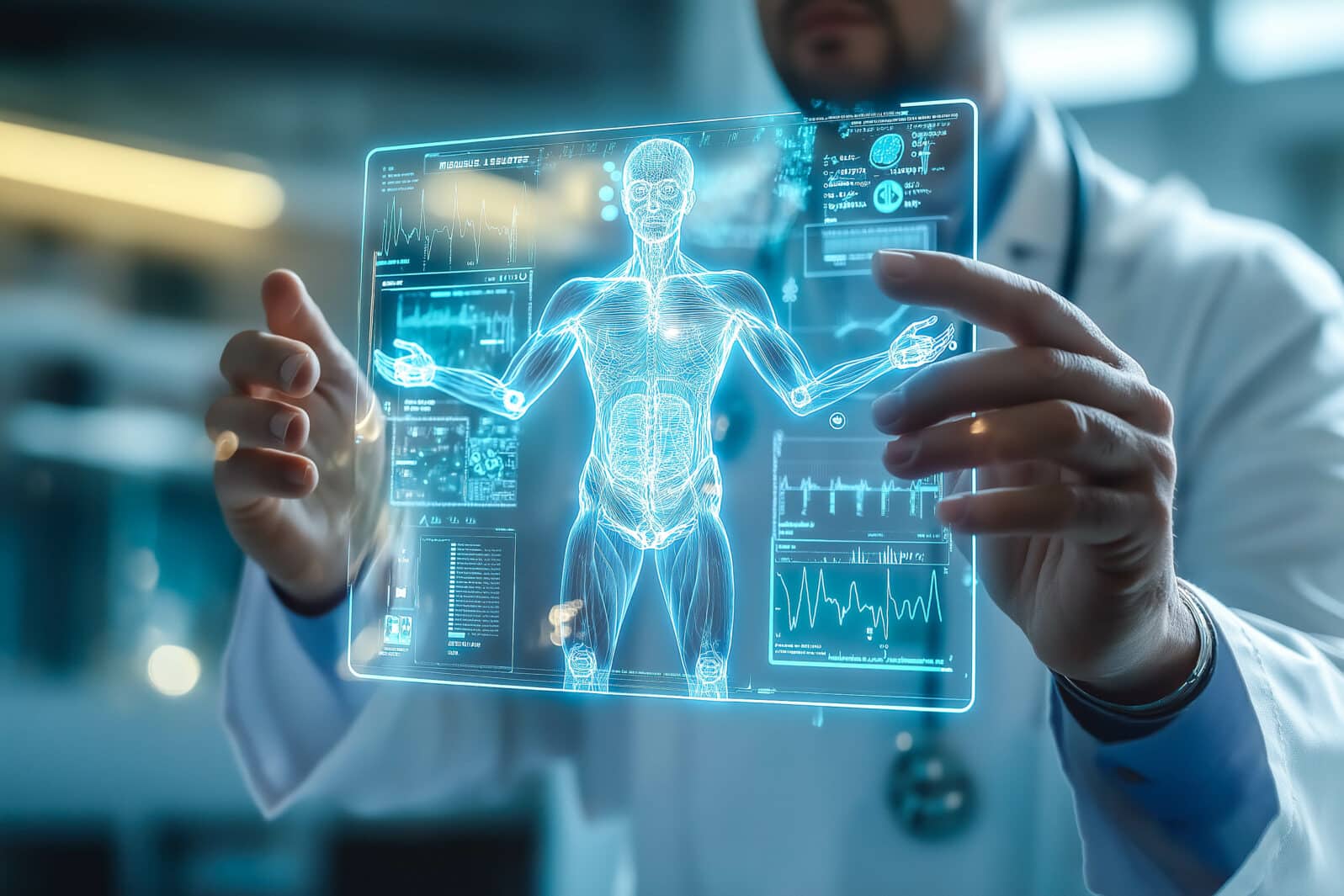
 Image Credit: Ilja -
 That sounds profound. But it is science fiction. Machines do not think. Computers cannot do anything that cannot be represented by adding up 1s and 0s.
In any event, the continuing problems with hallucination and model collapse in large language models serve as a warning about the practical limits of trying to outsource good judgment.
But then, a couple of paragraphs later, the editors say things that are much more rooted in reality:
Every second, millions of medical scans—X-rays, MRIs, CTs—are taken worldwide. Each image tells a story hidden in shades of gray, a story that can mean life or death depending on how quickly and accurately it is read.
AI algorithms, trained on millions of such images, can now spot patterns invisible to the human eye. They can detect minute tumors, subtle fractures, or the earliest signs of disease long before a radiologist might notice…
AI is also revolutionizing ophthalmology. Algorithms can scan retinal images to identify diabetic retinopathy, glaucoma, or macular degeneration with extraordinary precision. In dermatology, apps powered by AI can examine photos of skin lesions and determine whether they might be cancerous. Transforming Healthcare”
In short, what machines do have is massive computing power. They can take in vast amounts of information and provide answers to computable questions quickly.
But notice that the same article that identifies a number of instances of how that computing power can be used in medicine today begins by attributing to AI qualities it does not and cannot have. In this environment, we need sound advice.
Meet the Friday COSM breakfast panel…
At COSM 2025 next month, we will hear from three people who have been monitoring how AI will change health care:

● biotech entrepreneur Eric Garcia, COO at Oisin Biotechnologies (and moderator)
● Babak Parviz — CEO and Founder, NewDays.ai and formerly a vice president at Amazon
and
● Dr. Richard Cartledge — Chief Medical Officer, Syntheon and a thoracic surgeon
They’ll be helping us sort the hype from the hope in the “Innovations in Health Care” panel on Friday, November 21, 9:00 am, with breakfast provided from 7:30 onward. Register here.
AI offers challenges as well as benefits
It shouldn’t be surprising that AI comes with challenges as well as benefits for health care. At TechTarget, industry editor John Moore offers seven of them, including
3. Overcoming data fragmentation Health IT experts often point to data as being among the leading AI challenges in healthcare. “The one unifying principle that bubbles very much to the top of the list is the issue of data fragmentation across systems, locations and formats,” said Dr. Scott Schell, chief medical officer at IT consulting and outsourcing services company Cognizant.
This fragmentation makes data difficult to use in AI models and can lead to poor results. “AI depends on reliable and replicable data to be adequately trained so it can perform reliably and avoid hallucinations,” Schell said.
The varied data formats in the healthcare sector are particularly vexing. Providers, payers, pharmacies and testing laboratories, for example, employ a multitude of standards to house data. International Classification of Diseases (ICD)-11; Logical Observation Identifiers, Names, and Codes (LOINC); and Systematized Nomenclature of Medicine – Clinical Terms (SNOMED-CT) are just a few of the formats in use.
Amid the babel of technical dialects, healthcare organizations expend enormous effort gathering, cleaning and harmonizing their data so AI can make sense of it, said Shrikanth Shetty, chief growth officer and global head for life sciences and healthcare industries at IT consultancy HCLTech. “You have to have data in a shape and form that AI can consume,” he reasoned. “Otherwise, it will be junk in, junk out.”
“7 challenges of AI integration in healthcare and their remedies,” April 16, 2025

It’s easy to see how this happens. People enter the health care system under a variety of circumstances, which makes the fragmentation of data inevitable when first collected. But, IT professionals are working on systems that harmonize data collected under a variety of circumstances so as to enable a picture that can be analyzed.
Another critical issue that Moore mentions is confidentiality:
The security and privacy of AI models call for appropriate boundaries. “You need to have models that live inside your organization and create boundaries where access to outside public models isn’t possible,” [Scott] Schell said, “because that obviously represents an opportunity for data leakages or privacy breaches.”
Proactive security is also critical. That means baking security and patient data privacy into AI systems as they’re being built rather than after the fact. And their remedies”
Actually, the more concise and comprehensive an AI data collection system becomes, the more tempting a target it will be for hackers. Ironically, some serious risks are actually the price of success.
If your work includes health care concerns, you won’t want to miss this panel.
