
Monkey Wrenched: Science & the Specter of Private Truth
The landscape in which science flourishes has greatly changed. A rising power threatens even popular science staples like Darwinism. I call that new power “private truth.”Last April, I was offered the “Parting Shot” in Salvo 73. That issue focused on what did and didn’t happen at the Scopes Monkey Trial a century ago. I wrote about the decline since then in the idea that facts even matter much. Here’s the whole shot:
≻───── ⋆☆⋆ ─────≺
All the participants in the Scopes trial [about teaching common descent of humans and apes in Tennessee schools] took one thing for granted: public truth. Gravity, for example, is a public truth. What goes up must come down. Defying the law of gravity is a byword for folly.

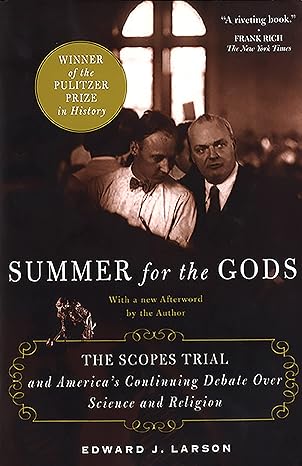
Scopes and his patrons regarded Darwinian evolution as truth of that sort. In Summer for the Gods (1997), Edward Larson quoted a lead story in The New York Times which asserted that Clarence Darrow “bearded the lion of Fundamentalism today, faced William Jennings Bryan and a court room filled with believers of the literal word of the Bible and with a hunch of his shoulders and a thumb in his suspenders defied every belief they hold sacred.”
The NYT writer, too, assumes that there is such a thing as public truth, and it is not Fundamentalism. The Darwinists thought that their (true) public truth, taught in the schools, would replace the Christian view of human origins, and for nearly a century, they were largely successful among the educated classes.
But the landscape in which science flourishes has greatly changed. A rising power threatens even popular science staples like Darwinism. I call that new power private truth.
Cancel Culture comes for Darwin’s faithful
Evolutionary biologists have come under assault from a quarter they hardly expected. Their public truth — which says humans accidentally evolved as unusually brainy apes —requires acknowledging the sex-binary nature of primates. But as transgenderism became a mass intellectual movement, the idea took hold that a human being could be “born in the wrong body.” Sensing a contradiction between biological reality and passionately held private truths such as this, elite institutions have begun to deplatform biologists who speak out.
The evolutionary biologists are the most vulnerable because they have the biggest stake in our kinship with the great apes. For example, Richard Dawkins lost his Humanist of the Year title for refusing to agree that humans can change sex. Colin Wright left academic life, tired of the constant attacks on his doubts about current gender ideology. Last summer, he was abruptly ejected from a taxpayer-funded National Institutes of Health webinar for no apparent reason — he had not even so much as submitted a question in the Q&A chat window. Evolutionary biologist Carole Hooven, author of The Story of Testosterone (2021), left her position at Harvard and appears to have suffered a nervous breakdown. University of Chicago’s Jerry Coyne found that anything other than total surrender was rejected. Thus, a recent Washington Post article announced, “Trump says there are ‘two sexes.’ Experts and science say it’s not binary.” Right. Those experts who say it is binary get canceled.
No one to plead science’s case
In a world of private truth, science has no one to plead its case. This problem is certainly not limited to evolutionary biology. We hear claims that witchcraft should be taken seriously and that the pursuit of correct answers in math is a form of oppression.
We face a very different intellectual world from the one in which Bryan and Darrow sparred.
During the birth of early modern science, long-held European folk beliefs were often upended. Belief in noxious vapors as a cause of disease, for example, eventually gave way to germ theory. But that happened in a world that held to public truth. Much has changed.
The trend to private truth has recently begun to face more criticism, but, in my view, it is more entrenched than some commentators suppose. Many people experience a vast liberation when they are freed from the constraints of logic, reason, and evidence. They will not part lightly with their new freedom.
≻───── ⋆☆⋆ ─────≺
You may also wish to read Salvo, Parting Shot: The Facts and Fictions of the Scopes Monkey Trial. Society has changed so much that biologists face trouble not for believing in Darwinism but for believing in the reality of biology. The biologists who pride themselves on enthroning Darwinism as a public truth find that what is publicly true no long even matters the way it used to. The idea can be used to persecute them.
