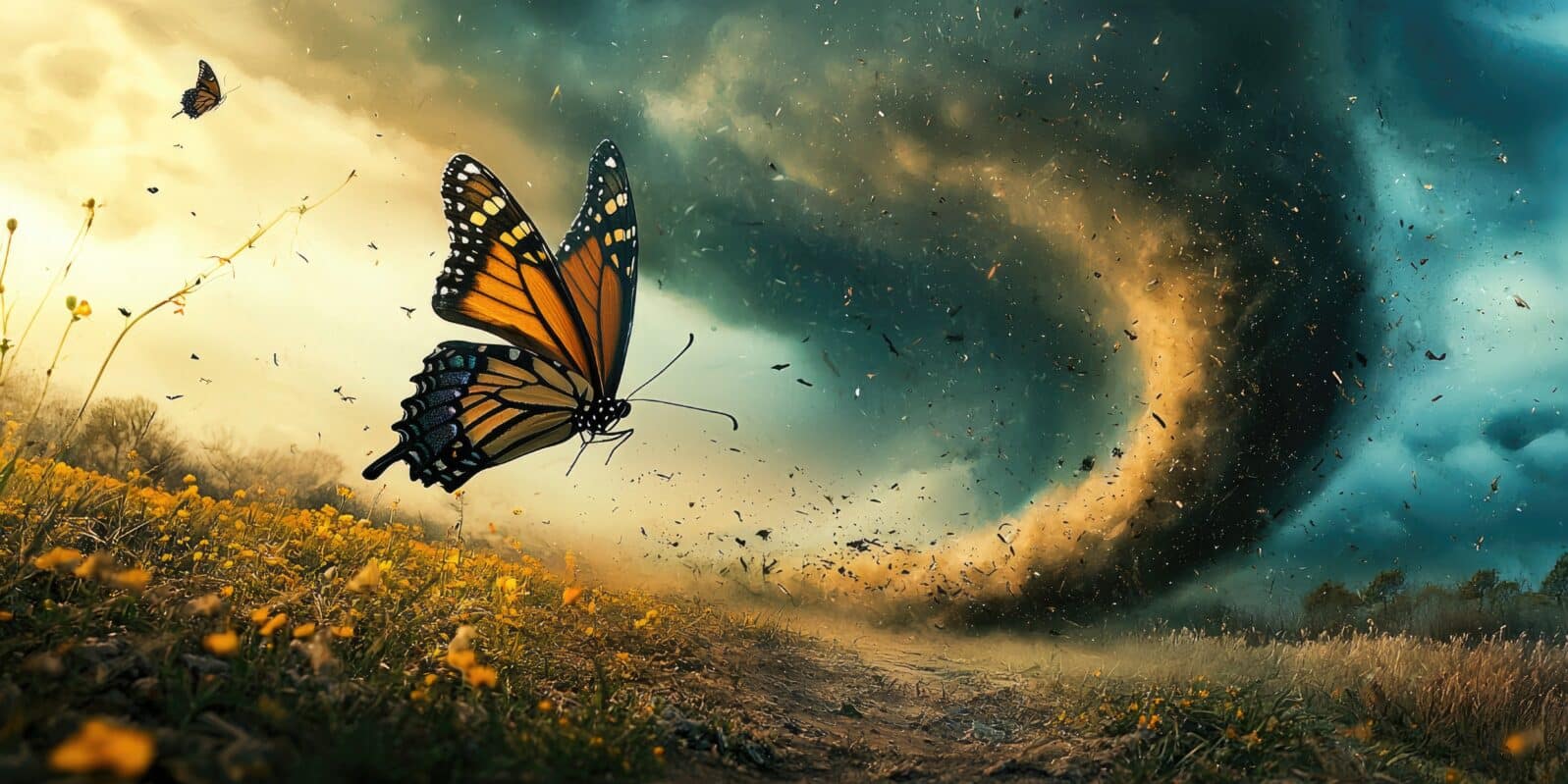
Sound of Thunder: Can Chance and the Butterfly Effect Coexist?
In Part 5 of my review of the sci-fi classic, I look at whether the effect could really upend evolution, however evolution is understoodLast Saturday, we talked about the first waves of the butterfly effect in the film A Sound of Thunder (2005). The film is based on a short story by Ray Bradbury, which tied the effect to events, things like spelling choices and who won an election.
However, the movie took a different approach to the question of time paradoxes. It described time alteration as a succession of waves, similar to the ripples in a pond, and each wave — save the first — was tied to a stage of evolution. The first wave was connected to the weather, the second, plants, and the third, bugs and “simple” life forms. The fourth wave began to affect the more complex animals like mammals. The ticking clock for the film is that eventually these waves will alter the most complicated life form of all, humans. The heroes must fix time before these waves alter our evolutionary development.
The perils of tying a sudden disaster scenario to evolution
Now to some, this idea might seem compelling. But anyone who takes a deeper look at the subject of evolution will quickly realize that the concept is nonsense. For example, the embryological development of fly larvae is vastly different from the development of a butterfly. So who decides what is simple? How could these waves distinguish a simple life form from a more complex life form when even the developmental systems of the supposedly simpler life forms are so varied?
I do want to take a moment to compliment the writers for this idea, however. It was a very original premise, and they put a lot of thought into certain aspects of the concept. It’s just a shame that the idea doesn’t work.
Could Darwinian evolution be subject to the butterfly effect?
To demonstrate why, I want to ask a broader question: Can a chance-driven mechanism like neo-Darwinism be significantly affected by the butterfly effect? Just to satisfy my curiosity, I asked ChatGPT, and its response was interesting. The short version of its response was yes, but before giving an answer, it listed a key distinction between neo-Darwinism and the butterfly effect.
When it comes to neo-Darwinian chance evolution, ChatGPT said, “So chance (random mutation, genetic drift, random recombination) plays a key role. Evolution is driven by both random events and non-random selection.” However, when describing the butterfly effect, it said, “It comes from deterministic but chaotic systems. The classic metaphor: a butterfly flaps its wings and weeks later causes a tornado.”
See the problem? Chance is random, but the butterfly effect is deterministic. In other words, the butterfly effect acts like a line of dominoes, whereas chance-driven mutation can have little to no correlation with the mutations that precede the first one. Mutations are not prompted by preexisting mutations. They are completely random. And to be random, those mutations must be, in some measure, isolated.
So, in light of that, let’s look at the scenario presented by the movie
A butterfly is crushed and taken into the future. First of all, a volcano is set to erupt, so the butterfly is going to die in any case. So the most that could happen is that some change might be created by the 1.3 grams of matter taken into the future. The missing matter is dead matter, so I don’t know why it would change anything. But let’s say the butterfly had lived.
Let’s say that it had offspring. Either that butterfly or its offspring had developed a single mutation. Of course, this mutation had to be beneficial; otherwise, the butterfly wouldn’t survive into the next generation. So, we have a single beneficial genetic mutation — which hypothetically produced a physical change — that no longer exists. What happens to the next mutation? Nothing. The next mutation is going to happen regardless of the mutations that precede it.
So, what’s the most that could happen? Not much. The modern butterfly’s wings might be smaller, or perhaps a different color. But the idea that mutations are linked to the degree that they create a domino effect powerful enough to alter multiple species couldn’t possibly be correct. The very nature of a random mutation is that it is isolated and in no way connected to the mutations that came before. So, how could the domino analogy required by the butterfly effect apply to evolution? It can’t.
But would the butterfly effect work anyway?
As to the original idea presented by Ray Bradbury in the short story, the idea that killing a butterfly would produce a chain of events related to what takes place in the world and the actions of other species, I don’t think that idea would work either. Ironically, as complicated as the butterfly effect sounds, I think it’s too simplistic. It doesn’t take systems into account.
Take a food chain for example. The whole point of a food chain in an ecosystem is to maintain homeostasis (self-regulated stability). If something dies and creates a lack of food in an environment, then one of two things happens: either the predator also dies, or another food source will move in to replace the lost one. But the entire process is designed to maintain stability in that ecosystem.
So the question becomes, how much can an environment really change because of the death of one butterfly? If there are separate systems in place designed to make sure things stay relatively the same, how could this runaway chain of cause and effect really destabilize those systems to the point that anything within an environment drastically changes?
The problem with the butterfly effect…
The problem with the butterfly effect is that it only takes the butterfly into account. But nature is flexible enough to handle a certain degree of variability. Therefore, if the environment of the butterfly is designed to take the creature’s death into account and anticipates those kinds of changes, how can the timeline create something as dramatic as a tornado, let alone change the spelling of words or determine an election?

The butterfly effect is one of those possibilities that sounds frighteningly plausible until one starts going into detail. The theory quickly falls apart the moment someone stops to consider it. The truth is there’s no correlation between a butterfly flapping its wings and the formation of a tornado, and even if there were, nature has systems that are meant to counteract dramatic changes. I’ll continue looking at A Sound of Thunder next Saturday.
Note: As an aside, when I asked ChatGPT about this, it produced a graph to help me understand the matter. I found the chart humorous and nonsensical, so I thought I would include it in this review:
Here are the first four parts of my seven-part review of A Sound of Thunder:
Does the famous butterfly effect make sense? I am going to look at the 1952 short story first — the premises and the plot — before tackling the 2005 film. I think “A Sound of Thunder” has remained popular partially because the butterfly effect is a unique idea if nothing else.
A Sound of Thunder: Comparing the film with the short story What’s the same? What’s changed? What works and what doesn’t? I compliment the writers for constructing a scenario where it is actually conceivable for time travelers to enter the past without altering it.
A Sound of Thunder: Time travel for fun and profit — and tragedy. In this third part of my review, I look at the adaptations leading up to the climax — the ones that worked and the ones that didn’t. We learn that expedition leader Ryer is hoping to use his time travel trips to help bring extinct species back to life.
and
Sound of Thunder: Surfing the time waves when the tide is high When plants start growing through cement walls, it is obvious that there is a problem. We learn that the butterfly effect only alters the evolution of biological material and the weather, and the effects start with plants.
