
Skepticism: Four Challenges From Near-Death Experiences
Neurosurgeon Michael Egnor offers these challenges to those who would explain away NDEs as a mere malfunction of the brainEarlier this month, on Piers Morgan Uncensored, Michael Egnor offered these challenges:
1. The clarity of near-death experiences
Michael Egnor: [12:18] Well, there are four reasons why near-death experiences point to survival of the mind after death that anyone who doubts them has to really account for.
The first thing is that near-death experiences are very clear. They’re very organized. they involve often a life review, which is not the kind of thing you see from a brain that is hallucinating or a brain that is dying, a brain that lacks oxygen.
“‘We Are Naturally IMMORTAL’ Is There Life After Death? Michael Shermer vs Michael Egnor” July 4, 2025 (36:16 min) The video is set to open at roughly 12:18 here.
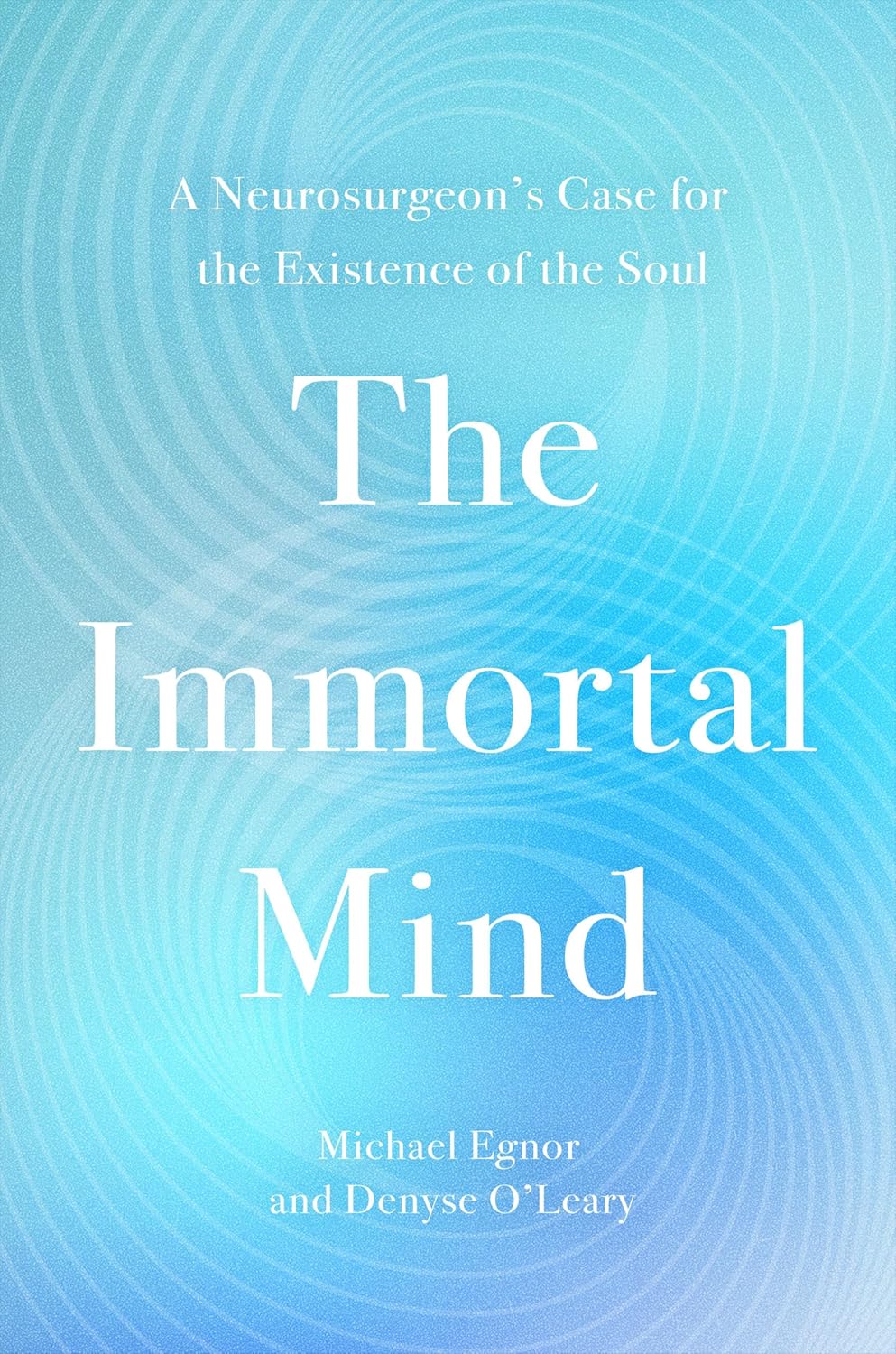 Published by Worthy Books
In The Immortal Mind, Egnor and O’Leary devote Chapter 6 to addressing various efforts to debunk near-death experiences. One suggestion is that they originate in hypoxia (shortage of oxygen) or hypercarbia (excess carbon dioxide). Egnor, who has treated these conditions, points out there that they produce distress, not at all the calmness of a near-death experience.
2. Seeing things that can be confirmed
The second thing is that about 20% of people with near-death experiences have out-of body experiences where they leave their body and they see things that are happening in the room during the time that they have no heartbeat, during the time that they are deeply unconscious and comatose because their brain is isn’t working.
We’ve recounted a few of these here from Bruce Greyson’s book, After (2021), including:
Psychiatrist Bruce Greyson, emeritus at the University of Virginia, tells us that he first started thinking about near-death experiences many decades ago when a young woman, rescued from suicide, asserted that she had seen a spaghetti stain on his tie during an out-of-body experience. She could not have known that he had gone to considerable pains to conceal the embarrassing mark from colleagues. “Agnostic Psychiatrist Says Near-Death Experiences Are Real” (February 23, 2022)
These are called veridical near-death experiences; that is, the experiencer reports information that can be verified.
3. Meeting only persons who have died
The third thing that fascinates me and isn’t often mentioned is: I’m unaware of any reports in the medical literature of a person who goes down the proverbial tunnel and meets dead relatives who actually met a living person. That is, all near-death experiences where you encounter people on the other side are [with] people who are dead, even if you didn’t know they were dead. There have been some fascinating cases of people in car accidents where somebody else in the car died. Somebody else has a near-death experience and the experiencer sees the dead person on the other side but no one else in the car who lived.
Of course, at some point, a credible instance of seeing a living person may emerge from the literature. But even so, if the vast majority of experiences involve seeing people who have died, we should ask, how likely is it that a mere hallucination would work so selectively that way?
4. The frequency of transformed lives
 Image Credit: Leigh Trail -
 The fourth reason is that … near-death experiences are often transformative. People are profoundly affected by this.
From The Immortal Mind:
Tulane University psychologist Marilyn A. Mendoza, a specialist in grief counseling, succinctly expresses what many counselors have noted: “Perhaps the most common after- effect of an NDE is the loss of the fear of death and a strengthened belief in the afterlife. There is typically a new awareness of meaning and purpose in experiencers’ lives. A new sense of self with increased self- esteem is reported.”
That effect shows up in research studies too. Leeds Beckett University psychologist Steve Taylor, author of Spiritual Science (2018), offers a striking fact about the depth of the transformation:
“It’s remarkable that one single experience can have such a profound, long- lasting, transformational effect. This is illustrated by research showing that people who have near- death experiences following suicide attempts very rarely attempt suicide again. This is in stark contrast to the normal pattern— in fact, a previous suicide attempt is usually the strongest predictor of actual suicide.”
That is indeed a significant finding. Some might argue that people who recall NDEs are overstating their newfound commitment to a different way of seeing life. But when suicidal people stop attempting suicide, they have clearly undergone a concrete and highly significant behavior change. Generally, the best predictor of any future behavior is past behavior. (P. 95)
And now… an additional challenge
Then there’s a paradigmatic near-death experience that I call the Pam Reynolds Challenge.
Pam Reynolds was a woman who had an aneurysm at the base of her brain who needed a special kind of neurosurgery.
It was done in 1991 in Phoenix. And what they had to do is they they had to stop her heart. they had to drain the blood out of her brain. They cooled her body temperature down to about 60° F and they had to repair the aneurysm. They had to open the artery at the base a her brain with no blood flowing. They monitored her brain to prove that she had no brain waves. She had no brain stem activity. And she had a near-death experience when she was proven to be basically clinically dead during the operation.
She popped out of her body, went up to the ceiling. She watched the operation. She was able to describe the surgeons instruments rather rather precisely afterwards. She described the conversations the surgeons had. She described who entered and left the room. She described the music that was playing. She went down a tunnel. She saw her dead relatives. It was a beautiful place, beautiful scene. She realized she had to return to raise her three children. She came back down the tunnel. Went back into her body. And when she went back into her body, she said it felt like diving into ice water because her body temperature was 60 degrees. So this is a very well doumented near-death experience and there have been hundreds of people in the medical literature who have had experiences similar to that.
So people who deny the reality of near-death experiences have to explain how Pam Reynolds saw the things she saw when all the blood was drained out of her brain during surgery.
You may also wish to read: The Piers Morgan show: Michael Egnor and Michael Shermer debate! Near-death experiences headlined the discussion. But Dr. Egnor made clear that there is much other evidence for the reality of the human mind. One thing that stood out was the commenters’ appreciation of a cordial discussion of often-controversial topics.
