
Can Faith and Neuroscience Align? Yes, Says Science Writer
If both faith and neuroscience are honestly seeking the truth, says Denyse O’Leary, they will find much that is mutually supportiveAt ID: The Future, Andrew McDiarmid interviewed Denyse O’Leary, co-author of The Immortal Mind: (Worthy, June 3, 2025):
Is the soul just a myth, or is there scientific reason to believe it’s real? In this thought-provoking interview, journalist Denise O’Leary discusses her new book The Immortal Mind, co-authored with neurosurgeon Dr. Michael Egnor. If you’ve ever wondered whether faith and neuroscience can align, this conversation is a must-watch.
From the transcript:
≻───── ⋆☆⋆ ─────≺
Excerpt from transcript [starting at 10:55]
Andrew McDiarmid: Now, materialist theories of the mind typically set out to either deny the mind outright or reduce it to mere function of the physical parts of our nervous system like the brain or the cerebral cortex. But after 40 years of clinical practice and tens of thousands of patients in very extreme circumstances, Dr. Egnor writes that he came to realize that none of the materialist explanations we hear are the least bit credible. So, in other words, the evidence he came across in his work just wasn’t matching up with the materialist assertions in the field of neuroscience.
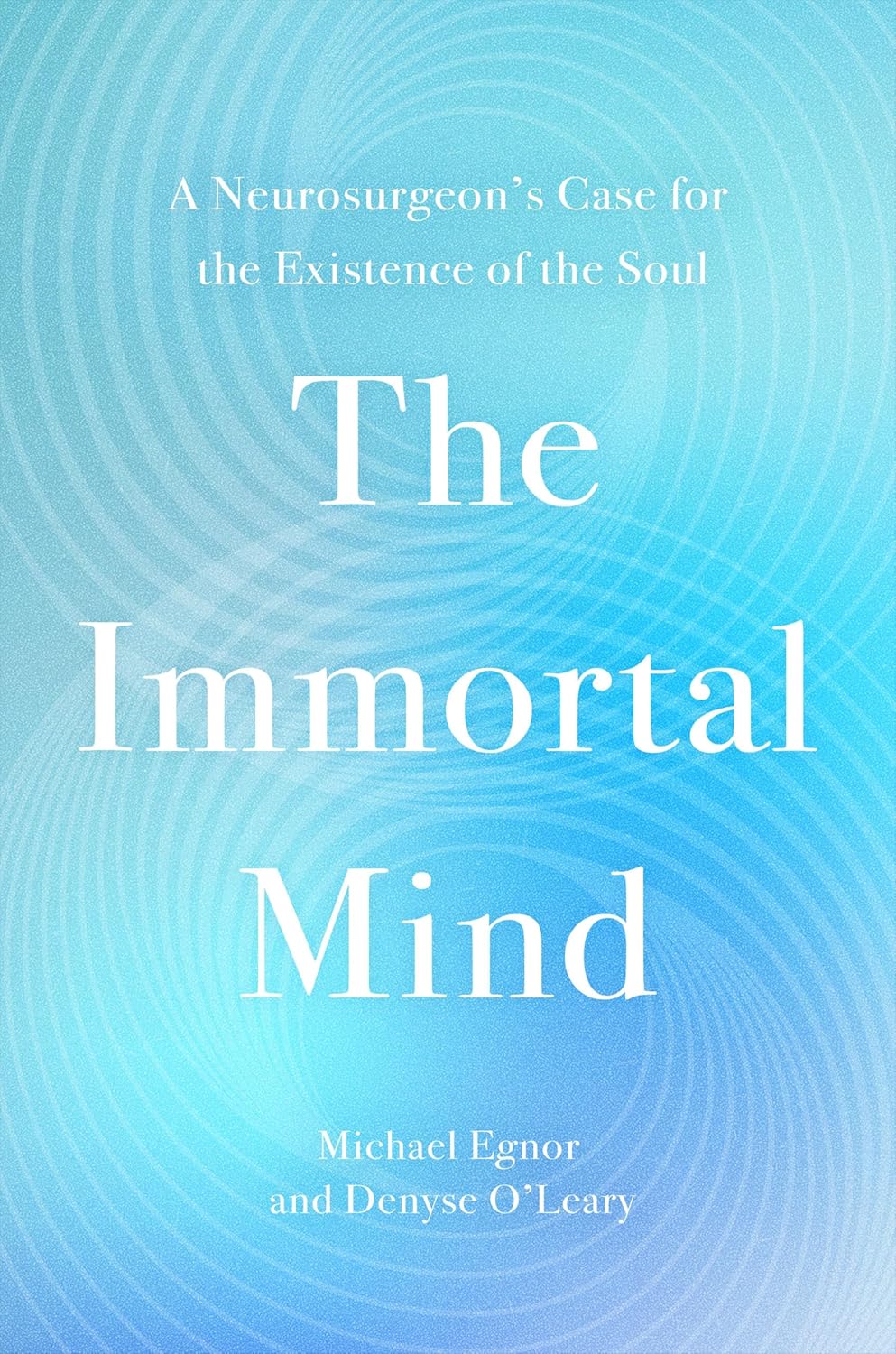 Published by Worthy Books
And in a lot of ways, the book sort of unpacks that and presents an alternative to the materialist views in neuroscience. Now, you say there’s a name for this kind of thing, where materialists are confident there’s going to be an explanation even if it’s in the future. And you say it follows a pretty typical script when this appears in science venues. Can you tell us a bit more about that?
Denyse O’Leary: Well, the term that Mario Beauregard introduced me to is promissory materialism, as in: “One of these days, we’re going to find the consciousness circuit in the brain. Now, it’s sort of like — unfortunately I’m a couple of generations removed from many of our 12:20 hearers perhaps — but there was once a cartoon character who was always promising to pay on Thursday for a hamburger that somebody bought him on Tuesday and of course you knew he never would…
But that’s where science writers will end their articles about some conundrum in consciousness by saying “And future research will shed light on this what they mean is we’ll show that there is a consciousness circuit in the brain” or that “Consciousness is just an illusion of folk psychology.” Or something.
It never happens but nobody questions the premise. Nobody asks “Could it be that we’re on the wrong track?” What if human consciousness is an immaterial reality?
McDiarmid: Yeah and I really want to linger on this just for a few minutes because I do think it’s a profound insight about materialism.
You say that, when it comes to evidence for the soul, a good place to start is by asking this question: What evidence: would be satisfactory to you?
Why is that a good jumping off point for having conversations about the mind and the brain?
O’Leary: Well, it establishes what the conversation could be about.
See, if it becomes clear that no evidence would be acceptable, that the only purpose of new information is to try to find a way to shoehorn it into a materialist interpretation or else ignore it, then — as a conversation — it may well be a waste of time.
That doesn’t mean there won’t be interesting new evidence. But one needs to see that the body of evidence quietly grows, quietly disconfirms materialism. But nobody discusses it that way. It’s always “One of these days more research will elucidate this area.” In other words, show that it really is material.
And, of course, that can go on indefinitely. They may be doing it 50 years from now. The trouble is, what’s lost in the meantime. If in fact the human mind is in some part immaterial, then the question becomes, What do we lose if we don’t recognize that fact?
One thing we have is textbooks that as Michael Egnor points out, persistently told him things that he found didn’t check out in practice, like if a person doesn’t have this brain part, he will not be able to XYZ.
Now often that’s true. Sometimes it’s not. If the materialist theory was right it should never be true.
What I mean is, a three-legged dog cannot win a serious race against a four-legged dog because we’re talking about a material situation, right? But what if some people, missing some brain part, actually function normally and you wouldn’t know…?
You see, one of the things that changed, Andrew, was that brain imaging came along. It was easy to say “Oh well, if a person doesn’t have this part, he can’t do X Y or Z.” And then you image the brain of someone who doesn’t have that part who does in fact do those things.
So, I mean, there may be explanations. But I would s suggest treating cautiously materialist explanations along the lines of “Oh well, all that happened was…” Because I want to stop and say, Wait a minute! That’s not what you said before. If you’re changing your story, that’s fine. You can change your story — but remember, you changed your story. So I wonder when that person will have to change the story again…
McDiarmid: So really, no matter how hard you try to disconfirm materialism with contrary evidence the reply is always going to be along the lines of extending that prediction out into the future with the belief that one day science will confirm what we currently predict. But the problem with that science or that type of science is that, you know, we’re not studying future evidence or future observations. It’s based on what we know now and what we observe now.
So as you were mentioning, perhaps no evidence is good enough to disconfirm materialism in the minds of its adherents. And really the only way to move forward is to reject materialism as a model and pivot to a theory that better explains the evidence. And it sounds like that’s what you and Dr Egnor are proposing in this book.
[Yes. That is what we are proposing. – O’Leary]
≻───── ⋆☆⋆ ─────≺
You may also wish to read/watch:
Piers Morgan show: Michael Egnor and Michael Shermer debate! Near-death experiences headlined the discussion. But Dr. Egnor made clear that there is much other evidence for the reality of the human mind. One thing that stood out was the commenters’ appreciation of a cordial discussion of often-controversial topics.
Michael Egnor on Lee Warren’s podcast: Two neurosurgeons on life, death, eternity and what truly matters. Lee Warren interviews Michael Egnor on the just-released book, The Immortal Mind. The two doctors turned out to share a bond of personal pain as well as immortal hope.
Michael Shermer’s show: Neurosurgeon Michael Egnor vs. neuroscientist Christof Koch. Released yesterday evening, the debate, hosted by science writer and broadcaster Michael Shermer, was cordial, and quite relatable. At one point, the discussion turned on the case of a girl who had her sense of guilt removed surgically. What does that prove about the mind and the brain?
